
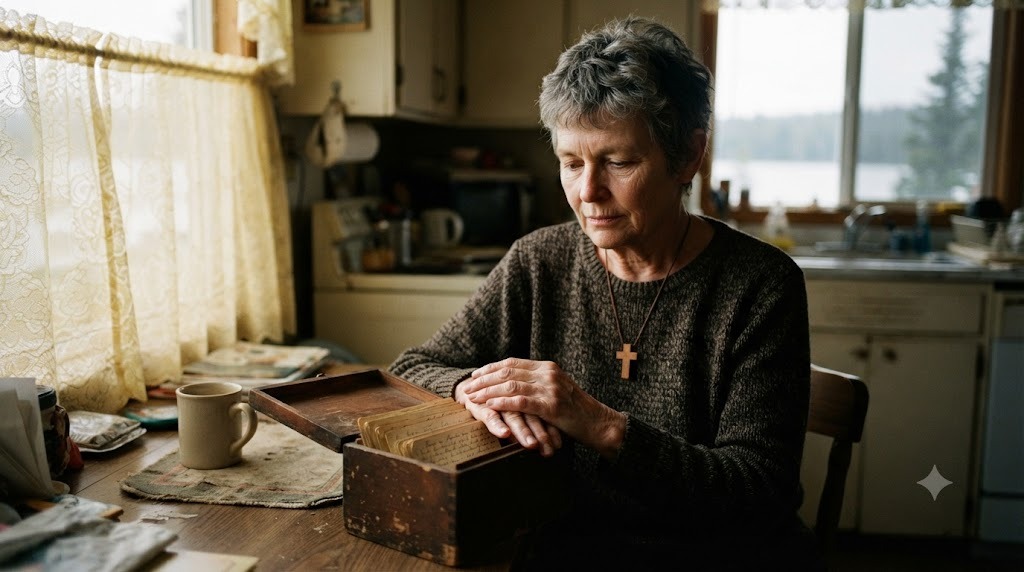

Part 1 — The Cardigan and the Recipe Box
They told me my cardigan looked like something from the lost and found, right there at the check-in table.
I said nothing. I set my recipe box down and touched the cross at my collarbone.
Through the kitchen door, I heard my daughter’s voice go low and certain, talking about me.
I didn’t go through that door. I finished pouring the coffee urn and carried it out, and homecoming Sunday went on as if nothing had happened.
It had started, if I’m honest, long before that morning — with a cardigan, a recipe box, and a man named Everett Hale.
They told me my cardigan looked like something from the lost and found, right there at the check-in table.
I said nothing. I set my recipe box down on the folding table, touched the cross at my collarbone, and kept smoothing the tablecloth.
Then, through the kitchen door, I heard my daughter’s voice go low and certain, talking about me like I wasn’t fifteen feet away.
What I did next, I did without raising my voice at all.
It was a gray, overcast morning in Cottonwood Lake, the kind where the fog sits low over the water and doesn’t burn off until noon, if it burns off at all. The tourist season had just ended — the float planes gone quiet, the fishing lodges boarding their windows for winter — and the church was holding its homecoming, the one Sunday a year when everyone who ever sat in these pews comes back, whether they still live in town or not.
I am seventy-one years old. I have been the secretary at the Cottonwood Lake School for longer than most of my former students have been alive, and I have set up this fellowship hall table more times than I could count. My late husband Frank’s mother’s recipe box has sat on that table every homecoming for forty years — a plain wooden box, corners worn soft and pale from handling, with index cards gone the color of weak tea, holding the salmon chowder and the blueberry buckle and every dish this church has ever fed itself on.
Frank gave me the cross I wear on our last anniversary before the cancer took him, twelve years ago now. I don’t take it off. Some mornings I don’t even remember putting my hand to it — it’s just there, the way an old habit is there, until a day like this one, when I needed something to hold onto.
“Mom.” Vanessa appeared at my elbow before I’d finished pinning the tablecloth. My daughter has my late husband’s height and none of his patience. She looked at my cardigan the way she looks at a listing photo she’s about to reject. “You can’t wear that here. Half the town is going to be in that hall.”
“It’s warm,” I said. “It was chilly on the walk over.”
“It looks like something from the lost and found.” She reached over and refolded the collar for me, the way you’d straighten a crooked picture frame, not looking at my face while she did it. “I don’t know why I have to say this every time I visit.”
I let her fix it. I have let her fix a great many things over the years — my posture, my grammar, the way I hold a fork — and I have learned that the fastest way through it is to let it happen and keep moving.
I was reaching for the coffee urn when I heard her, through the kitchen door, talking to her cousin Denise in the voice she uses for people she thinks can’t hear her.
“She’s seventy-one and she’s dating some drifter nobody can find a record on,” Vanessa was saying. “No obituary for his first wife. No college transcript. Nothing. That’s exactly how those men work, Denise — they let a lonely woman fill in the gaps herself.”
I stood very still with the coffee pot in my hand. I did not go through that door. I did not raise my voice. I filled the urn, wiped the counter, and carried the tray back out to the hall, because that is what you do at a homecoming — you keep the coffee coming, whatever else is happening in the kitchen.
Everett Hale came in through the side door not five minutes later, shaking rain off his coat, carrying a foil pan of his own smoked salmon dip like it was nothing. He’s seventy-four, built like a man who spent his life on boats, because he did, and he sings bass in the choir loud enough that Pastor In-graham jokes he doesn’t need the microphone. He found me by the coffee urn and set his pan down next to Frank’s recipe box, gentle, like he understood without being told what that box meant on this table.
“You look tired, Joan,” he said quietly, just for me.
“I’m alright,” I said, and I almost believed it.
The hall filled up fast after that — homecoming Sundays always do — and I thought the worst of the morning was behind me. It wasn’t. Somewhere near the end of the second hymn, Vanessa stood up in front of the whole fellowship hall, in front of people who have known me since before she was born, and said the thing about Everett’s name that I still, to this day, wish I hadn’t had to hear in that room.
And when I turned to look at Everett’s face while she said it, I saw something cross it that I had never once seen there before — something he had never explained to me, and that I suddenly understood he’d been carrying alone for a very long time.

Part 2 — What the Recipe Box Remembered
I didn’t confront anyone that day. I drove home along the lake road with the wipers going, let myself into the quiet house, and sat down at the kitchen table with Frank’s recipe box in front of me before I’d even taken my coat off.
I don’t know how to explain what that box does for me except to say it’s the closest thing I have to sitting with Frank again. I ran my thumb along the worn top edge, closed my eyes, and folded my hands over it the way I used to fold them over his hand in the hospital, when there was nothing left to say and nowhere left to put my worry except down, quietly, into something bigger than myself. I didn’t say a prayer out loud. I never do. I just sat there with my hands on that box until the shaking in my chest settled.
Everett and I had been keeping company for a little over a year by then — coffee after Wednesday Bible study first, then Sunday drives out to the point, then him showing up with his toolbox to fix the dock Frank never got around to. He never pushed. He never once asked me for anything I wasn’t ready to give. And two weeks before homecoming, sitting on my porch with the lake going gold behind him, he’d asked me to marry him, and I’d said yes before he finished the sentence.
Vanessa hadn’t found out from me. She’d found out from Denise, and she’d been building her case, apparently, ever since.
She showed up at the diner on Tuesday wanting to “talk sense” into me, as she put it, over coffee she didn’t finish. She corrected the way I held my fork before she’d even sat all the way down — an old habit of hers, ever since she was a girl embarrassed by a mother who never went to college and never wanted to leave a town of eleven hundred people. She wanted me in Seattle near her, in a condo with a doorman, and every year that I stayed in Cottonwood Lake instead felt, to her, like a decision made against her.
“I looked him up, Mom,” she said. “There’s no scholarship record for an Everett Hale anywhere. There’s a name gap in the eighties — like he used a different one for a while. That’s not nothing. That’s exactly what they teach you to watch for.”
“I’ve known him two years, Vanessa.”
“You’ve known the version of him he’s shown you.” Her voice was climbing now, loud enough that two women at the next booth had stopped pretending not to listen. “I raised — I mean, you raised me better than to fall for this. An old man with a hole in his story, and you’re just going to hand him a ring and your house and —”
“That’s enough.”
I didn’t say it loud. I said it the way you’d hush a child in church, and then I did something that surprised even me. I folded my napkin, set it beside my cup, and said only, “I love you, Vanessa,” and I got up and paid for both our coffees on my way out.
I didn’t slam the door. I didn’t cry in the parking lot, though I wanted to. I have spent seventy-one years believing that the loudest voice in a room isn’t always the one that wins it, and I wasn’t going to abandon that belief in a diner over a folded napkin. When I glanced back through the window, the two women at the next booth weren’t looking at me anymore. They were looking at Vanessa, and neither one of them looked like they thought much of what they’d just heard her say to her own mother.
I didn’t go home. I drove straight to Everett’s, because whatever the truth was, I wanted it from him and not from a background search my daughter had run behind my back.
He opened the door before I’d even knocked, like he’d been watching the road, and he was holding something in his hand — an old, creased piece of newsprint, soft at the folds from being carried a long time.
“I heard what happened at the diner,” he said. “Denise’s husband was two booths over.” He looked down at what he was holding, then back up at me, and for the first time since I’d known him, Everett Hale looked afraid. “I think it’s time I told you why my name doesn’t match up the way it should. I should have told you before you ever said yes to me.”

Part 3 — The Empty Chair at the Wedding
He set the clipping on the porch rail so I could read it myself, in the fading light, instead of just taking his word for it.
It was a photograph of a boy, maybe eighteen, arms raised, a state championship medal around his neck. The headline named him Everett Halvorsen — not Hale — state track champion, offered a full scholarship to a university Outside. The date was more than fifty years back.
“My father died that spring,” he said. “Heart, same as yours took Frank, near enough. My mother couldn’t run the boat or pay for the house on her own, and I had two younger sisters still in school. I turned the scholarship down before anyone could talk me out of it. Took work on the fishing boats under my stepfather’s name for a few years, because the man who owned the boat wouldn’t hire a Halvorsen — bad blood between our families going back before I was born. By the time I came back to my own name, most people had already stopped asking. It got easier to just let it lie than to explain it to strangers, and then to you, and I let two years go by without finding the right moment. There wasn’t a scam here, Joan. There was just a boy who chose his mother over a track scholarship, and never learned how to talk about it without it hurting.”
I stood there on his porch with my hand at my collarbone, at the cross Frank gave me, and I laughed — not unkindly, but because I suddenly understood something Frank’s recipe box had been telling me for a year without either of us noticing. There is a card in that box, in Frank’s own handwriting, for a blueberry cake recipe he’d written down “from E.H. — state meet, before he shipped out.” Frank ran track himself, decades ago, on a rival team. He’d known this boy. He’d admired him. He’d carried that memory quietly into a marriage recipe box and never once mentioned the name, because by then Everett Halvorsen had already become Everett Hale, and Frank likely never made the connection himself.
I went home and I called Vanessa. I told her everything Everett had told me. I asked her to come to the wedding.
She was quiet for a long moment on the phone, and then she said, “That doesn’t change that you’re marrying a stranger, Mom,” and hung up.
I won’t pretend that didn’t hurt. It did. But I had already decided, sitting on that porch with the cross cool against my skin, that I would not spend whatever years I had left being corrected out of my own life by someone who loved me and couldn’t say so plainly. Faith, for me, has never been about winning an argument. It’s about staying gentle when you have every reason not to be, and trusting that gentleness is doing something you can’t yet see.
We married on a gray, overcast morning — the same kind of sky as the homecoming, fog low over the lake, the church half full of people who’d known me my whole life. I wore the cross. I carried Frank’s recipe box up the aisle myself, because Everett had asked, gently, if there might be room in it for one more card — his late mother’s blueberry cake, the same one Frank had written down fifty years before under two different initials that turned out to belong to the same good man.
There was one folding chair left empty at the end of the second row. I asked the ushers to leave it that way rather than fill it, and nobody in that church needed me to explain why.
I didn’t hear from Vanessa that day. I mailed her a card afterward — no lecture in it, no correction, just an invitation to come to the house whenever she was ready, and a photograph of the two of us, Everett and me, standing by Frank’s old recipe box with one new card tucked inside it. I don’t know if she’ll ever open that door. That’s hers to carry now, not mine.
What I know is this: I chose the smaller life, the one in the town of eleven hundred people my daughter was always ashamed of, with a man who once gave up a scholarship for the people he loved and never once asked me to be anyone other than exactly who I am. I don’t look back on that choice, and I don’t regret the napkin I folded instead of the words I could have thrown across that diner table. Some kinds of strength don’t raise their voice. They just keep setting the table, keep carrying the box, and keep leaving the chair empty instead of the door closed.