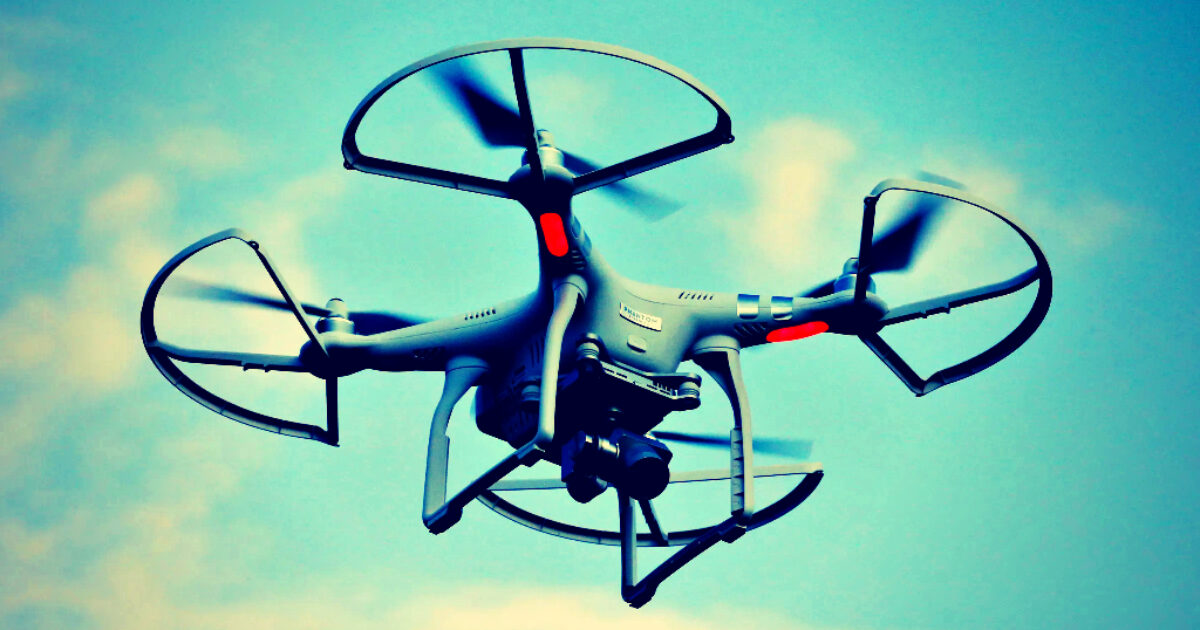

President Trump has imposed 100% tariffs on some Chinese-made drones, citing national security concerns tied to foreign unmanned aerial vehicles. The move singles out a category of technology that has grown from a niche hobby into a working tool across American agriculture, construction, film production, real estate, surveying and public safety.
The stated reasoning is direct: some foreign UAVs are treated as a national security threat. That framing is the core of the announcement, and it shifts the conversation about drones away from price and performance and toward origin, control and trust.
**What a 100% Tariff Actually Does**
A tariff set at 100% is not a marginal adjustment. It is an import duty equal to the value of the goods themselves, which in practical terms doubles the landed cost of every covered unit before a distributor, retailer or operator adds anything on top. Duties of that size are rarely designed to nudge buying habits at the margin. They are designed to change what appears on the shelf at all.
For any market where imported hardware dominates the mid-range and consumer tiers, a duty at that level tends to work in one of two directions. Either importers absorb part of the cost and thin their margins to stay competitive, or the covered models become materially more expensive than the alternatives beside them. Buyers who once compared devices on flight time, camera quality and software then find themselves comparing on a price gap that has little to do with the hardware.
**The National Security Argument**
The justification offered is national security rather than trade imbalance, and that distinction matters. A trade-based measure usually turns on questions of pricing, subsidies and domestic manufacturing capacity. A security-based measure turns on a different question entirely: what a device does while it is operating.
Modern drones are not simple remote-controlled aircraft. They are flying sensor platforms. A typical unit carries high-resolution cameras, GPS receivers, onboard storage and a wireless link back to a controller or an app. Many are tied to companion software, firmware update channels and, in some configurations, cloud services. Every one of those elements is a point where flight paths, imagery and location data can be created, stored or moved.
Placed in that context, the security concern described in the announcement is about the chain of custody around what a drone sees and where that information can ultimately travel. When the same category of aircraft is flown over farmland, industrial facilities, construction sites, ports and by emergency responders, the question of who built the platform and who can reach its data becomes an infrastructure question rather than a consumer one.
**What the Announcement Leaves Open**
Two words in the announcement carry a great deal of weight: “some” and “certain.” The tariffs apply to some Chinese drones, not to every drone imported from China. The scope of that carve-out is the single most consequential detail for anyone who flies commercially, and it has not been laid out in the material available so far.
Several practical questions follow from that. Which manufacturers and which specific models fall inside the covered category. Whether the classification turns on the maker, the components, the software stack or the intended use. When the duty takes effect, and how units already in transit or already sitting in domestic warehouses are treated. Whether replacement parts, batteries, controllers and payloads travel with the airframe under the same rate or are handled separately.
Those answers determine whether the measure lands as a narrow restriction on a defined set of products or as a broad reshaping of what American operators can realistically buy. Commercial drone fleets are typically standardized around a small number of platforms, and operators build training, workflows and accessory inventories around them. A tariff that captures a widely used model has effects that reach well past its sticker price.
For now, the confirmed facts are these: the tariff rate is 100%, it applies to some Chinese drones, and the stated basis is national security grounded in the view that certain foreign UAVs represent a threat.