
Part 1 — The Tin Box
Brooke Anderson stood on my porch on the Fourth of July and asked if she could see the ring.
I did not ask which one she meant.
I only said I would need a minute, and shut the screen door so she wouldn’t see my hands shake.
By the time the thunder rolled in over the ridge, I already knew the summer was going to end differently than it started.

Three weeks before that, I hadn’t known her name at all.
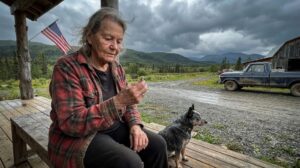
I am eighty-four years old. For forty-one of those years I worked the front office at Bracken Valley School, the kind of job where you know every child’s allergies, every mother’s maiden name, and exactly which fathers to call gently and which ones to call twice. I retired at seventy-one and Walter told me I’d go stir crazy inside a month. I told him forty-one years of other people’s emergencies had earned me the right to be bored for a while. We laughed about it the way you laugh about things when you’ve been married fifty-two years and you’ve already had most of the arguments you’re ever going to have.
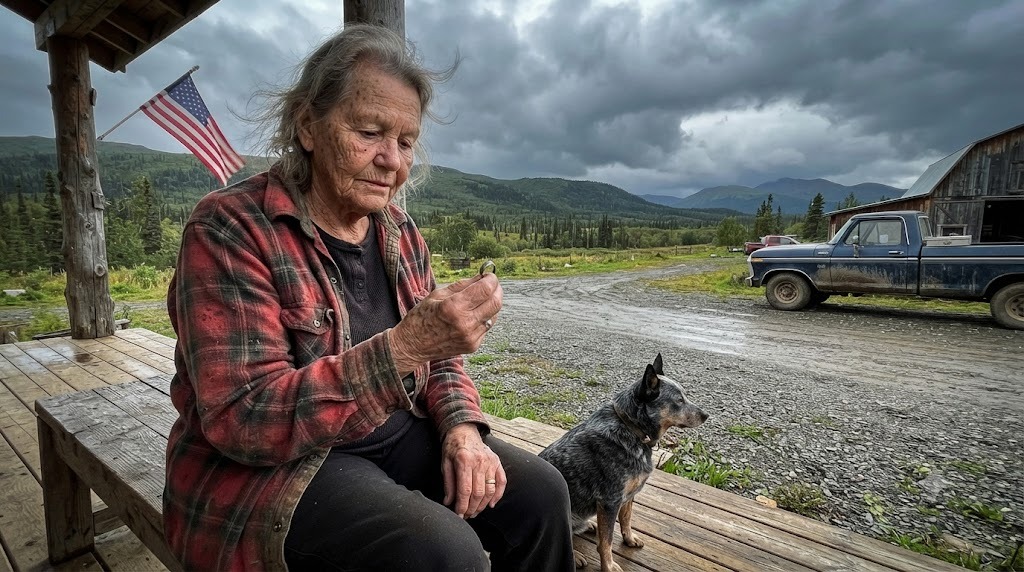
Walter passed in April. Heart, quick, out by the equipment shed with his boots still laced. I found him myself, and Duke found him before I did — our blue heeler mix, thirteen years old, arthritic in the back hips, who has slept at the foot of our bed since he was a pup Walter carried home in his coat. Duke stopped eating for four days after. I understood the feeling. I stopped doing most things for longer than that.
Out here you don’t get to disappear into grief the way you might in a city. The ranching community I live in sits nearly four hours from the nearest town with a real grocery store, and everyone who has ever borrowed a chainsaw from you shows up eventually with a casserole and a reason to stay twenty minutes too long. By June, the church ladies had started asking, gently, whether I’d be donating any of Walter’s things to the Independence Day rummage sale. It’s tradition here — the sale runs the same weekend as the parade, tables set up under the flagpole, folding chairs, a coffee urn that’s older than some of the volunteers.
I decided I would. Not because I was ready. Because I thought being useful might feel like a smaller kind of ready.
So on a gray Tuesday with rain threatening, I sat on the floor of our bedroom with a cardboard box marked DONATION in Walter’s own block handwriting — he’d used the same box for coats every winter — and I went through his dresser one drawer at a time. Flannel shirts. A pocketknife with his father’s initials scratched into the handle. A coil of fishing line he never once used because he hated the smell of the lake by our place and never told me why. Duke lay against my hip the whole time, sighing the way old dogs do, like the weight of the world has finally caught up to their joints.
In the bottom drawer, under a stack of undershirts, I found a small tin that used to hold peppermints. I hadn’t seen it in years. I nearly set it in the donation box without opening it — one more thing to let go of, I told myself — and my hand was actually over the box when something made me lift the lid instead.
Inside was a ring.
Silver, thin, tarnished nearly black in the grooves, with a scrap of tissue paper gone soft with age wrapped around it like someone had meant to protect it once and then forgotten to finish the job. I turned it under the lamp and read the inside, where the engraving had worn but not vanished: W & E, always.
It was the ring I had chosen for him. The one from our wedding, back when we were young and had exactly one hundred and ten dollars between us and I’d picked the plainest band the jeweler in Anchorage had, because plain was what we could afford and plain, I told him, would age well. I remembered slipping it onto his finger in a church that smelled like cut lilies. I remembered him wearing it every single day for over fifty years — I would have sworn to that in a courtroom.
Which meant something didn’t line up, because Walter had been buried three months earlier wearing a ring, and it was not this one.
I sat there a long moment with Duke’s head heavy on my knee, turning the tarnished silver band over and over between my fingers, trying to build a explanation that made sense. Maybe he’d had it resized. Maybe there’d been a second, older ring from before I knew him, though we’d met at nineteen and there had been no one before me that I ever knew of. Maybe I was simply an old woman confusing herself over an old man’s drawer.
I put the tin in my apron pocket instead of the donation box. I told myself I would ask someone about it later, the way you tell yourself you’ll deal with a strange noise in the truck later, already knowing you won’t sleep right until you do.
That was a Tuesday. The knock on my door came the following Thursday, four days before the Fourth of July, and it was a woman I had never once seen in Bracken Valley in my life.
She was maybe forty-five, dressed like she’d driven a long way in a hurry, and she introduced herself as Brooke Anderson before she’d even fully stepped off the porch boards. She said Walter’s name like she had a right to it. She said she was sorry to bother me. She said she’d come about the ring.
Part 2 — The Other Life
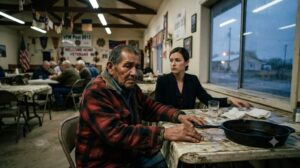
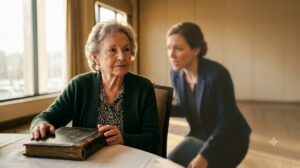
I want to say I slammed the door. I didn’t. Forty-one years answering phones in a school office teaches you that the worst news usually comes from the calmest voices, and the only thing you can control is your own. So I invited her in, put the coffee on because that is simply what you do out here, and sat across from her at the same table where Walter had eaten breakfast six mornings a week for half a century.
Brooke Anderson told me she had known my husband for twelve years.
She told me it carefully, like she’d rehearsed it on the drive, which I later learned had taken her most of the day, because she lived in the city, several hours south down the one highway that connects us to anything larger than a feed store. She said Walter used to tell her he came up that way for supply runs — equipment parts, cattle auctions, the kind of trip a rancher can explain to a wife without either of them thinking twice.
Except the trips ran both directions. For twelve years, my husband had also had a life down in that city. An apartment above a hardware store. A woman who believed, she said, looking at her own hands and not at me, that she was going to marry him once his “situation” was settled. She said he told her I was gone. Not dead — gone. Left years ago, she said. She said he told her that so many times she’d stopped questioning it, the way you stop questioning a story once it’s held up for over a decade.
Duke came and sat by my chair while she talked, and I put my hand on his head because it was easier than looking at her.
She asked about the ring because, she said, she had given Walter a ring herself. Gold, not silver. A ring she said he wore every day, told her it meant the world to him, told her — and here her voice did finally catch — that it was the only wedding band he’d ever really worn, because his first marriage, to me, had ended so long ago it barely counted.
I understood then what I was holding in my apron pocket.
The silver band I made him promise to wear forever, the one I’d found tarnished and boxed away like a coat gone out of style, had been quietly retired sometime in the last decade — I couldn’t say exactly when, only that I remembered a night, years back, when I’d commented that his ring looked different in the porch light, and he’d laughed and said it was just tarnish catching the bulb wrong, and I had believed him, because you do not spend fifty years married to a man and go looking for lies in the shape of his hands.
The gold ring he wore in this valley, the one people saw at church and at the feed store and at his own funeral, was not a ring at all in the way I understood the word. It was a gift from a woman I had never met, worn in place of the one I had chosen, while he told her a story about me that made it easy for both of us to be replaced by something he considered nicer.
I did not cry in front of Brooke Anderson. I want that understood, because I think a woman my age is allowed at least that much dignity, even when the ground under her has just been quietly pulled away for the second time in one summer.
What I did was set my coffee cup down very carefully, the way you set down something you’re afraid you might otherwise throw, and I asked her what exactly she had come for.
She said she wasn’t sure anymore. She said she’d found my address in an old envelope of his, and she’d driven up not knowing if I was a woman he’d truly left decades ago or something else entirely, and somewhere around Fairbanks, watching the mile markers go by, she’d started to suspect the truth was going to be worse than either version she’d been telling herself.
Outside, the sky had gone the color of a bruise. Independence Day was two days off, and half the valley was already stringing up flags and bunting for the parade, and here I was at my own kitchen table learning that my husband of fifty-two years had spent the last twelve of them as two different men, in two different towns, wearing two different rings, and lying so gently to both of us that neither lie had ever once cost him a raised voice.
Brooke mentioned, almost as an afterthought, on her way back out to her car, that she thought someone from my own church might have seen them together once, years ago, in a parking lot. She said Walter had gone pale about it afterward for days. She’d never known why.

I stood on the porch a long time after her taillights disappeared down the gravel, with Duke pressed against my leg and the first fat drops of rain starting to fall, thinking that I now had a name to ask about, and exactly one weekend, with the whole valley gathered for the Fourth, to find out who it was.
Part 3 — What the Parking Lot Knew
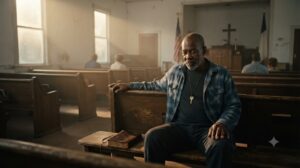
Her name was Dot Rasmussen, and I had known her thirty years the way you know someone from every rummage sale, every funeral casserole, every folding chair set up under that same flagpole. She ran the church’s donation table every Independence Day without fail, which meant on the Saturday of the sale, in the hour before the parade, I found her exactly where I knew I would, sorting coats into size piles while the first thunder rolled somewhere back over the ridge.
I didn’t work up to it. I’ve never been a woman who works up to things.
I asked her, plainly, if she remembered seeing Walter in this parking lot with a woman who wasn’t me.
Dot’s hands went still over a stack of children’s jackets. She didn’t ask which woman, and she didn’t pretend not to understand, and that told me almost everything before she said a single word. She said it had been maybe nine years back. A church supper, she thought, or the harvest potluck — she couldn’t be certain which — and she’d come out to her car early to beat the crowd and seen Walter standing by his truck with a woman neither of us knew, standing close in the particular way that tells you everything a photograph would, though nothing was said and nothing, that she saw, was done.
She said she’d told herself it was nothing. A cousin, she thought. A ranch hand’s wife needing directions. She said Walter caught her eye across the lot that day, and something in his face made her decide, right there, that whatever it was, it wasn’t hers to carry to me. She’d carried it anyway, she admitted, quietly, for nine years, and she was sorry, because she understood now that silence, even kindly meant, is still a kind of choice, and she had made hers without ever asking me if I wanted it made on my behalf.
I told her I wasn’t angry with her. I meant it. Dot Rasmussen had guessed wrong about what kindness required, the same as half this valley probably had at one time or another, and I found I had exactly enough grief in me for the man who’d earned it and none left over for an old woman who’d only ever tried to mind her own business.

The parade went on that afternoon in spite of the weather, the way it always does here — flags, the volunteer fire truck, children on bicycles with cards clothes-pinned to the spokes — and I stood at the curb with Duke’s leash wrapped twice around my hand and watched it pass and did not feel, for once, like a woman whose whole life had just been rewritten by a stranger at her kitchen table.
I had a decision in front of me, and it wasn’t the one people expected. Brooke had left me her number before she drove back south, said something about lawyers, about the apartment, about what might be owed one way or another once everything was untangled. Two of Walter’s cousins, hearing pieces of the story secondhand within a week, started talking about the estate, about what a woman in my position ought to fight for.
I didn’t want any of it. Not the apartment, not a settlement, not a courtroom where strangers would decide what fifty-two years and one secret decade were worth in dollars. I wanted the ranch, and the dog who still slept pressed against my hip every night with one ear listening for a man who wasn’t coming back, and the particular quiet of a place four hours from anywhere, where I had built the only life I actually recognized as mine.
So I let the lawyers’ letters go unanswered longer than was probably polite. I told Brooke, the one time she called again, that I didn’t blame her for believing a story a good liar had spent twelve years perfecting, and that I hoped she’d find whatever she’d actually driven all that way looking for. Then I asked her, gently, not to call again, and she didn’t.
The storm that had been threatening all weekend finally broke that night, late, after the fireworks had finished echoing off the ridge and the valley had gone dark and quiet. I sat on the porch with Duke and the tin box in my lap and took out the tarnished silver ring, and I cleaned it — slowly, with a soft cloth and the kind of patience I have never once had for anything I didn’t love — until the engraving came up clear again under the porch light. W & E, always.
I put it on my own hand.
It didn’t fit quite right, made for a man’s finger and not mine, so I wear it now on a thin chain instead, tucked under my collar where no one has to ask about it and I don’t have to explain. Some mornings I still reach for the coffee cup that used to be his before I remember. Duke still waits by the equipment shed some evenings, the way he used to when Walter was running late from town.
A letter came in October, no return address I recognized, and inside it, in handwriting I now knew, Brooke Anderson had written four short paragraphs. She said she was sorry. She said she understood if I never wanted to hear from her again. She said she thought I deserved to know that she’d finally understood, somewhere on that long drive north or maybe only afterward, that she had never really known Walter Baker at all — that the man she’d loved for twelve years and the man I’d buried in April were, in the ways that mattered, two different people, and neither of us had ever gotten the real one whole.
I haven’t written back. I don’t know yet if I will. Forgiveness, at eighty-four, isn’t a door that swings open just because someone finally knocked on the right side of it.
But some evenings, when the light goes long and gold over the ridge the way it did the day I married him, I take the ring out from under my collar and hold it a minute, and I think that whatever Walter Baker actually was, the woman who chose this valley, this dog, and this small, unglamorous, entirely her own life — she is not lost. She was here the whole time. And she is the one I intend to keep.