
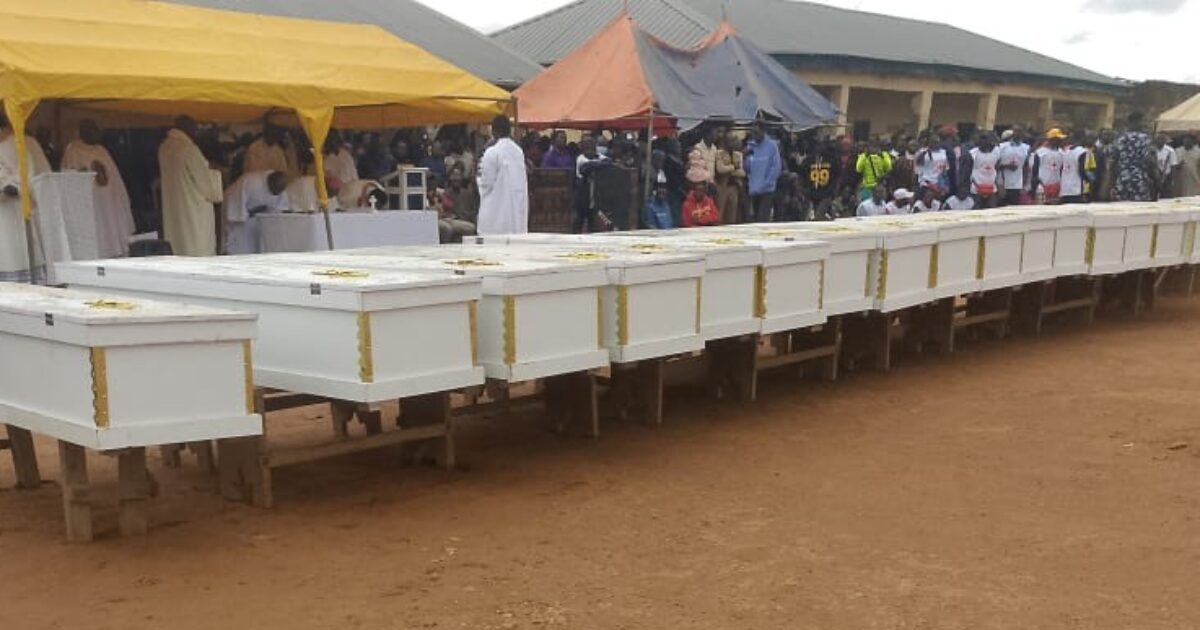

The coffins are lined up end to end, plain wood under an open sky. Villagers stand shoulder to shoulder along the edge of the trench. Somebody starts a hymn. Somebody else can’t finish it.
In parts of Nigeria, this is not a rare and terrible day. It is a routine that families have learned by heart.
For more than ten years, Christian communities across Nigeria’s Middle Belt — including Plateau State and southern Kaduna — have gathered again and again to bury their neighbors after attacks by Fulani militants, according to a report published by The Gateway Pundit. The report describes the killings as a genocide, and describes the mass burials that follow as something the survivors now simply expect.

A Decade of the Same Scene
Most tragedies have a before and an after. Grief arrives, then it recedes, and life slowly closes over the hole it left. That is not what the report describes in these communities.
Here, the report says, the cycle has not broken. Attack. Burial. Attack again. Families who came to mourn at one grave site have returned to the same ground for someone else. Children have grown up knowing what a mass funeral looks like, because they have stood at more than one.
The word the report uses is deliberate: genocide. Not scattered violence, not a string of unrelated crimes, but a sustained campaign against Christian communities in a specific stretch of the country — the Middle Belt, where Nigeria’s Muslim north and Christian south meet.
Plateau State and southern Kaduna sit near the center of it. These are farming areas. Small towns. Places where everyone at the graveside knows the name being lowered into it.
The Detail That Changes Everything
You could read all of that and still file it away as a distant conflict — awful, but far off, and somebody else’s problem to solve.
Then comes the part of the report that stops people cold.
According to the account, the burials themselves have come under fire.
Read that again. Not just the villages. Not just the homes and the fields and the church services. The funerals. The moment when a community is at its most defenseless — unarmed, standing in the open, heads bowed, hands full of dirt.
That is the detail that reframes the entire story. It means there is no safe pause in the cycle. No moment set aside, by custom or by decency, for the living to bury the dead. The report describes mourners who have had to scatter from a grave site, leaving the work unfinished.
Why Americans Are Only Now Hearing This
For years, this violence was filed under vague headlines — “clashes,” “herder-farmer tensions,” “communal unrest.” Language that splits the blame evenly and lets the reader move on.
The report pushes back hard on that framing. It argues the pattern is one-directional and has been for more than a decade, and that describing it in neutral terms has helped keep it out of American headlines.
What has changed is that the survivors keep documenting it themselves. Photographs of the coffin rows. Video from the graveside. Testimony from pastors and villagers who have stood at more of these than they can count.
Here’s the part worth sitting with:
- The violence has continued for more than ten years, the report says.
- It is concentrated in the Middle Belt, Plateau State and southern Kaduna.
- Even the funerals have not been spared.
Somewhere in Nigeria’s Middle Belt tonight, the wood is being cut and the ground is being opened. The people doing that work have done it before. They expect to do it again.
That expectation — not any single attack — may be the most disturbing thing in the entire account.