

Part 1 — The Kitchen Table at 11:40 at Night
“We ran out of room at the main table. You don’t mind, right? You’re not really one for speeches anyway.”
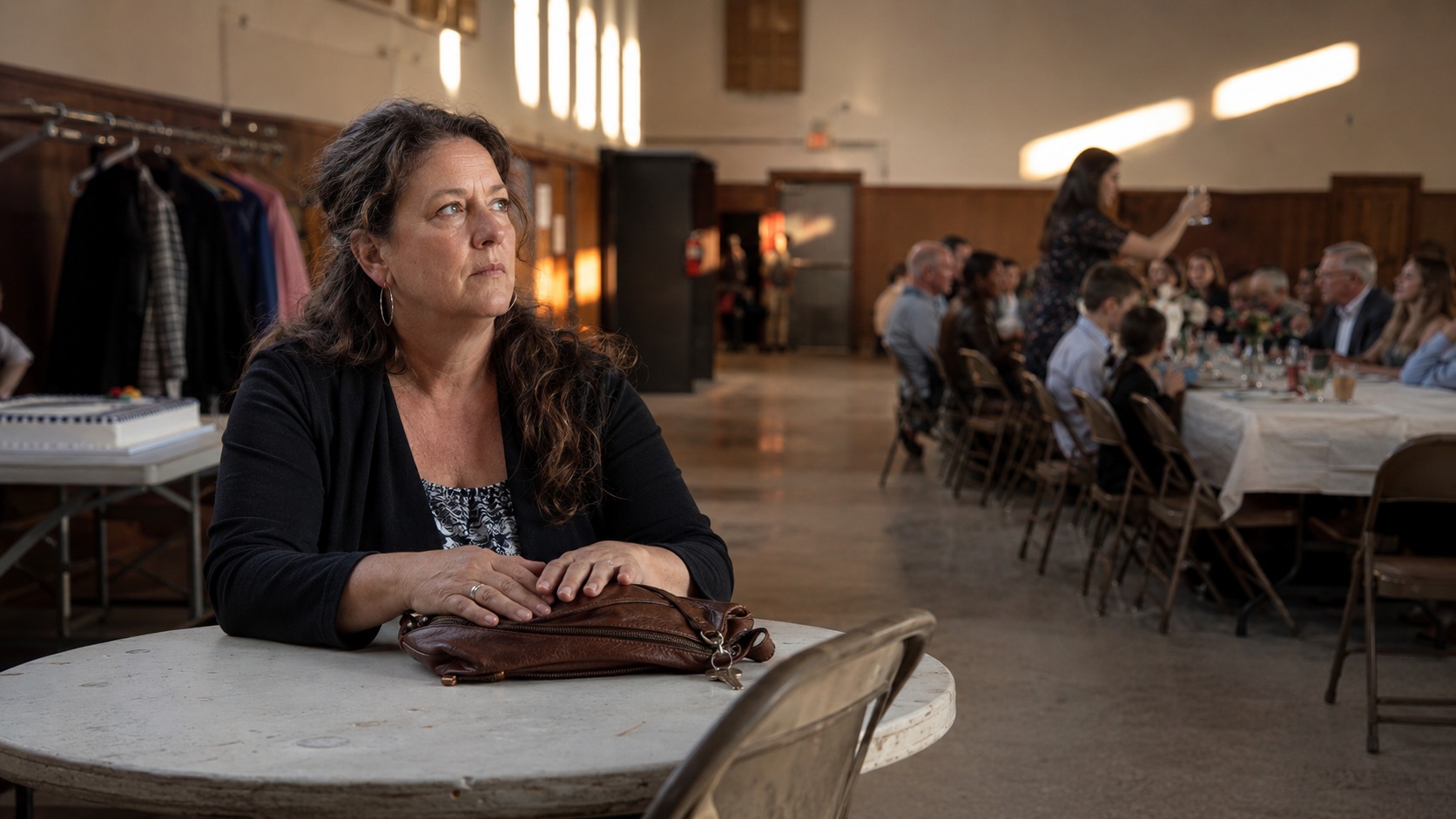
Marie Carter set her purse in her lap at the small round table by the coat rack, and said nothing at all.
Ninety minutes later, someone stood up to make a toast — and Marie was the only person in that hall who already knew it was impossible.
But to understand why she sat still through all of it, you have to go back six weeks, to a kitchen table at 11:40 at night.
Because that was the night Marie counted three hundred eighty dollars twice, and finally understood what she had been saving for.
Marie Carter counted the cash twice, because the second count was the only part of the day that ever came out the same as the first.
Eleven-forty at night, the kitchen table in a working-class suburb outside Atlanta, Georgia, the overhead light buzzing the way it had buzzed for nine years. Her register drawer from the feed store didn’t come home with her — that stayed locked in the office off Highway 42 — but her tips did, and the side money from the Saturday deliveries did, and the little envelope she kept behind the flour canister did. Forty-eight years old and still counting singles at a kitchen table like a girl saving for a car.
Three hundred eighty. She wrote it in the notebook. Under it, in the same handwriting she’d had since high school, she wrote the number they needed: eleven thousand, four hundred.
That was the workshop. That was the whole point of the counting.
Twenty-two years ago, when Ray Carter married her at the Baptist church on Pine, he’d handed her a rusted key on a bent ring and said it was the only inheritance he had. His father’s workshop out past the county line — a cinderblock building with a tin roof and a lathe older than both of them. Ray’s daddy had died owing money on it, and the bank had taken it, and Ray had kept the key anyway.
“One day,” he said, “I’m buying it back. And I’m going to hand you that key like it means something.”
She’d carried the key in her purse for twenty-two years. It had gone soft with rust at the shoulder. It didn’t open anything anymore. It had never opened anything for her.

Ray worked twenty-nine years at the distribution warehouse. Loading dock, then dispatch, then floor supervisor. He was retiring in October and they were throwing him a dinner, and the whole family was coming — his brother Dale, his sister Nita, the cousins from Macon, the grandkids. Ray’s daughter from before, Hailey King, was organizing it.
Marie should say this plainly, because everything after depends on it: Hailey was not a stranger. Hailey had been eleven years old when Marie married Ray. Marie had driven her to volleyball. Marie had paid for the braces. Marie had sat in the emergency room at two in the morning when Hailey rolled her ankle at a party she wasn’t supposed to be at, and Marie had not told Ray, because Hailey asked her not to.
Hailey was thirty-three now. She sold real estate. She had a good voice on the phone and a better one in person, and somewhere in the last four years she had stopped calling Marie by name at all. Not “Marie.” Not “Mom” — Marie had never asked for that. Just nothing. A gap where a name should go.
Marie had told herself that was normal. Grown daughters get busy.
The thing she couldn’t tell herself was normal was the money.
Ray’s paycheck had not changed in three years. Marie knew what it was; she’d done their taxes since 2009. But the balance had been going down, then up, then down again in a rhythm that had nothing to do with a paycheck. Four hundred out on a Tuesday. Six hundred out on a Thursday. Twice, twelve hundred.
He said it was tools. He said it was Dale needing a hand. He said it was a truck payment on a truck he was helping his brother float.
Marie was a feed store clerk. She could tell you what forty pounds of cracked corn cost in every county between here and Macon. She could tell you which farmers rounded up and which rounded down. She had a head for numbers that had never once done her any good in her own house.
Because the number that bothered her most wasn’t a big one.
It was a Sunday afternoon in September, bright autumn sunlight coming through the front room, and Ray was on the couch with his phone and she was folding towels, and she looked up at exactly the wrong second.
He was smiling.
Not a smile at a joke. Not a smile at a video. A soft, tired, private smile — the one he used to give her across the truck seat when they were twenty-six and had eight dollars between them. He had that smile out in his hand like a coin he was showing to somebody who wasn’t in the room.
He put the phone face-down when she walked by.
That was all. That was the whole thing. A man puts his phone face-down.
Marie folded the towels. She put them in the hall closet. She sat down at the kitchen table and counted three hundred eighty dollars twice, and both times it came out three hundred eighty, and both times it was not enough, and she understood for the first time that she had been saving for a workshop that was never going to be bought.
She didn’t cry. That surprised her. What she felt was closer to a math problem finally balancing.
She got up and checked the doorbell camera app, the way she did every night, because a woman alone in the house until eleven checks the door. And she scrolled past the raccoon, and the neighbor’s dog, and the UPS truck, and then she stopped.
Tuesday, 2:14 p.m. She’d been at the store. Ray’s truck in the driveway. Ray coming out the front door with a duffel bag she had never seen.
And behind him, in the doorway, holding the door for him like it was her house — Hailey.
The doorbell camera had a microphone. Marie turned the volume up.
Hailey said: “She’s not going to find out. She doesn’t look at anything.”
And Ray said, “She looks at everything. That’s the problem.”
Part 2 — Bright Autumn Sunlight, Back Table
Here is what Marie did not do.
She did not scream. She did not throw the phone. She did not call her sister in Valdosta, who would have been in the car within ten minutes with a casserole and a great deal of opinion. She did not confront Ray at midnight in a kitchen where the only witness was a buzzing light.
She went to work the next morning at 6:45 and sold eleven bags of layer pellets to a man named Curtis who told her about his knee.
People think calm is the same as weak. Marie had watched her own mother scream for thirty years at a man who simply waited her out, and she had learned the lesson exactly backward from how her mother intended: the person who is loudest is the person who gets managed. The person who is quiet is the person who gets to see.
So she got quiet, and she looked.
She went back through six weeks of camera footage on her lunch break, sitting in her truck in the gravel lot with a chicken sandwich going cold on the dash. Hailey’s car, eleven times, always between one and three in the afternoon, always on a day Marie worked a full shift. Ray’s truck, meeting it. Bags going out. Once, a box.
And on the twelfth clip, October 2nd, Hailey standing on the porch talking to somebody on speaker, not knowing the doorbell heard her, saying the sentence that reorganized Marie’s entire understanding of her own marriage:
“No, it’s fine, the house is in his name, and after the dinner he’s signing. He already told the buyer’s agent. It’s a done deal — I’ve got a client waiting.”
The house.
Marie’s name was not on the deed. It had never been on the deed. Ray’s daddy had left him the lot in 1998, four years before the wedding, and there had never seemed to be a reason to change it, and every year Marie had said she’d deal with it and every year there had been a water heater or a transmission or a Christmas instead.
She sat in the truck in the gravel lot and looked at the rusted key on her ring — the workshop key, the thing she’d carried for twenty-two years — and she understood that she’d been given a key to a building nobody owned so she’d stop asking about the one she lived in.

The retirement dinner was the second Saturday in October, at the VFW hall on Church Street, and the light that day was the best light Georgia gives you all year — bright autumn sunlight coming through the high windows in long gold bars, the kind that makes even a rented hall look like something.
Forty-one people. Sheet cake. A banner Hailey had made that said 29 YEARS, THANK YOU RAY.
Marie arrived at eleven to help set up and was told, kindly, that it was handled.
At noon, when everyone sat, there was a long table down the center for the family — Ray at the head, Hailey to his right, Dale and Nita, the grandkids, Ray’s cousins from Macon whom Marie had cooked Thanksgiving for eleven times.
And there was a small round table by the coat rack at the back, near the kitchen door, with four folding chairs.
Hailey touched Marie’s elbow with two fingers. “We ran out of room at the main one. You don’t mind, right? You’re not really one for speeches anyway.”
Twenty-two years, and she was seated by the coat rack.
Marie sat down. She put her purse in her lap. She could feel the rusted key through the leather, a hard little ridge against her thigh, and she pressed her thumb into it until it hurt, and she did not stand up.
Because she had spent six weeks learning something about herself: she was not going to get her dignity back by grabbing at it. She was going to get it back by letting the truth walk out on its own legs, in front of witnesses, while she sat still.
She watched from forty feet away. She watched Ray laugh with his hand on Hailey’s shoulder. She watched him accept a plaque. She watched Nita cry a little. She watched a man she had loved for twenty-two years be surrounded by every person who mattered to him, and not once — not once in ninety minutes — look toward the back of the room.
Then Hailey stood up with a champagne flute of sweet tea and tapped it with a fork.
“I want to say something about my dad,” she said. “This man has worked twenty-nine years so other people could have what they needed. And I want everybody here to know — because he’d never say it himself — that this house, our family house, the one my granddaddy built, is staying in this family. Dad and I talked about it. It’s not going anywhere. That’s a promise. In front of all of you.”
The room applauded. Somebody whooped.
Ray’s face went the color of dishwater.
Marie watched him from the back table and understood the whole architecture of it in about four seconds. Hailey didn’t know that Marie knew. But more than that — Hailey had just made a promise in front of forty-one people that the closing papers on Ray’s desk made impossible. She’d said it because she thought it was free. Because she thought it would never be checked.
She had promised, out loud, in bright autumn sunlight, the exact opposite of what she’d already arranged.
And Marie was the only person in the room holding six weeks of video.
She did not stand up. She did not say a word.
She took out her phone, under the table, and she forwarded eleven clips to one person: Ray’s brother Dale, who had loaned Ray four thousand dollars in June for what Ray had told him was a truck.
Then she put the phone away and ate her cake.
Part 3 — What Was Said in the Truck
Dale left the hall at 1:20 p.m. and did not come back.
By Tuesday, everyone knew — not because Marie told them, but because Dale did, loudly, at the Waffle House on 42, to two cousins who told everyone else. The four thousand had not gone to a truck. There was no truck. Ray had been paying Hailey’s brokerage debt for eighteen months, and the plan for the house had been in motion since spring, and the “family house staying in the family” was going to become Hailey’s listing and Hailey’s commission and Hailey’s way out from under a hole she’d dug.
Ray came home Tuesday night at nine and found Marie at the kitchen table with the notebook open.
“You went to Dale,” he said.
“I sent Dale eleven videos. He watched them himself.”
He sat down across from her. He looked older than he had on Saturday. He said, “It wasn’t what you think. It was never another woman.”
“I know,” Marie said. “That’s what took me so long. I kept looking for a woman. It never occurred to me the person you were lying to me for was your own daughter.”
He put his hands flat on the table. Big hands, cracked across the knuckles from twenty-nine years of pallets.
“She was drowning, Marie. She came to me in the spring and she was crying and she said if I told you, you’d make her—” He stopped.
“Say it.”
“She said you’d make her pay it back.”
Marie sat with that.
“And you decided that was true,” she said.
“I decided it was easier.”
There it was. Not a villain’s speech. Just a tired man admitting he’d picked the road with less shouting on it, over and over, for a year and a half, until the road went somewhere neither of them recognized.

“Twenty-two years,” Marie said, “I carried your daddy’s key in my purse. You told me it meant one day. I counted money at this table for nine years toward a building. Ray — was there ever a plan to buy that workshop?”
He didn’t answer for a long time.
“No,” he said. “There was a plan to keep you hoping.”
That was the sentence. That was the one that took the wind out of her, more than the money, more than the deed, more than the back table by the coat rack. Because the workshop had never been a lie about a building. It had been a way of handing her a future she could hold in her hand instead of one written down anywhere legal.
She reached into her purse and put the rusted key on the table between them.
“I’m not going to scream at you,” she said. “I watched my mother do that for thirty years. It doesn’t work. Here’s what’s going to happen instead, and I’m telling you, not asking you.”
She’d already been to a lawyer in Jonesboro on Monday morning, before work, with printouts and a thumb drive. Georgia is an equitable division state. Twenty-two years of a marriage, and mortgage payments out of her paycheck, and nine years of receipts in a spiral notebook, do not vanish because a name is missing from a deed.
“The house isn’t selling,” she said. “Not this fall, not to Hailey’s client. And I’m not staying in it.”
He looked up.
“I’m taking my half,” Marie said. “And I’m going to Valdosta, to my sister, and I’m going to work, and at some point I’ll figure out what forty-eight is supposed to look like. I’m not doing that here.”
“Marie—”
“I need you to say one thing,” she said. “Not sorry. I don’t want sorry, it’s cheap and you’d mean it for about a week. I want you to say out loud that I was right. That I wasn’t crazy, or bitter, or looking for something to be upset about. Because for a year and a half every time I asked you a straight question you looked at me like I was the problem in this house, and Ray — I started to believe you.”
The refrigerator hummed. The overhead light buzzed.
“You were right,” Ray said. “About all of it. From the first time you asked. I knew you knew, and I let you think you didn’t, and that’s the worst thing I ever did to anybody.”
Marie nodded once.
She’d expected to feel triumphant. She didn’t. What she felt was the specific, hollow relief of a person who has been carrying a heavy thing up a hill for a year and is finally allowed to set it down and look at how far she is from where she started.
That was the whole victory. Not the lawyer. Not the deed. Not Dale at the Waffle House. Just one person, in a kitchen, saying: you saw it correctly.
It cost her the house she’d painted twice. It cost her the cousins from Macon, most of whom stopped calling. It cost her a stepdaughter she had driven to volleyball — Hailey has not spoken to her since, and Marie has stopped expecting a day when she will. It cost her the version of her own life where she was a woman with a husband and a plan.
She left in November. She took her clothes, her mother’s cake pans, the spiral notebook, and the rusted key.
Her sister asked why she’d keep the key.
“Because it was never a promise,” Marie said. “It was a receipt. And I paid it.”
She hung it on a nail by the door of the little apartment on Ashley Street, where she can see it every morning when she leaves for the feed store on the east side of town — forty-eight years old, starting over, and, for the first time in a very long while, believed.