
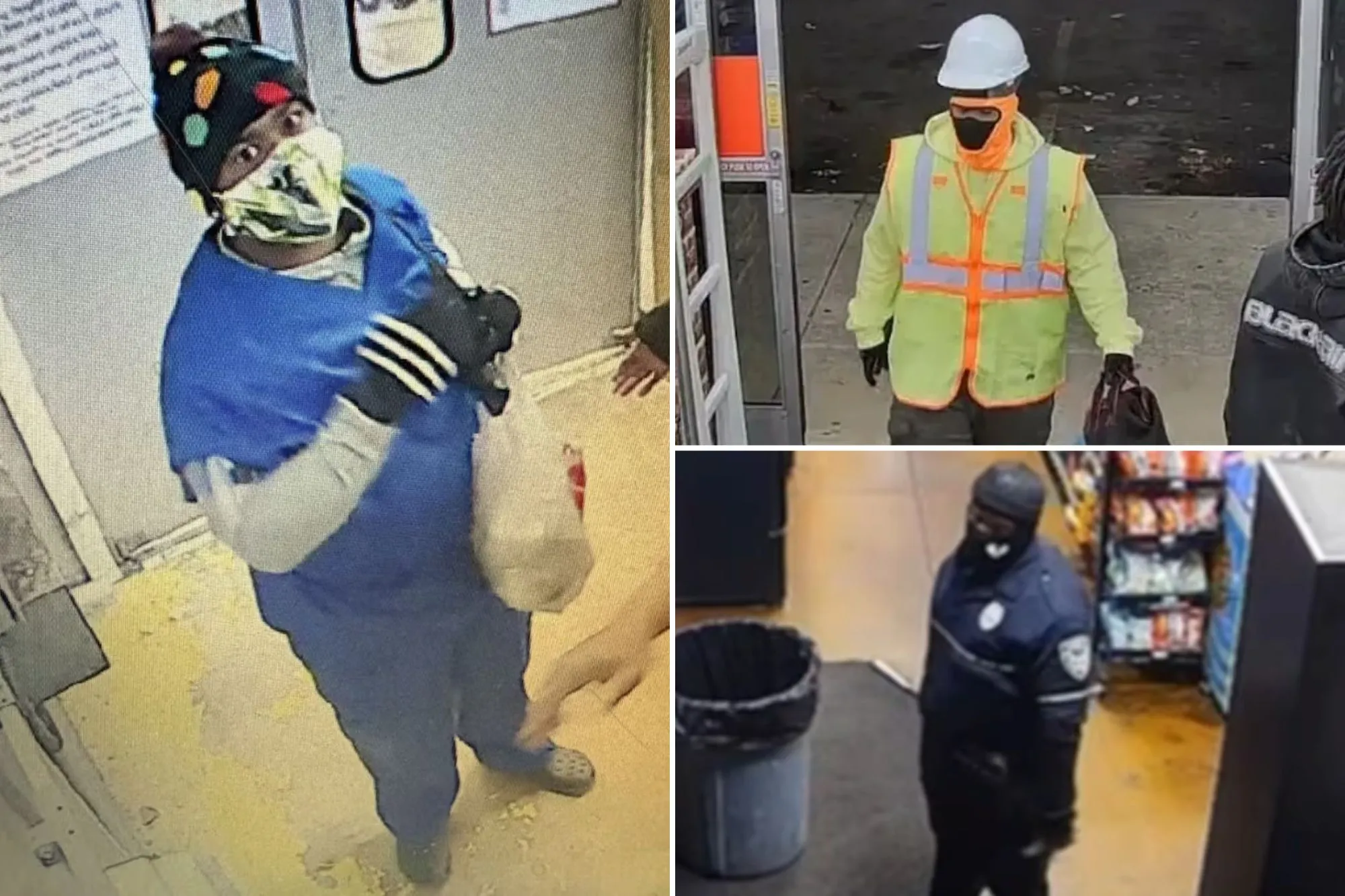

The security cameras kept rolling. That was never the problem.
Store after store across the Atlanta area captured the same scene: a man walking in, pulling a gun, walking out. The footage was there. The timestamps were there. What investigators didn’t have was a face they could match from one case to the next.
Because every single time, according to authorities, the man looked like somebody else entirely.
A Different Man Every Time
Prosecutors say the suspect didn’t just change clothes. He built characters.
In one robbery, authorities say he appeared as a construction worker — the kind of guy nobody looks at twice on a Georgia job site. In another, he took on the look of a health care professional. In another still, he presented himself as a security guard, the very type of person a frightened clerk might turn to for help.
Ten stores. Ten armed robberies. And, officials say, a rotating cast of disguises designed to keep anyone from connecting the dots.

It’s the kind of detail that sounds like a movie plot. For the clerks and cashiers who were behind those counters, it was a gun in their face on an ordinary shift.
The Phrase Investigators Used
Law enforcement didn’t reach for gentle language when they described what had been happening. They called it a reign of terror.
That phrase matters. Police describe a lot of robbery cases in a lot of ways, and most of the time the words are flat and procedural. This one wasn’t. It signals a pattern that stretched long enough, and hit enough businesses, that the people investigating it saw something bigger than a string of unrelated crimes.
Consider what a spree like this does to a community. Every employee working a late shift starts scanning the parking lot. Every manager starts rethinking who gets to close alone. A man in a hard hat, a man in scrubs, a man in a guard’s uniform — ordinary sights on any American street — become things you look at twice.
That’s the cost that doesn’t show up in a police report.
Why Disguises Work — Until They Don’t
Investigators build robbery cases the same basic way almost everywhere:
- Physical description from witnesses who were terrified and had seconds to look
- Surveillance video that captures clothing, build and movement
- Pattern recognition — linking cases by method, timing and location
Change the outfit, and you weaken the first two. A witness at one store describes a construction worker. A witness at another describes a man in a uniform. On paper, those are two different suspects. Two different investigations. Two case files that may never sit on the same desk.
That, authorities allege, was the entire point.
But there’s a hard truth buried inside a strategy like that. The more times you run it, the more chances you give someone to notice. Ten robberies is ten opportunities for a camera to catch the wrong angle, for a habit to repeat, for one small thing to stay the same no matter what costume is worn over it.
The nickname now attached to the case — “Master of Disguise” — carries an irony that’s hard to miss. A man accused of going to extraordinary lengths to be nobody in particular has ended up with a title that guarantees the opposite.
What Comes Next
The accusations are exactly that: accusations. Charges are not convictions, and the case now moves into a legal process where prosecutors will have to prove, robbery by robbery, that the man in the hard hat and the man in the guard’s uniform were the same person.
For the workers who lived through those ten encounters, though, the identification was never really in question. They remember the gun. They remember the voice. They remember the moment an ordinary day stopped being ordinary.
The costumes were for everyone else.