
Part 1 — The Wrong Name on the Clipboard
They listed Nathan Martin as family on the hospital form, not the woman who held Walter’s hand every night for eight months.
Phyllis Martin read the clipboard, said nothing, and asked only if she could go back inside.
Three days later, at her own family’s picnic, someone handed her a different set of instructions entirely.
She followed them without a word, the way she had followed most things that summer, and let the evening carry her toward whatever came next.
It started, as these things usually did with Phyllis, somewhere she hadn’t expected to find herself at sixty-six.
They had listed Nathan Martin as family on the hospital intake form, not the woman who had sat beside Walter Hayes’s bed every night for eight months.
Phyllis Martin stood at the nurses’ station under the flat fluorescent light, sixty-six years old, in the same navy cardigan she’d worn to a hundred church suppers, and said nothing about the mistake. She only asked, quietly, if she could go back in.
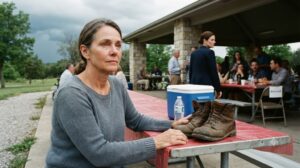
Three days later, at her family’s Fourth of July picnic, they gave her a separate door to use so the guests would not see her arrive on his arm.
She said nothing then, either. But by the time the thunderheads started stacking up over the wheat fields that evening, she had already decided exactly what she would ask for, before she agreed to give her family anything at all.
Millbrook, Illinois, was the kind of ranching town where everyone still called the hospital “the county hospital” even though it had been renamed twice, and where the nearest real city was three hours east on a two-lane road that flooded every spring. Phyllis had spent thirty-one years there as a nurse, most of them as head of the medical-surgical floor, the woman new doctors were quietly told to listen to. She had retired at sixty, buried her husband Robert two years after that, and spent the following four years doing what everyone told her a woman her age was supposed to do — keeping busy, keeping quiet, keeping small.
Then Walter Hayes had walked into the church potluck line behind her, a retired large-animal vet with flour on his sleeve from a pie he’d insisted on bringing himself, and something in her that she had assumed was finished woke back up.

She still wore Robert’s wedding ring on a thin silver chain around her neck, the band gone soft and tarnished from thirty years on his hand and eight more against her skin. She had never once thought of it as something she needed to choose between — Robert, and this new, unexpected warmth that Walter brought into a kitchen that had gone quiet for too long. She simply carried both.
The night Walter’s heart gave him trouble at his own supper table, she had ridden with him in the ambulance, held his hand through triage, and told the admitting nurse, calmly, that she was the one who should be called. The nurse had looked at the screen and told her, just as calmly, that the emergency contact on file was his stepson, and that family only meant certain names.
Phyllis had nodded. She understood forms. She had filled out ten thousand of them herself over the years, on the other side of that same counter. What she had not expected was how much it would hurt to be told, in that particular sterile language, that she did not officially count.
She found the hospital chapel two floors down — four pews, a plain wooden cross on the wall, no stained glass, nothing fancy. She sat by herself with her coat still on. She did not fold her hands or say a word out loud. She simply reached up under her blouse and pressed the ring against her palm through the fabric, closed her eyes, and let the quiet do what it had always done for her.
It was the same cross, more or less, that hung in the sanctuary at Grace Community, second pew from the back, third window on the left — her and Robert’s pew for twenty-six years, and hers alone since. She had sat in that same seat every Sunday since his funeral, the space beside her a little too wide, a little too obviously empty. She had never once complained about it to anyone. She had simply kept showing up.
Walter came home from the hospital four days later, stable, chastened, and more certain than ever that he wanted this woman in the rest of whatever years he had left. Phyllis’s daughter, Carol, heard about the hospital mix-up secondhand, from a cousin, and said only, “That’s what happens when you go around introducing him as if he’s something official.”
Phyllis let that pass too. She had learned, over sixty-six years, which battles were worth the breath.
But she had also learned, over thirty-one years of nursing, that a person could be quiet and still be keeping very careful count.
Part 2 — The Side Door
Carol and her husband, Nathan Martin, ran Martin Ranch Supply out on County Road 9, the feed-and-tack store that Phyllis’s late husband Robert had started in the back of their machine shed forty years earlier. Nathan had taken the Martin name into the business the same year he married Carol, back when marrying into that family and running that store had felt, to him, like the same promise.
By this July, the store was two payments behind on its equipment loan, and everyone in Millbrook who cared to notice could see it in the half-empty shelves and the sign that hadn’t been fixed since the wind took two of its letters in March.
Nobody had told Phyllis any of that directly. She had heard it the way she heard most things now — sideways, through the church ladies, through the granddaughter who still called her every Sunday.
What Nathan and Carol did tell her, in the days before the Fourth, was that the picnic this year would be “a little more done up” than usual, since two of their biggest suppliers were coming as guests, along with half the county’s ranching families. Nathan wanted the yard looking a certain way. He wanted, he said, carefully, for things to look stable.
“And Walter?” Phyllis had asked.
“Of course Walter can come,” Carol said, not quite meeting her mother’s eyes. “We just thought — maybe not through the front, with everyone watching. There’s a side gate by the machine shed. Easier parking anyway.”
It was never said outright that the problem was two people in their sixties holding hands in front of the bank’s regional manager. It didn’t need to be said outright. Phyllis had raised these two children well enough to read a silence.

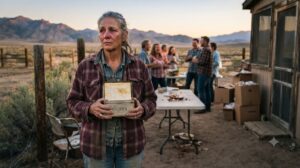
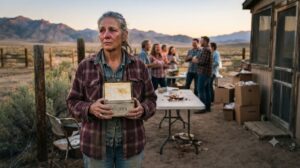
She and Walter came through the side gate anyway, at the hour they were told, past the propane tanks and a stack of feed bags still in their plastic wrap. Walter squeezed her hand once, said nothing, and Phyllis said nothing back — not because she had nothing to say, but because thirty-one years on a hospital floor had taught her that the person who stays calm is the person the room eventually has to listen to.
The sky had that particular greenish weight to it that ranching families learn to read before the radio ever catches up. Somewhere past the tree line, thunder was already practicing.
It was near the end of the afternoon, with paper plates going soft in the humidity and the supplier from the regional co-op making polite small talk about interest rates, that Nathan finally pulled Phyllis aside, behind the same machine shed she’d just walked past.
“Mom,” he said — he had called her that since he was twenty-six years old, and it had always meant something to her, until today. “We need to talk about the loan. The bank wants a co-signer with clean credit and some — history. Somebody steady. We were hoping you’d consider it.”
“Steady,” Phyllis repeated.
“You know what I mean,” Nathan said. “Somebody the bank sees as sensible. Not somebody who’s just… starting things over at sixty-six.”
He didn’t say Walter’s name. He didn’t have to.
Phyllis looked past him at the darkening tree line, at Walter standing near the drink table with her granddaughter, laughing at something, entirely unaware he had just been used as a reason. She thought about the ring against her chest. She thought about the second pew, third window, twenty-six years of Sundays.
She did not raise her voice. She never had, not once in sixty-six years, and she was not going to start in a machine shed doorway with rain coming.
“I’ll think about the loan,” she said, evenly. “But before I agree to anything, there’s a condition. One condition. And I want you and Carol both to hear it together, in front of the family, not out here where nobody else can hold you to it.”
Nathan blinked. Whatever he had expected, it wasn’t that.
The first fat drops of rain started coming down through the leaves as they walked back toward the house.
Part 3 — What the Room Didn’t Know
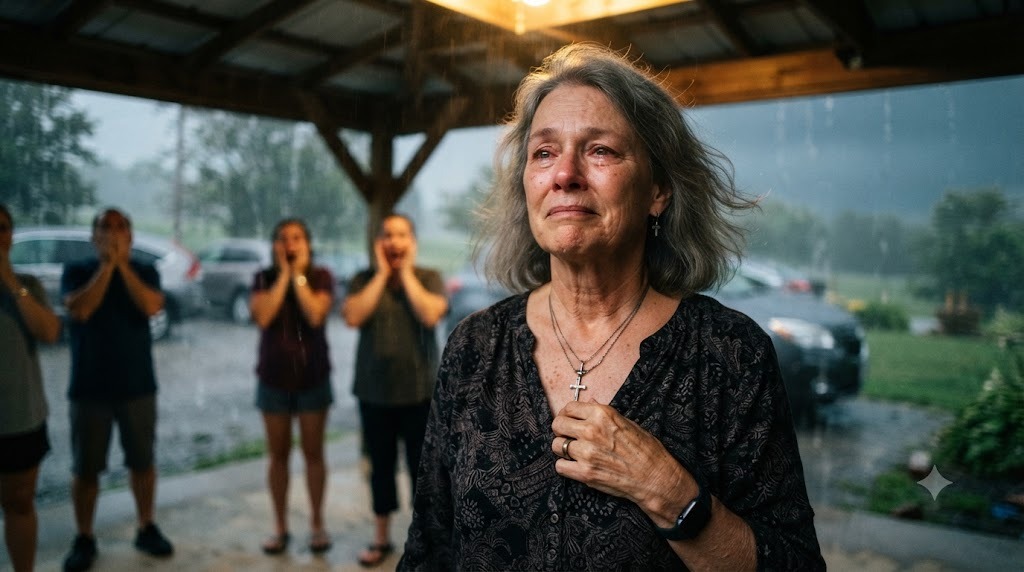
They gathered everyone under the big carport as the storm finally broke, twenty-some people crowded in among the folding chairs and the leftover watermelon, the co-op supplier included, Carol’s arms crossed tight, Nathan standing very still.
Phyllis stood at the front of it with Walter’s hand loosely in hers, the tarnished ring resting against her collarbone outside her blouse now, in plain sight for the first time all day. She touched it once before she spoke, the way she always touched it, though almost nobody in that carport knew what the gesture meant.
“Nathan asked me tonight to co-sign on the equipment loan,” she said, her voice steady enough to carry over the rain on the tin roof without ever rising. “He said the bank wants somebody sensible. Somebody with history.”
A few guests shifted, uncertain whether this was meant to be private.
“I have a condition,” Phyllis went on. “Just one. If I help save this store, Walter Hayes comes through the front door of this family from now on, same as anyone else who’s ever been welcomed here. No side gate. No separate door. Not at Christmas, not at anyone’s wedding, not ever again.”
Carol’s face went through several colors. “Mom, it was never about — ”
“It was exactly about that,” Phyllis said, gently, without heat. “And I’m not angry. I raised you both better than most, and mostly you turned out fine. But I won’t be quietly helpful and quietly hidden in the same year. You can have one or the other.”
It was Walter, of all people, who broke the silence that followed — not to defend himself, but to say, simply, “She’s not asking anything of you that she hasn’t already given you a hundred times over.”
That was when the co-op supplier, a woman named Bev Kowalski who had been mostly quiet all afternoon, set down her plate and said, “Wait — Phyllis Martin. You’re the Phyllis Martin who put up the original note on this place forty years ago?”
The carport went still except for the rain.
Nathan looked at his mother-in-law as though seeing her for the first time. “What is she talking about?”
Phyllis let out a breath she seemed to have been holding for forty years. “When Robert wanted to start this store, the bank turned him down twice. I’d been saving my nursing wages since I was twenty-two, in a separate account he never touched, because my own mother taught me a woman keeps something of her own, quietly, just in case. I put it up as the guarantee. Robert never told anyone but Bev’s father, who ran that same co-op back then. I asked him not to. It never seemed important who got the credit, as long as the doors stayed open.”
Bev nodded slowly. “My dad talked about it once, years ago. Said there was a woman behind that loan nobody in town ever knew about. I never thought to ask which woman.”
Carol sat down hard on the arm of a lawn chair, staring at her mother as if the ground had shifted under the whole carport. Nathan said nothing at all for a long moment, and when he did speak, his voice had lost its earlier certainty entirely. “You’ve had the money to help us covered this whole time. And you never said.”
“I have some of it still,” Phyllis said. “Not all — I’m not made of money, Nathan, I’m made of thirty-one years of double shifts. But enough to help, if it’s asked for honestly, and given back honestly. That was never the part I was withholding.”
She didn’t raise her voice through any of it. She didn’t need to. It was the very evenness of her — the same evenness that had carried her through a hospital hallway that denied her his name, through a side gate meant to hide her, through forty years of silence about a debt nobody thanked her for — that seemed to shame the room far more than any shouting could have. Carol wouldn’t meet anyone’s eyes. Even Nathan, a man not given to softness, looked, for the first time in a long while, like a boy who understood exactly what he had done.

Phyllis reached up and touched not the ring this time, but the small, worn cross she wore just beneath it on the same chain — her own mother’s, older than the ring by twenty years, the one thing she had never once mentioned to anyone in that carport, though she had worn it every single day of her life. She held it for just a moment, the way she had in that hospital chapel, the way she had in the second pew, third window, for twenty-six years and six more besides. No words. She didn’t need the room to see her pray. She only needed herself to remember Whose steadiness she’d been borrowing all along.
“I’ll sign the loan,” she said finally. “Under my one condition. And I’d like an answer tonight, not next week, because the bank isn’t the only one running out of patience.”
Nathan looked at Carol. Carol looked at her mother for a long moment, then, quietly, nodded.
Phyllis didn’t wait for the hug that came a beat too late, or the apology that would take Carol another two days to actually say out loud. She simply took Walter’s arm, and the two of them walked out from under the carport into the rain, unhurried, her chin level, her back straight, the storm soaking through her cardigan within a dozen steps.
She didn’t look back to see if anyone was watching. For the first time in a long while, it didn’t matter whether they were.
The store kept its doors open that fall. Walter came through the front one every single time after that, and nobody at Martin Ranch Supply ever mentioned a side gate again. Carol and Phyllis are still working their way, slowly, back toward something like the closeness they’d once had — some Sundays better than others, the empty space in the second pew a little smaller each year, but never quite gone, and never quite pretended away either.