

It started with a sound that wasn’t there.
A visiting American correspondent was working through an ordinary hotel breakfast in Ukraine — coffee, plates, the low hum of a dining room filling up. Then the hum stopped. Not gradually. All at once.
Chairs scraped back. Guests rose to their feet. Staff stopped where they stood, trays still in hand. Nobody made an announcement. Nobody explained anything.
So the reporter did the only thing that felt right in a room full of strangers who all clearly knew something he didn’t. He stood up too.
A Country That Stops on Cue
To an outsider, the scene reads as bewildering. To Ukrainians, it is simply what happens at that hour, the way Americans might rise for the national anthem before a ballgame — except this one arrives every single morning, without a stadium, without music, without warning for anyone unfamiliar with it.
There is no ceremony to watch. That’s the part that catches visitors off guard. No flag detail marches in. No voice comes over a loudspeaker asking for reverence. The room just empties itself of noise.
And in that quiet, a foreigner starts doing math he’d rather not do. Because a country doesn’t build a daily habit around grief unless the grief is arriving daily.

What the Standing Actually Means
The pause is a nationwide moment of silence for Ukraine’s war dead, formalized by presidential decree after Russia’s full-scale invasion began in 2022 and observed across the country ever since — in hotels and offices, on public transportation, in schoolrooms and shops.
It was never designed as a spectacle for cameras. It was designed to be unavoidable.
That’s the difference an American visitor feels immediately. In the United States, remembrance tends to be scheduled and contained — a holiday in May, a wreath, a rifle volley, then back to the cookout. Ukrainians folded remembrance into the workday itself, because for them the war is not a chapter that closed. It is the weather.
Here’s what makes the silence heavier than it looks: the list being honored is not finished. Every morning, the same minute of stillness covers a slightly larger number of names than it did the morning before.
The Grief You Can See From the Sidewalk
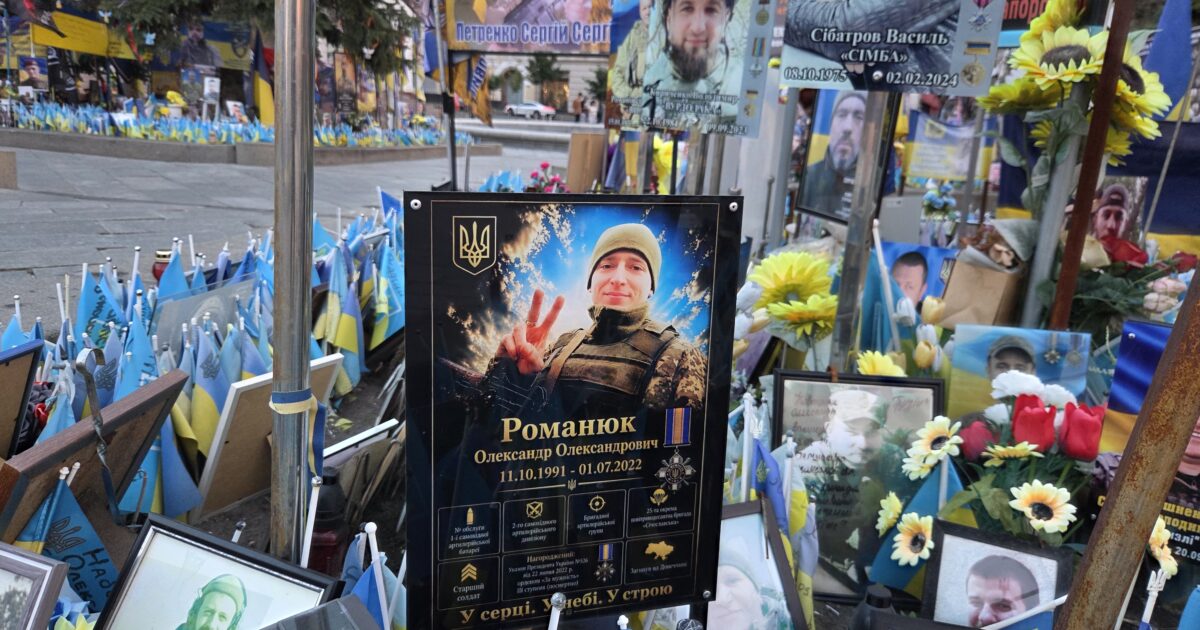
Away from the hotels, the mourning turns visible. Public squares hold makeshift memorials where families plant small flags, one for each person lost, each with a name attached. Cemeteries have expanded into fields that used to be empty. Photographs of the dead appear on fences, in churches, in storefront windows — young faces, mostly, in uniform.
Ukrainian officials have released only limited information about total military losses, and outside estimates vary widely. What isn’t in dispute is the direction. The count moves one way.
So the flags multiply. The photographs multiply. And the morning silence stays exactly the same length, absorbing more each time.
Why It Sticks With Americans Who See It
Visitors describe the same reaction: it isn’t the noise of war that lands hardest. It’s the calm around it. The waitress who resumes pouring coffee the second the minute ends. The businessman who sits back down and reopens his laptop. The child who returns to breakfast.
Not because they’ve stopped feeling it, but because they have had years to build a routine around feeling it.
- The pause is daily, not annual
- It happens in ordinary places, not just monuments
- No one enforces it — people simply stand
- The names it honors keep being added
For one American at breakfast, the whole thing lasted about sixty seconds. It was long enough to understand something no briefing had managed to convey: this is what a nation looks like when it has learned to grieve on schedule, and still can’t get ahead of the list.