
Part 1 — The Envelope
My grandson’s wife handed me a DNA test kit at my own eighty-first birthday party — with a microphone in her hand.
I sat there holding the box, said nothing, and let the room’s laughter run its course.
Twenty minutes later, someone set my sister’s old recipe box down in front of me, and my grandson asked me a question I never expected to answer out loud.
It didn’t start at that party, though. It started three weeks earlier, with an envelope.
And before that envelope, it started forty-seven years ago, in a kitchen in a coal town that no longer had a mine.
They will tell you it started with the DNA kit. It didn’t.
It started three weeks earlier, with an envelope.
The handwriting on the front wasn’t mine to recognize. Formal, looping, each letter of my name pressed so hard into the cardstock it left a shadow on the back page — Mrs. Gloria Parker — like I was a guest being informed of something, not a grandmother being invited to something. I stood at my own kitchen counter in Blackridge, Maryland, turning that envelope over twice before I opened it, the way you do when a thing feels a little too polished to be good news.
Inside was a card announcing my eighty-first birthday. My own birthday. Printed by someone who had never once asked me what kind of cake I liked.
I want you to understand something about me before I tell you the rest. I am not a woman who cries easily, and I am not a woman who tells a story to make herself look brave. I cooked eggs and grits for thirty-one years at the Blackridge Diner, six days a week, and before that I raised a boy who was not, on paper, mine to raise.
Blackridge was a coal town once, back when the mine still ran and the whole valley smelled like scorched rock in the mornings. My younger sister Ruth married a miner named Samuel Whitfield, and for a few years the four of us — Ruth, Samuel, my husband Earl, and me — sat on the same porch on Sunday afternoons like nothing bad could ever reach that high up the mountain.
Something bad reached it anyway. The Blackridge Colliery collapsed in the spring of 1974, and it took Samuel with it, and it took Ruth six weeks later, when her heart simply stopped keeping time with the rest of her. She left behind a six-year-old boy named Tom, and a wooden recipe box she’d built herself out of cedar scraps, with a hinged lid and a burned-in R on the front.
Earl and I didn’t discuss it. We didn’t hold a family meeting. I went to the county office, I signed the papers, and Tom Parker became our son in every way that mattered, and in every way the law allows. I was twenty-eight years old. I had been six months from finishing my nursing certificate at the community college in Cumberland. I never finished it. You cannot raise a grieving six-year-old and sit for exams on the same Tuesday, and I have never once told anyone that this was a loss, because it didn’t feel like one at the time. It felt like the only decision there was.
I kept Ruth’s recipe box on the counter of my own kitchen for forty years. Her stew. Her biscuit dough, heavy on the buttermilk. Her apple stack cake, the one that takes four days to build right. I cooked every one of those cards into my own hands until I didn’t need to read them anymore, and I fed them to Tom, and later, when Tom married and had a son of his own, I fed them to that boy too — my grandson, Wesley, who grew up calling me Grandma the way every child in that family had for two generations, without ever once being told there was a different word he could have used.
I rub my thumb over the burn scar on my left palm sometimes without meaning to — the grill left it on me in 1986, and it’s the first thing I touch when I’m bracing for something. I was rubbing it the morning I opened that envelope, though I didn’t know yet why my hands already knew.
The birthday itself was to be at the country club forty minutes outside Blackridge, in the newer part of the county where the money had moved once the mine closed. Wesley’s wife, Cameron, had planned the whole afternoon. Cameron does things properly. Cameron posts photographs of things done properly. I had learned, over eleven years of being her husband’s grandmother, that Cameron loved a party more than she loved most of the people standing in it.
I almost didn’t go. I want that on the record too. I stood in my own front hallway on the morning of the party with my good navy dress already buttoned, my hand on the doorknob, telling myself I had a headache, telling myself Wesley wouldn’t notice if his old grandmother sat this one out. Then I thought of Wesley’s face if I wasn’t there, and I thought of Ruth’s recipe box sitting on my counter like it always had, and I picked up my pocketbook and went anyway.
I did not know, walking out that door, that by four o’clock that afternoon a room full of people I had fed my whole life would be laughing, and that I would be the joke.
https://cdn-story.jovaaqua.com/st00000048-p1.jpg
Part 2 — What They Handed Me
The country club dining room had white tablecloths and a banner that said HAPPY 81ST GLORIA in gold script, and for the first hour it was, I’ll admit, a lovely afternoon. Wesley kept refilling my iced tea before I’d finished it. Tom sat beside me and told the same story about my apple stack cake that he tells every year, and every year I let him, because some stories are meant to be worn smooth like a stone in your pocket.
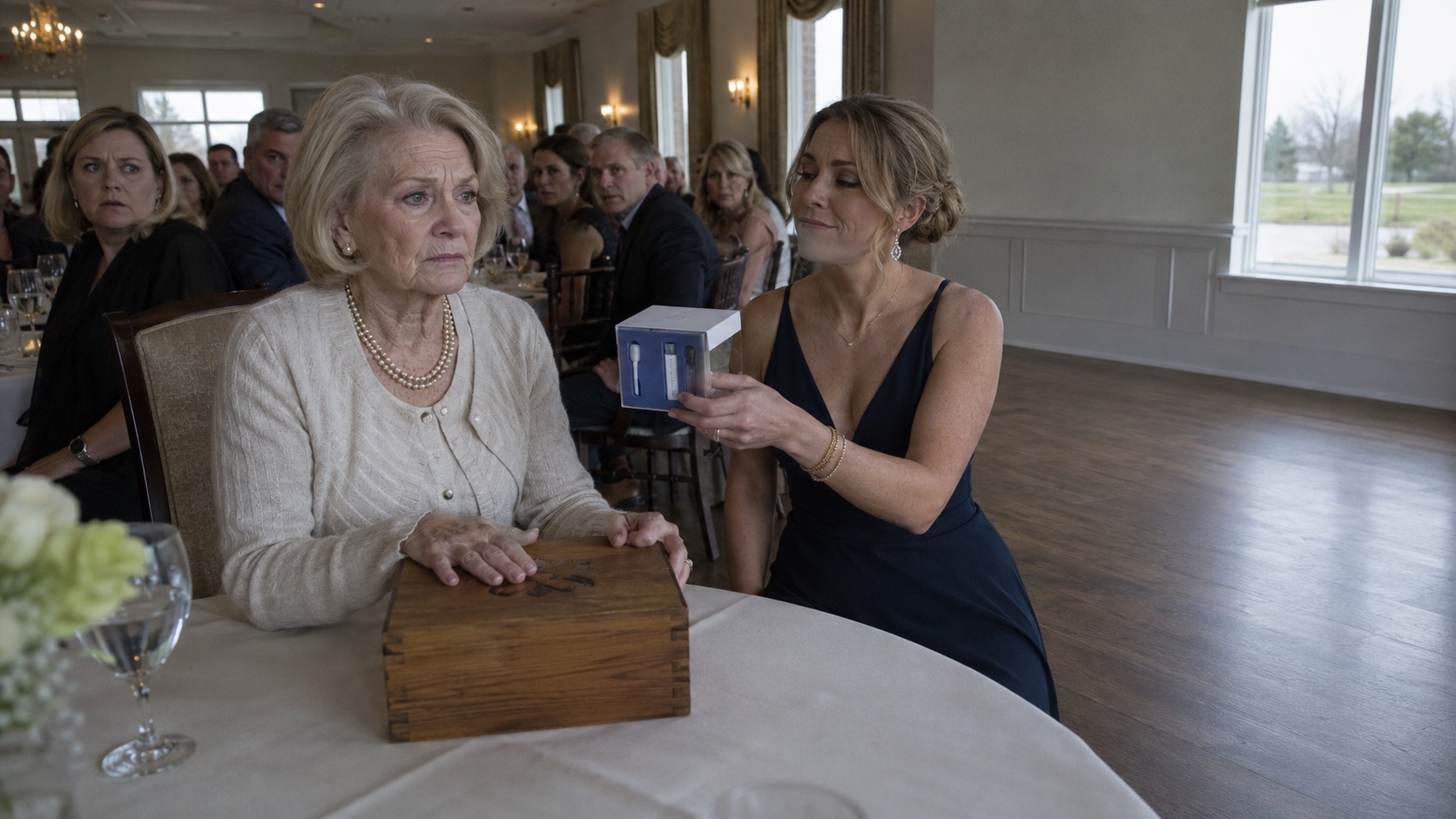
Then came the gifts, and Cameron stood up to hand me hers personally, in front of the whole room, holding the microphone the club had set up for toasts.
“This one’s a little different,” she said, smiling at the tables around her before she looked at me. “Wesley’s grandmother has told this family for years that she raised his father like her own son. So we thought — for her birthday — wouldn’t it be fun to finally find out if that’s actually true?”
She set the box in front of me. A home genealogy kit. A DNA test.
The room laughed. Not everyone. But enough of them, in that easy, relieved way people laugh when someone else has decided a thing is funny and they don’t want to be the one who didn’t get it.
I sat with that box in my lap and I did not say anything for a moment. I want to tell you I had some clever line ready. I didn’t. I looked down at the box, and then at my own hands folded on top of it, at the old burn scar catching the light from the chandelier, and I thought about Ruth’s fever the week before she died, and how I sat up with her three nights running, and how none of that had a barcode you could scan.
“Come on, Grandma,” Cameron said, still smiling, still holding the microphone like it was a fun bit and not a knife. “It’s a joke. Everyone knows you’re not really — I mean, you know what I mean.”
She didn’t finish the sentence. She didn’t need to. The whole room finished it for her in the silence that followed.
Wesley’s face did something I will remember until I die. Not anger, not yet — just a kind of dawning, the look of a man watching his wife say a true thing in the cruelest possible way and not knowing, in the moment, which part to fix first.
I did not raise my voice. I did not cry, though my eyes stung, and I let them sting rather than blink, because I have found that a woman who blinks first at a table like that loses something she can’t get back.
“You’re right,” I said finally, to Cameron, in a voice that came out steadier than I expected. “I’m not his blood grandmother. I never have been. I’m his father’s aunt by blood, and I chose to become everything else the day the county let me sign those papers, and I have chosen it again every single day since. A test in a cardboard box isn’t going to tell you anything I haven’t already told this family myself, for free, for forty-seven years.”
Nobody laughed at that. Tom’s hand found mine under the table.
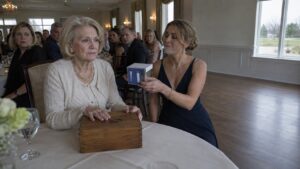
Somebody — I never did find out who — must have gone looking through the gift table after that, because it was Wesley who came and set Ruth’s old cedar recipe box down in front of me not twenty minutes later, the one with the burned-in R, the one I keep at home and had not brought with me, had not expected to see there at all. Cameron, it turned out, had taken a photograph of it weeks earlier for what she’d called a “surprise memory board,” never once asking where it came from or why the R didn’t match anyone’s initials at the table.
“Grandma,” Wesley said quietly, sliding it toward me, “what does the R stand for?”
I looked at that box a long moment before I answered him. Forty years of buttermilk biscuits and apple stack cake, four days in the building, sitting in the middle of a country club banquet table like it had wandered in from another life entirely — because it had.
“Ruth,” I said. “Your grandfather’s mother. My sister.”
I watched something shift across Wesley’s face — not shock, because some small true part of him had known the shape of this his whole life, only never the name of it. Cameron’s smile had gone thin and uncertain, the microphone still loose in her hand, the room around her waiting to see what I would do with a silence I had, for the first time in eleven years, no interest in filling for her comfort.
https://cdn-story.jovaaqua.com/st00000048-p2.jpg
Part 3 — One Condition
I did not stand up and give a speech. I am eighty-one years old and I have buried a sister, a husband, and more friends than I care to count, and I have learned that dignity rarely announces itself with a raised voice.
What I did was set both hands flat on the cedar lid of that recipe box, feel the old grain under my palms the way I have a thousand times at my own kitchen counter, and say what I had never said out loud to any of them in forty-seven years.
“I have one thing to say, and then I’d like my cake.”
The room, to its credit, went quiet enough to hear it.
“I raised Tom because Ruth and Samuel didn’t get the chance to. I gave up my nursing certificate to do it, and I never once asked anyone in this family to thank me for that, because it wasn’t a favor. It was love, and love doesn’t send a bill. But I am done being brought out at parties to be the punchline of a joke about whose blood is real and whose isn’t. If this family wants me at its tables going forward — and I hope it does, because I have loved every one of you my whole life — then here is my condition.” I looked at Wesley. “Nobody in this family, ever again, gets to make a joke at my expense about what I am or am not to this boy. You are my grandson. That was decided the day I filled out those papers, and it is not up for a vote at a birthday party.”
Nobody argued.
Tom said, “Agreed,” before I’d even finished, his hand still over mine.
Wesley said it next, quieter, looking at his wife rather than at me. “Agreed.”
Cameron didn’t say anything for a long moment. Then she set the microphone down on the table, sat, and said, so low I almost didn’t catch it, “I’m sorry, Gloria. I didn’t think it would land like that.” It wasn’t much of an apology, and I didn’t need it to be more than it was. I have found, at eighty-one, that I no longer require an apology to be perfect in order to accept that it was offered.
I did not stay for the whole party. I ate my cake — it was store-bought, and Cameron’s caterer had never once come close to Ruth’s stack cake, and I said so, and for the first time all afternoon somebody actually laughed with me instead of at me — and then I asked Tom to walk me and the recipe box out to the car.
The sky over the parking lot was the same gray, overcast color it had been all day, the kind of Maryland morning-that-never-quite-brightened that used to mean rain over the old mine road. I held Ruth’s box on my lap the whole ride home, running my thumb over the burned R the way I run it over the scar in my palm, and Tom didn’t try to fill the quiet with anything.
Two weeks later, Wesley drove out to Blackridge alone, without Cameron, and sat at my kitchen table while I made him Ruth’s stew from the card in the box, the one with her handwriting gone soft and gray at the corners. He asked me questions about her I don’t think he’d ever felt he had permission to ask before — what she sounded like, whether she was funny, whether Tom looked like her. I answered every one of them. I gave him the box’s twin recipe, the apple stack cake, written out fresh in my own hand this time, on a card he could keep of his own, separate from Ruth’s originals, which stay with me until I’m not here to keep them anymore.
Nobody rode in on a horse to defend me that afternoon at the club. No lawyer stood up with a document that changed anything. There was no trust fund, no long-lost fortune, no dramatic unmasking of a villain. What happened was smaller than that, and I have come to think it mattered more: a room full of people who had spent years treating my sacrifice as a charming old family story finally sat still long enough to hear it as the true thing it always was, and to believe me.
That is the whole of my victory, and I have decided it is enough. I raised a boy who was not mine to raise, and I am not required to prove it in a lab to have it count. I walked out of that country club with my head up, Ruth’s box under my arm, and I have not, since that day, had to ask twice to be believed.
https://cdn-story.jovaaqua.com/st00000048-p3.jpg