
Part 1 — The Apron
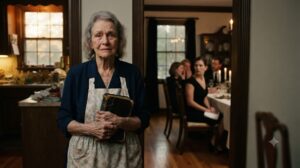
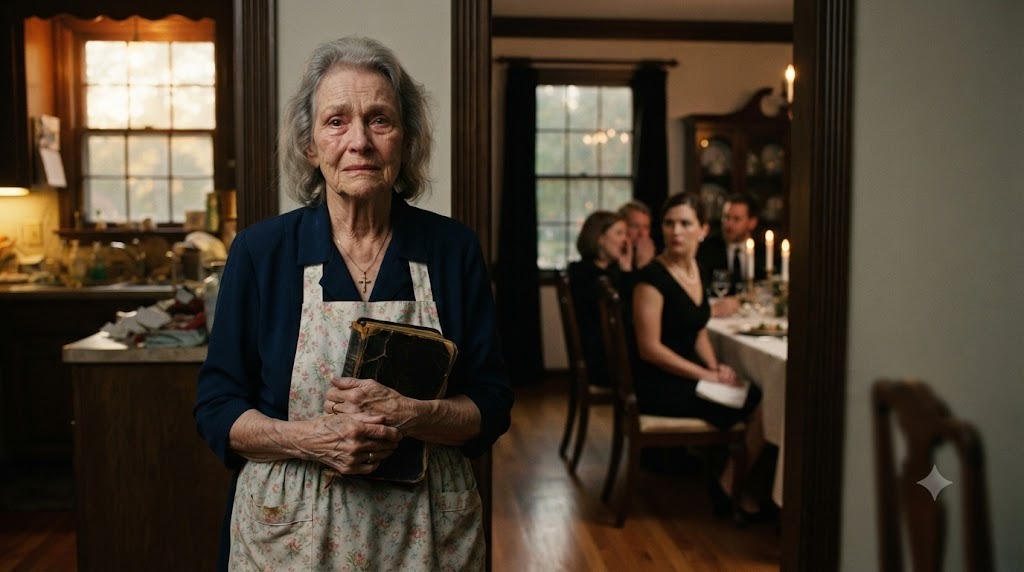
Nicole pressed a folded apron into my hands before I’d even taken off my coat and told me it would “look better” if I worked the kitchen instead of sitting with family.
I tied it myself, said nothing, and carried the coffee pot to a card table near the pantry.
Twenty minutes into the reception, a sound rose from the dining room that made every nurse’s instinct in me go still.
My name is Carol Mitchell, and before that sound ever reached me, I had already spent the whole afternoon learning exactly where I stood in this family.
I am eighty-four years old, a retired Army nurse who had just buried a husband of sixty-one years, and none of that had counted for much since I walked through my grandson’s front door.
They handed me an apron before they handed me a chair.
I did not argue. I tied it once, then twice, and walked into the kitchen of my own husband’s funeral.
Nobody in that dining room noticed I was gone.
Not yet.
My name is Carol Mitchell. I am eighty-four years old, and for sixty-one years I was married to a man named Walter, who used to say I could set a broken arm and boil coffee at the same time and never spill either one. I spent forty years as an emergency room nurse before that, and before that, I spent two years in an Army hospital tent learning that the difference between panic and calm is usually just one person deciding to be calm first.
None of that mattered on the day of Walter’s funeral. What mattered, apparently, was optics.
The reception was held at my grandson Bradley’s house — the big one, the one with the circular driveway and the stone columns, built on what used to be forty acres of Mitchell family farmland. We sold it off in pieces over the years, when Walter’s heart first started giving out and the medical bills piled up faster than the hay. Bradley bought the best parcel, the one with the pond, and built what his wife Nicole called “our forever home.” I still remember standing in that same field as a young bride, watching Walter walk fence line in the evening light. Now there was a circular driveway where the fence used to be.
Nicole met me at the door before I’d even taken off my coat.
“Carol, honey, we just need an extra set of hands in the kitchen,” she said, already pressing the apron into my palms. “It’ll look better if the family’s up front for the guests. You understand.”
I looked down at the apron. It was clean, folded, obviously new — bought for exactly this purpose.
“I am the family,” I said.
Nicole’s smile didn’t move. “Of course you are. I just mean the — the presentable part.”
I tied the apron myself. My hands did not shake. They have not shaken in fifty years, not through gunshot wounds, not through a hurricane evacuation with four patients on ventilators, not through the night Walter’s own heart stopped in our kitchen and I brought him back before the ambulance ever turned onto our road. They did not shake now, either. But something in my chest folded up small and quiet, the way it does when you decide not to fight a fight you already know the shape of.
Later, when the minister asked if any family wanted to say a few words, Bradley found me by the coffee urn.
“Grandma, we’ve already got someone lined up to speak for the family,” he said, not quite meeting my eyes. “We don’t want it to turn into, you know — one of your Army stories. People don’t always know how to take those. Not at a thing like this.”
I had not offered to speak. I had only been standing there, holding a coffee pot, when he decided I needed to be told not to.
“Alright,” I said, and poured another cup for a man I didn’t recognize.
I want to tell you I felt rage. What I actually felt was smaller and colder than that — the particular tiredness of a woman who has spent her whole life being useful to people who only remember it when they need something poured, lifted, or cleaned up. I set the coffee pot down. I straightened the little card table they’d put me at, off to the side, near the pantry door, where I could see the good dining room but not quite sit in it. I folded my hands in my lap the way I’d been taught as a girl, and I watched my husband’s funeral happen from the wrong side of the room.
Nobody at that party knew I had once kept eleven men alive in a tent with two working IV lines and a flashlight. Nobody knew, and on that particular afternoon, nobody cared to ask.
Then, from the front of the house, I heard a sound I have heard a thousand times and will recognize until the day I die — the high, thin, panicked half-cough of a person whose airway has closed.
Chairs scraped. Someone shouted a name. And I was already moving before I decided to move, apron still tied, straight through the kitchen door and into the dining room, toward an old man in a gray suit clawing at his own collar with his face going the color of a plum.

Part 2 — What Nobody Saw
His name was Colonel James Whitfield. He had served with Walter forty years earlier, had flown down from Ohio for the funeral, and was now three seconds from losing consciousness at a stranger’s dining table while twenty people stood around him frozen.
I did not think. Thinking is for people who haven’t done a thing enough times to trust their own hands. I got behind him, found the spot below his ribs I have found on I-do-not-know-how-many bodies over forty years, and pulled up and in, once, twice, and on the third time a piece of ham the size of a quarter shot across the tablecloth and Colonel Whitfield gasped like a man surfacing from deep water.
The room was silent for exactly one beat. Then it exploded into noise — relief, someone calling 911 out of habit, someone else asking if he was alright, a dozen hands reaching for a man who, thirty seconds earlier, none of them had known how to help.
I stepped back. My apron had come untied on one side. My hands, for the first time that day, were shaking just slightly — not from fear, but from the particular drop that comes after your body does its job and lets you feel again.
Nicole appeared at my elbow almost instantly.
“Carol, oh my goodness, thank you — okay, let’s get you back in the kitchen, let’s not make this the story of the day, alright? Today is about Walter.”
She said it kindly. That was almost the worst part. She was not trying to be cruel. She simply could not imagine that the woman in the apron might, for one moment, be allowed to be the center of anything — even the thing she had just done with her own two hands in front of forty witnesses.
I let her steer me back through the kitchen door. Through the little window in it, I watched Colonel Whitfield being fussed over, watched Bradley shake the paramedics’ hands when they arrived, watched no one — not one person — come find the woman who had actually done it.
Except one.
A young woman in a caterer’s black shirt slipped into the kitchen a few minutes later, her hands still trembling as she stacked plates. She looked at me for a long moment.
“That was incredible,” she said quietly. “The way you just — you didn’t even think about it.”
“You don’t, after a while,” I told her.
She nodded slowly, like she was filing something away. I did not think much of it at the time. I had a sink full of dishes and a husband in the ground and no room left that day for anything else.
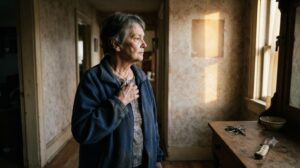
I went home that night to the small house Walter and I had kept at the edge of what used to be our land, took off the apron, and hung it on a hook by the door like it belonged there now.
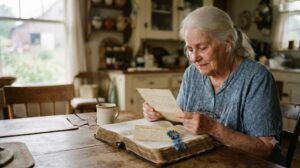
It was three weeks later that I made my decision, and I made it quietly, the way I have made most of the important decisions in my life. I called a realtor. I sold the small house. I packed forty years of a marriage into eleven boxes, and the only thing I refused to let the movers touch was Walter’s old Army Bible — worn leather, cracked clean down the spine from being carried through two wars and sixty-one years of Sunday mornings. I carried that one myself, in my lap, the whole drive across town to the little senior apartment I’d found near the VA clinic.
I did not send an announcement. I sent Bradley one short note: I’ve moved. I’m fine. Don’t worry about me. It was, in its way, the truest sentence I had written in years, because I had finally stopped waiting to be worried about.
For a long while, no one did.
Bradley called twice that first month, both times when I was out, both times leaving a message he never followed up on. On my birthday, he told me later, he’d actually had my number pulled up on his phone, thumb hovering over the call button, when a work call came through instead. He meant to call back. He always meant to.
Meanwhile, in a town small enough that everyone still reads the same newspaper, a young caterer named Priya Sandoval — who, it turned out, had once worked the ER front desk during my last two years on the floor, back before she’d left nursing school and gone into event work instead — could not stop thinking about the woman in the apron who’d calmly saved a man’s life and then gone back to the dishes like it was nothing.
She wrote a letter. Not to me. To the local Veterans of Foreign Wars post, care of a Veterans Day recognition dinner they held every year for anyone in the county who’d served — nurses included, this year, for the first time.
She signed it: a witness who was there.

Part 3 — The Room Stands
The invitation came to my apartment on a Tuesday, plain as anything — a card from the VFW post asking if Carol Mitchell, US Army Nurse Corps, would attend their Veterans Day dinner as an honored guest.
I almost said no. I have never much liked being looked at. But I thought of Walter, who used to say that showing up was ninety percent of honor, and I put on my good blue dress and I carried his Bible with me, the way I had taken to doing most places now, the cracked spine worn smoother every year from my own thumb.
I did not know Colonel Whitfield would be there until I saw him at the head table, and I did not know he had asked to speak until the room had gone quiet and he was already standing.
“Some of you know me,” he said. “Most of you don’t know that I am only standing here at all because a woman in an apron, at her own husband’s funeral, walked out of a kitchen and saved my life while the rest of us stood around like furniture.”
I felt the room turn toward me the way a field turns toward weather.
“I asked around,” he went on, “and I found out that woman spent forty years in an emergency room and two more in a war zone before that, and that on the day she buried her husband of sixty-one years, her own family handed her an apron and told her not to speak at his service.”
Somewhere near the back, I heard a chair creak, and I did not need to turn around to know it was Bradley. I had seen him and Nicole come in ten minutes earlier, invited as family, seated three tables back from where Nicole clearly thought family should sit.
“Tonight,” the Colonel said, “I’d like this room to do what that dining room didn’t.”
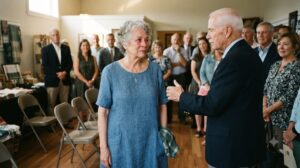
He asked me to stand. Then he asked the whole room to.
They gave me a small plaque — nothing fancy, a piece of brass with my name and forty-two years of service — but what I remember is not the plaque. What I remember is the sound of a hundred people standing up at once in a room that did not have to do that, that owed me nothing, and did it anyway.
Afterward, they asked if I wanted to say a few words.
Nobody told me not to, this time. And this time, I chose to.
I did not talk long. I talked about Walter, and about the farm that is a subdivision now, and about the difference between the people who show up when it’s easy and the people who show up when someone’s turning blue at the dinner table. I held his Bible while I spoke, the cracked spine facing out, and I did not open it, because some things don’t need reading — you just need to be holding them.
I did not mention the apron by name. I didn’t have to. I watched Nicole’s face while I spoke, and I watched her understand, in front of a room full of people whose good opinion she had spent years chasing, exactly what she had done.
Bradley found me afterward, by the coat rack, the same kind of spot he’d found me at Walter’s funeral. This time he didn’t tell me anything. He just stood there for a while, working up to it, and then he said, “I didn’t know. About any of it. I should have called back.”
“You should have,” I agreed.
“Can I take you home? We could — Nicole and I have a guest room now. You wouldn’t have to be alone out there.”
I looked at my grandson for a long moment. There was real shame in his face, and I believed it. I have spent my whole life reading faces for the difference between a person who is sorry and a person who is only sorry they got caught, and his was the first kind.
But I thought of the apron, and the card table by the pantry, and the eleven boxes I had packed myself, and the small apartment near the clinic that was, for the first time in a long time, entirely mine.
“I have a home, Bradley,” I said. “You’re welcome in it. Sundays, if you want to start coming by.”
It wasn’t everything he was offering. It wasn’t everything I’d lost, either — you don’t get back the years you spent invisible just because a room finally stood up for you once. But I drove myself home that night, alone, the way I had chosen to for months now, and I set Walter’s Bible on the shelf by the window where the evening light hits it, and for the first time since the funeral, the quiet in that apartment didn’t feel like something I was hiding in.
It felt like something I had built.