

They thanked the wrong brother for paying my granddaughter’s way through school.
I stood in the third row of the gymnasium in my one good coat, said nothing, and folded my hands the way I always do when there is nothing left worth saying out loud.
Nobody in that room knew what was really sitting at the bottom of an old dented lunchbox in the cab of my truck.
By the end of that week, one deed with one name typed on it was going to change who owned half the things people in my family thought they already owned.
Part 1 — The Wrong Name at Graduation
The principal thanked my brother for the gift I had been paying for two years.
I folded my hands in my lap and said nothing.
Something sitting in my truck that morning was about to prove all of them wrong.
None of them knew where that money had really come from, or how long I’d been carrying it in secret.
To understand why, you have to go back to a morning that started, like most of them did, with fog still sitting low over Ashcombe and flour already on my hands.
The fog hadn’t burned off Ashcombe yet when we filed into the high school gym. New Hampshire mornings do that in June, wrap the old brick buildings in gray until nine o’clock like the town isn’t sure it wants to wake up. I’d worked the bakery ovens since four, same as I have most mornings for thirty years, so the smell of proofing dough was still on my hands under the borrowed cologne I only ever wear to funerals and graduations, which by sixty-three feels like it’s starting to be the same short list of occasions.
I parked the truck two blocks down because the school lot was already full, and I walked past the old commissary building on the way in without really looking at it, the way you stop seeing a thing you pass every day. It’s a bakery now — Corbin’s — but the brick underneath is the same brick that stood there when this whole town ran on the granite works instead of the highway interchange. My father used to say that building had more of our family’s history in its foundation than the house we grew up in did.
Emily looked for me before she looked for anyone else. Sixty-three years old and I still felt it in my chest every time my granddaughter’s eyes found mine in a crowd. She was already in her cap, gown draped over one arm because it was too warm inside for it yet, and she waved like she was twelve instead of eighteen. I waved back with the hand that wasn’t holding the lunchbox.
I’d almost left it in the truck. Some habits you keep even when they don’t make sense to anyone watching. That lunchbox has gone to work with me every single morning since my father handed it to me the week I turned sixteen and told me a man ought to carry something of his own into a place of work, even if it’s just his lunch. It’s dented on one corner from a shelf that fell on it in 1994. The latch sticks in cold weather. I don’t carry it to graduations. I don’t know why I brought it that day, except that something in me wanted it close.
Marcus found me near the bleachers, Robin a step behind him, both of them dressed nicer than I’d seen them dress in months. My son shook my hand instead of hugging me, which is something that’s happened more in the last four years than it ever did before, and I’ve stopped letting myself wonder why.
Then the principal took the microphone, and the gym went quiet the way gyms do when four hundred people all decide at once to be polite.
“Before we begin, the Hall family has asked us to recognize a very generous gift. The Hall Family Trust — established by Preston Hall — covered Emily’s AP testing fees and her college application costs this year. Preston, would you stand?”
My brother stood. Straightened his jacket, the good gray one, the one Vivian buys him from a shop in Concord that doesn’t put prices on the tags. He gave a small, humble wave, the kind of wave a man gives when he has practiced looking like he didn’t want the attention.

I kept my hands folded in my lap, the lunchbox resting against my shin where nobody could see it under the bleacher seat in front of me.
Because I was the one who paid those fees. Every dollar of it came out of that lunchbox — out of the envelope I keep taped under the tray where the sandwich used to go, filled slow, five and ten dollars at a time, from selling the day-old loaves at half price to the mill workers who still come by at closing, from tips a widow at the counter slips me some mornings because she remembers when Dottie used to work the register. I’d been slipping cash to Emily’s guidance counselor in sealed envelopes for two years, asking her not to say where it came from, because I knew if that money went through the family account, it would need a signature that wasn’t mine.
I remembered the morning I’d handed the counselor the first envelope, back in the fall of Emily’s junior year. She’d looked at me over her glasses and said, “Mr. Hall, are you sure you want this anonymous? Most grandparents like the recognition.” And I’d told her no, I didn’t need recognition, I just needed Emily to walk into that testing room without worrying about the fee. I hadn’t thought, back then, about what it would feel like to watch someone else take a bow for it in front of the whole town.
Afterward, in the parking lot, Preston’s wife Vivian found me by the truck, her heels sinking slightly into the gravel, sunglasses pushed up into hair that never seems to move in any wind.
“You’re not upset, are you, Leslie? Preston didn’t ask for the credit — the school just wanted to thank somebody, and, well, it made sense to name the trust.” She tilted her head, the way she does when she’s about to say something unkind and dress it up as concern. “And honestly — it’s sweet, what you try to do. But let’s be real. Thirty years of shift work doesn’t add up to what real investment does. It’s nothing special, what you give. It’s the thought that counts, isn’t it.”
Nothing special.
Thirty years of four a.m. mornings, of burned forearms from oven racks, of a lunchbox that’s outlived two of my trucks. Nothing special.
My son Marcus stood a few feet away, jaw tight, not quite meeting my eyes, not quite defending me either. I watched him decide, in real time, not to say anything, and something in my chest folded up small the way it does when I know an argument isn’t worth starting in a school parking lot.
“Dad, I didn’t know you—” he started, then stopped, like he wasn’t sure which sentence he even meant to finish.
“It’s fine,” I said, the way I always say it’s fine.
That afternoon I drove to the bank to take out three hundred dollars for a graduation watch, the good kind, the kind Emily had pointed at in a shop window back in March without meaning for anyone to notice her noticing. I’d seen her face in the reflection of that window and I’d made up my mind right there on the sidewalk.
The teller typed my account number, frowned at her screen the way people frown when they’re about to say something they wish they didn’t have to, and slid a form across the counter.
“I’m sorry, Mr. Hall. This account requires a co-signature release for withdrawals over two hundred dollars. Your son, Marcus Hall, is listed as the authorized second signer.”
I stood at that counter with my own name printed on my own retirement money and I could not touch three hundred dollars of it without my son’s permission.
I put the form back down, said I’d come back later, and drove — not home, not to the bakery — to the only place that had ever made the weight in my chest feel lighter. A church three blocks off Main Street, empty on a Tuesday afternoon, cool and quiet after the June heat outside, the stained glass throwing thin colored light across the last pew like it always does around four o’clock.
I sat down. Folded my hands. Didn’t say a word out loud. Didn’t need to. Some prayers don’t have language in them at all — they’re just a man sitting still long enough for the noise in his head to settle.
Part 2 — What the Trust Was Really Protecting
Four years earlier, Dottie died in March, on a Tuesday, in a hospital bed with the window cracked because she liked to hear the birds even in the cold. Thirty-eight years of marriage ended in a room that smelled like antiseptic and the coffee nobody had finished. After that, I stopped being able to keep track of things the way I used to. I missed a mortgage payment. I let a truck payment lapse for two months. I forgot, three separate times, that Wednesday was trash day, until a neighbor started reminding me. I wasn’t reckless. I was a man who had just buried his wife and forgotten, for a season, how to hold a pen steady enough to write a check without his hand shaking.
Preston used that season.
He sat Marcus and my daughter Robin down at his dining table — the good one, mahogany, nothing like the folding table Dottie and I raised our kids around — and told them their father needed protecting. I know this because Robin told me, years later, crying, apologizing for something she didn’t understand yet that she’d done. Preston talked about “the incident,” which was one missed truck payment blown up into a pattern. He talked about “patterns,” plural, when there had only ever been that one bad season of grief. He set up a joint account, a durable power of attorney, a trust that required Marcus’s signature on anything past two hundred dollars, and he called it love. He told them, “Your father won’t ask for help, so we have to give it to him whether he wants it or not.” It sounded, I’m sure, like the responsible thing. It sounded like the kind of thing a good son does.
What he never told them was that the land under Corbin’s Bakery — the old commissary lot from when Ashcombe was still a working mining town, back when the granite works ran three shifts and half the men in this county carried lunchboxes just like mine down to that same yard — had been sitting in a legal gray zone since our father Walter died. Preston had spent a decade quietly collecting the lease payments on that lot himself, telling the town clerk’s office he held power of attorney over “the family’s interest,” while our father’s actual paperwork sat untouched in a filing cabinet nobody had opened since the funeral.
Preston rewrote what happened to me. He took one hard winter and turned it into a story he told often enough that it hardened into fact — the story of the brother who couldn’t be trusted, set beside the story of himself, the responsible one, the one with the trust and the tailored blazer and the Concord office. And in rewriting it, he made himself the protector and me the cautionary tale, in front of my own children, at a dining table I’d never once been invited to.

Pastor Averill found me at the bakery loading dock two mornings after graduation, before sunrise, before Corbin had even unlocked the front. He leaned against the brick the way he always does, hands in his coat pockets, not in any hurry, the way men who’ve spent forty years listening to grief learn not to be in a hurry around it.
“You’ve had a hard week, Leslie.”
“I’ve had harder.”
“I know you have.” He let that sit a minute. “I’ve watched you slide cash into the offering plate every Sunday for four years now. Not much. Steady, though. Same amount, same seat, same quiet. A man who by his own son’s account can’t be trusted with two hundred dollars, giving faithfully every week to a church that never asked him to prove himself first.”
I didn’t answer right away. The ovens were starting to tick and hum inside as the timers came on.
“Leslie,” he said, “how many more Sundays are you going to keep paying for people who only call you when they need something?”
I thought about Dottie’s old hymnal on my nightstand, her handwriting still soft in the margins of the hymns she liked best, and about every Sunday I’d sat in that pew after everyone else had gone home, saying nothing, asking for nothing, just sitting, the way I’d sat there that Tuesday afternoon after the bank.
“I don’t know what else to do, Pastor. He’s my brother.”
“Maybe it isn’t about doing something to Preston,” he said. “Maybe it’s time you looked at what actually belongs to you before you keep asking permission to touch what’s already yours.”
He knew something I didn’t, or at least suspected it. The church basement still held decades of boxes nobody had ever sorted through — old town-adjacent records, deeds, mining company ledgers, church rolls going back to when this congregation was mostly granite-cutters and their wives. My father used to be a deacon there, back when Averill’s predecessor still ran things, and it was possible, Averill said carefully, that whatever Walter Hall never got around to sorting out before he died was still sitting in a box nobody had opened since his funeral in 1997.
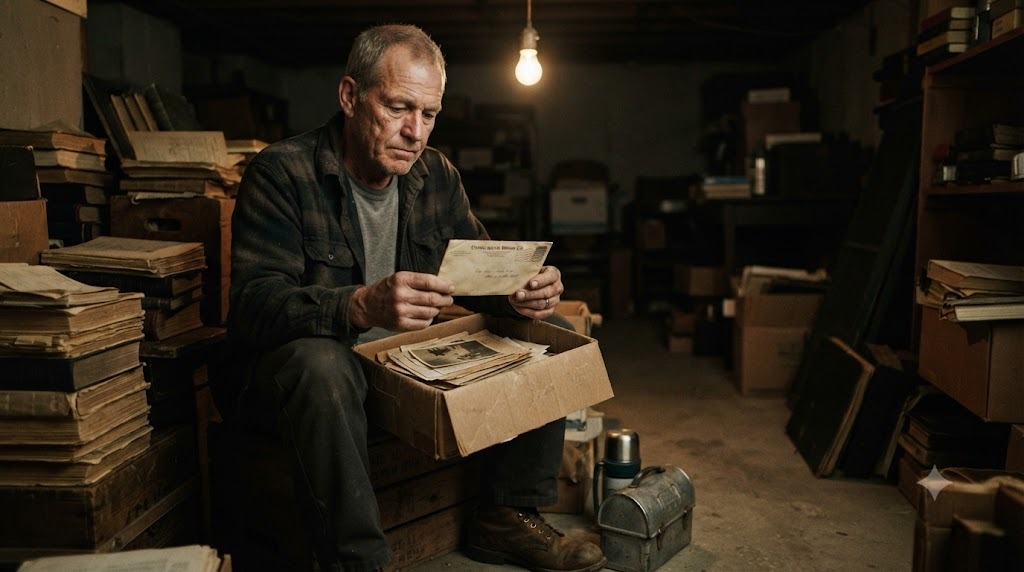
We went down together that same morning, before the bakery got busy. Dust thick enough to see in the light from a single bare bulb. Cobwebs strung between shelving units that hadn’t been touched in years. Box after box of mining company records, church rolls, old bakery ledgers in my father’s careful, slanted handwriting — grocery lists, flour orders, a note in the margin of one page that just said “L. good with the register today,” which I didn’t know existed until that morning and which nearly undid me right there on the basement floor.
Near the bottom of the third box, under a stack of hymnals gone soft and swollen with old damp, there was an envelope with the old Ashcombe Granite & Mining Company letterhead, sealed, my father’s name across the front in blue ink gone soft with age.
I sat down on an overturned crate and held it in my hands for a long time before I opened it. Averill didn’t rush me. He just stood there with one hand resting on a shelf, waiting, the way he waits with families in hospital hallways.
Part 3 — What the Deed Said
Inside was a single deed, dated 1968, transferring the commissary lot — the land Corbin’s Bakery still sits on — from the mining company to “Walter Hall, in trust for Leslie Hall, eldest son.”
Not Preston. Me.
I read it three times before the words sat still on the page. Our father had put my name on that land before I was even old enough to understand what a deed was, back when I was nine or ten and used to sweep the commissary floors with him after school while Preston stayed home with a book, uninterested in flour dust and rent ledgers. I was the one who learned to read a proof cabinet before I learned algebra. I was the one who stood beside my father at that same counter learning how bread rises before I ever learned how a business runs. Preston went to college in Concord, went into finance, built a life two towns over with polished floors and a wife who plays tennis on Thursdays — until, somewhere along the way, he realized what that lot near the new highway interchange was quietly becoming worth, and decided the story of our family could be rewritten to make that worth his.
For a decade, Preston had been collecting lease income on land that was never legally his to collect, using a power of attorney that expired the day our father died, and building a story about his irresponsible older brother loud enough, often enough, that even my own son believed it more than he believed me.
I did not call a lawyer to sue him. I did not stand up at a family dinner and read that deed out loud in front of everyone, the way some hard, tired part of me wanted to. I sat with it for two days, prayed on it in that same back pew without saying a word out loud, and then I did the one thing I knew, in my chest, was actually mine to decide.

I called Marcus.
“I need you to come down to the registry of deeds with me,” I told him over the phone. “Not to fight anyone. I need you to see something with your own eyes.”
He met me there at nine the next morning, fog still sitting low over the courthouse steps the way it had at graduation. I watched his face while the clerk pulled the recorded copy and matched it, line by line, against my father’s original. I watched thirty years of a story about his father come apart in about four minutes, watched the particular kind of stillness settle over him that comes when a man realizes the ground he’s been standing on wasn’t where he thought it was.
“Dad,” he said finally, voice cracking, “I signed off on treating you like you couldn’t be trusted. With Uncle Preston. I did that to you.”
“You believed what you were told,” I said. “I’m not asking you to carry his lie for him anymore. I’m asking you to stop carrying it at all.”
I filed the deed in my own name that same morning at the counter, my hand steady this time. It was, for the first time in ten years, legally and entirely mine.
Then I did the part that surprised even Pastor Averill.
I didn’t take the money for myself. I didn’t move into a bigger house, didn’t pay off every bill with the settlement Preston’s lawyer scrambled to offer once he understood the deed was recorded and the lease income he’d been quietly pocketing for ten years was, technically, owed back with interest. I signed the land and the settlement over to the Ashcombe Community Foundation, through the church, to start a scholarship fund — because a courtroom fight would have cost me another ten years of being the brother who “couldn’t let it go,” and because some things are worth more when you let the truth stand on its own instead of making everyone watch you win.
Preston hasn’t spoken to me since. Vivian sent one card, unsigned, a stiff little note about how she “hoped I’d found peace.” That’s the cost of it — I don’t pretend it isn’t. My brother is gone from my life in every way that matters, the last living connection to the parents who raised us both, and some nights that still sits heavy in my chest, heavier than I expected grief for a living person to feel. I sit in the pew some Sundays and feel the empty space where a brother should be, the way you feel a missing tooth with your tongue.
Marcus and I are not fixed either, not the way people want stories to be fixed. He calls more now. He came to church with me twice, sat beside me both times without needing to say much. But trust, once it’s been signed away on paper, takes longer to rebuild than a single morning at the registry of deeds can manage. We’re rebuilding it slowly, the way you proof dough — you can’t rush it, and if you try, it falls flat and you have to start over.
What I have is this: this spring, at Emily’s little sister’s eighth-grade moving-up ceremony, the principal announced the first recipient of the Dottie Hall Memorial Scholarship, named for my late wife, funded by land that had quietly belonged to me the whole time nobody believed I could be trusted with a checkbook.
The old dented lunchbox sits in the fellowship hall now, behind glass, with a small brass plate Pastor Averill had made without asking me first. It just says: Carried faithfully, thirty years.
I still fold my hands the same way I always did, in the same quiet way, asking for nothing out loud. But these days, more often than not, somebody’s sitting next to me when I do it.