
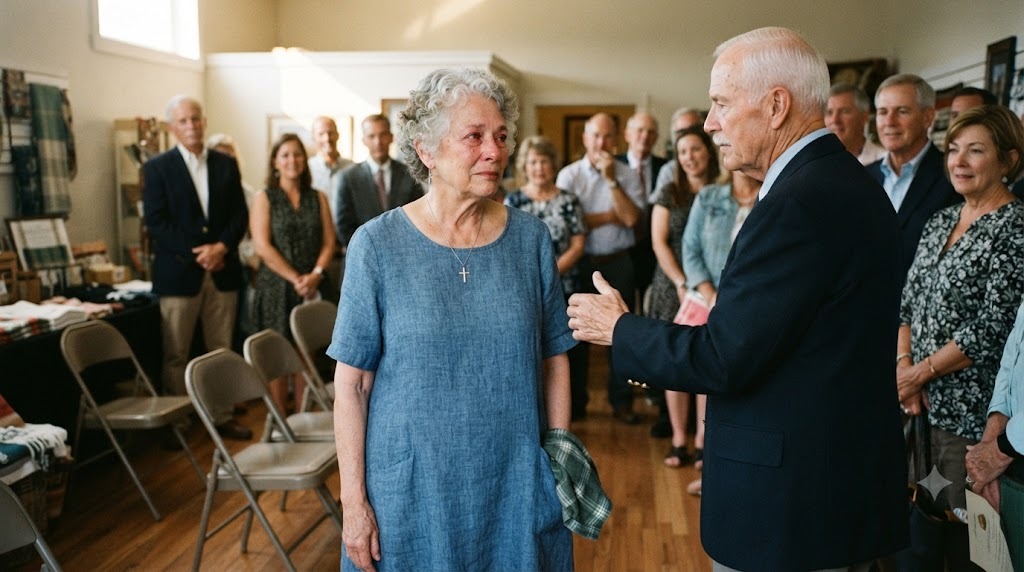

Part 1 — The Black Smock
“She’s staff today, not family. Put her in the black smock so people don’t get the wrong idea.”
I touched the small cross at my collarbone and said nothing at all.
Something in my grandson’s voice that morning told me this day would not end the way he thought it would.
I have learned, over seventy-five years, that silence can hold more than an argument ever could.
So I let the moment pass, and let my mind go back to how any of this began.
“She’s staff today, not family. Put her in the black smock so people don’t get the wrong idea.”
I heard my grandson say it across a room full of strangers holding coffee cups, and I did not flinch. My hand went, out of old habit, to the small silver cross at my collarbone — a cross I’ve worn every day since 1974 — and I said nothing at all.
The fog outside hadn’t burned off yet. It was Veterans Day morning, seven-forty, and the ribbon in front of the new Carter Menswear flagship store was still damp with dew. I’d ironed my good blue dress the night before. I wouldn’t be wearing it today.
I’m seventy-five years old, twenty-six years retired from the United States Army, and for the last six years I’ve sewn, hemmed, and rebuilt nearly every garment that carries my grandson’s name on the label. Nobody outside this family knows that. That’s always been the arrangement — quiet, unpaid, “family helping family,” Blake calls it, usually while introducing himself to reporters as self-taught.

In my mending kit, tucked behind a spool of olive-green thread, is a small frayed square of flannel. It was part of a baby blanket I stitched the week Blake was born, plaid in Army green because that was the only fabric I had enough of at the time. I’ve kept the scrap the way some women keep a photograph.
“Grandma, it’s just for the photos,” Blake said, not quite meeting my eyes, holding out the black staff smock like it was a kindness. “The Colonel’s people are doing a whole thing about the brand’s story today. I need it clean. You understand.”
I took the smock. My fingers, still strong from decades of needle work, folded it once before I put it on.
“I understand,” I said, and that was all.
I learned this kind of silence in the Army first, long before Blake was born — the kind that keeps a room from falling apart, the kind a command sergeant major uses when a young soldier says something foolish under pressure and correcting him in front of everyone would only make it worse. I’ve used that silence for six years in this shop. I used it again now.
What almost nobody in the room understood was that Carter Menswear exists, at all, because a seventy-five-year-old widow with reading glasses on a beaded chain has spent her Tuesdays and her Saturdays and most of the money she saved from a career in Army logistics keeping her grandson’s business from falling apart at the seams — literally. I altered the samples he showed to buyers. I fixed the jackets he ruined learning to cut a proper shoulder. I did it since before there was a storefront, back when Blake worked out of a rented garage and told everyone the fit was “in his blood.”
It was in my hands. It has always been in my hands.
The event that morning was built around veterans — a small plaque, a photographer, a local news van with its antenna poking up through the fog. Investors were coming later for a private showcase, including a man named Colonel Daniel Reyes, retired, the reason Blake’s business had money enough to open a second location at all. Reyes had served thirty-one years. He funded small American-made brands the way other men collected watches, and he had a soft spot, everyone said, for anyone who’d worn the uniform.
Blake had never once mentioned that I’d worn it longer than the Colonel had.
I stood near the back of the store, by the pressing table, in the black smock, pins in a magnetic dish at my elbow, and watched my grandson shake hands under a banner that read HONORING THOSE WHO SERVED. A young assistant asked if I needed a folding chair.
“I’m fine standing,” I said. “I’ve stood longer for less.”
I didn’t tell her I meant it two ways.
Near ten, as the crowd thinned and the fog finally lifted off the parking lot, I went into the back office to collect the garment bags for pressing. Blake’s desk was a mess of swatches and coffee rings. Sitting on top of the mess, half-buried under a bolt of gray wool, was a second phone — not the sleek one he used for investor calls, but an older, cracked one I’d never seen him carry in public.
It buzzed once, lit the room a pale blue, and went dark again before I could see anything at all.
I didn’t touch it. I’ve never been a woman who goes looking. I simply noticed it, the way I notice a hem that doesn’t lie right, and set it back exactly where it had been. Then I picked up the garment bags and walked out into the fog to load my car, the black smock still on, the small flannel square still in my pocket, and drove home to get ready for church.
Part 2 — Saved Seats
My own grandchildren stopped coming to church with me four years ago. First it was schedules — travel soccer, then Blake’s business trips, then simply nothing, no reason given at all, the way a habit doesn’t end so much as quietly stop happening. For a while I kept saving the seat beside me out of stubbornness. Eventually I stopped saving it and just sat with my handbag there instead.
Then, about eight months ago, a young family started sitting two pews up — a mechanic named Ray Alvarez, his wife Priya, and their two small children, who’d moved to Maple Grove for his job at the tractor plant and didn’t know a soul in Iowa. The first Sunday, their younger boy, maybe five, wandered back during the closing hymn and handed me a crayon drawing of what he called “a lady soldier.” Nobody corrected him. I’ve kept the drawing folded in my Bible ever since, behind the ribbon marker.

By spring, the Alvarez children were saving me a seat before I even arrived. By summer, Priya was saving me a plate at the potluck. Nobody had asked me to be anybody’s grandmother. It just happened, the way real family sometimes does and the kind you’re born into sometimes doesn’t.
That Sunday after the ribbon cutting, the little girl, Marisol, patted the pew beside her without looking up from her coloring book. “You’re late,” she said. “We saved it.”
I sat. I didn’t tell them about the smock, or the phone, or the sentence my grandson had said loudly enough for strangers to hear. I folded my hands during the closing prayer the way I always do — not performing it, not announcing it, just closing my eyes and letting the ache sit there a minute, the way I learned to do in field hospitals a lifetime ago, when there was nothing to say that would fix anything, only something to carry until it got lighter.
I didn’t ask God to punish Blake. I asked, quietly, that he would someday be the man I still believed he could be — the boy who used to fall asleep under that green flannel blanket with his fist closed around the edge of it like it was the only solid thing in the room.
Wednesday, Blake called in a panic. The Colonel was coming a day early for a private walkthrough before the evening showcase, and half the sample rack needed re-hemming by six. Could I come in. Family helping family.
I came in.
I was alone in the fitting room that afternoon, working a seam by the window, the flannel scrap tucked in my apron pocket where it always rides now, when Colonel Reyes arrived early himself, unannounced, and let himself into the back office to wait for Blake, who was stuck in traffic.
I didn’t know he was there until I heard the second phone buzz on the desk through the thin wall, and then heard him say, quietly, almost to himself, “That’s not the number I have for him.”
I kept sewing. It wasn’t my business what phone the man used.
But the phone buzzed again, and this time the screen must have stayed lit, because when I came around the corner a few minutes later with a finished jacket over my arm, Colonel Reyes was standing very still by the desk, reading something he plainly hadn’t meant to read, his jaw set in a way I recognized instantly — I’d seen that exact stillness on men receiving bad news for thirty years.
He looked up at me. Really looked, for the first time all week — not at the smock, not at the pins in my collar, but at my face.
“Mrs. Carter,” he said slowly, “how long have you been doing this alterations work for your grandson’s company?”
I set the jacket down on the pressing table. “Since before it was a company, Colonel.”
“Paid?”
I thought about the smock. I thought about the years. I thought, briefly and without bitterness, about the truth.
“Family helps family,” I said, which was the answer Blake always gave, and which I realized, saying it aloud for the first time, had never once been true in the direction it was supposed to run.
The showcase started in three hours. Blake’s car pulled up outside just as Colonel Reyes set the second phone down, screen still glowing, exactly where he’d found it.
Part 3 — Believed
The showcase that evening filled the store with investors, a few local officials, and the same banner from the morning, HONORING THOSE WHO SERVED, now lit gold under the track lighting. I’d gone home to change first. Nobody had told me not to wear my blue dress this time, so I wore it, the small cross still at my collarbone, and stood near the back out of old habit rather than instruction.

Blake found me there twenty minutes before the toasts began, his voice pitched low and fast, the voice of a man who suspects something has shifted and doesn’t yet know how badly. “Grandma — whatever the Colonel said to you earlier, I can explain—”
“You don’t need to explain it to me,” I said. “I already know what’s on that phone. I’ve known what was true for years. I just never said it out loud.”
“Are you going to—”
“I’m not going to do anything, Blake. I’m going to stand here. That’s all I’ve ever done.”
He didn’t have an answer for that. The room called him away for the toast, and he went, visibly rattled, leaving me standing where I’d stood that morning, in almost the same spot, minus the smock.
Colonel Reyes didn’t make a speech about phones or evidence or betrayal. That’s not the kind of man he is, and I understood, watching him take the small stage, that he’d chosen his moment carefully, the way officers learn to.
“Before I say anything about investment,” he began, “I want to correct something I got wrong today. I came here to honor people who served this country. I was told the story of this company was one man’s vision.” He paused. “I’ve since learned that isn’t the whole story. There’s a woman in this room who served twenty-six years in uniform and has spent the last six sewing this brand together with her own hands, unpaid, uncredited, standing in the back in a staff smock this very morning while we all shook hands under a banner that was, frankly, supposed to be about her too.”
A few heads turned. I didn’t move.
“Mrs. Carter,” Reyes said, “would you come stand up here. Not in the back. Here.”
I went. My knees aren’t what they used to be, and the walk felt longer than the distance actually was, but I went, and the room — investors, reporters, a few of Blake’s stunned friends — watched a seventy-five-year-old seamstress in a blue dress take her place at the front of a store she’d helped build stitch by stitch.
Nobody handed me a check. Nobody read a will. There was no dramatic unmasking, no crowd gasping at a hidden fortune. Colonel Reyes simply said, in front of everyone who mattered to Blake’s future, that he believed me — that whatever the business decided going forward, he’d only continue funding a company that paid and credited the person actually holding it together.
That was the whole victory. Being believed, out loud, by someone my grandson respected more than he had ever respected me.
It cost something. Blake didn’t throw his arms around me that night with tears and apologies the way it might happen in a story built to comfort instead of one built to be honest. He stood at the edge of the room, pale, aware for the first time that the ground under his brand had a name and a face he’d been asking to disappear into a back room. Things between us, afterward, stayed careful. Some Sundays he called. Most he didn’t. I didn’t pretend that one speech had mended six years.
What I did was set new terms — mine, not the Colonel’s, not Blake’s. A real contract. A real wage. And a plain sentence, delivered without anger, the week after: “I’ll keep sewing for this company, Blake. I won’t keep disappearing for it.”
That Sunday, I sat in my usual pew. Marisol Alvarez had already saved the seat, coloring book open, a fresh drawing waiting on top — me in my blue dress this time, no uniform, just a woman with a needle in her hand and a small cross around her neck.
I folded the flannel scrap from my pocket into the little girl’s hand instead, the last piece of a blanket I’d once made for a grandson who no longer remembered it. “For the next baby your mama’s expecting,” I said. “Something soft to hold onto.”
Then I folded my own hands during the opening prayer, the way I always have, and said nothing out loud at all — because by now, I didn’t need to. I had already been heard.