
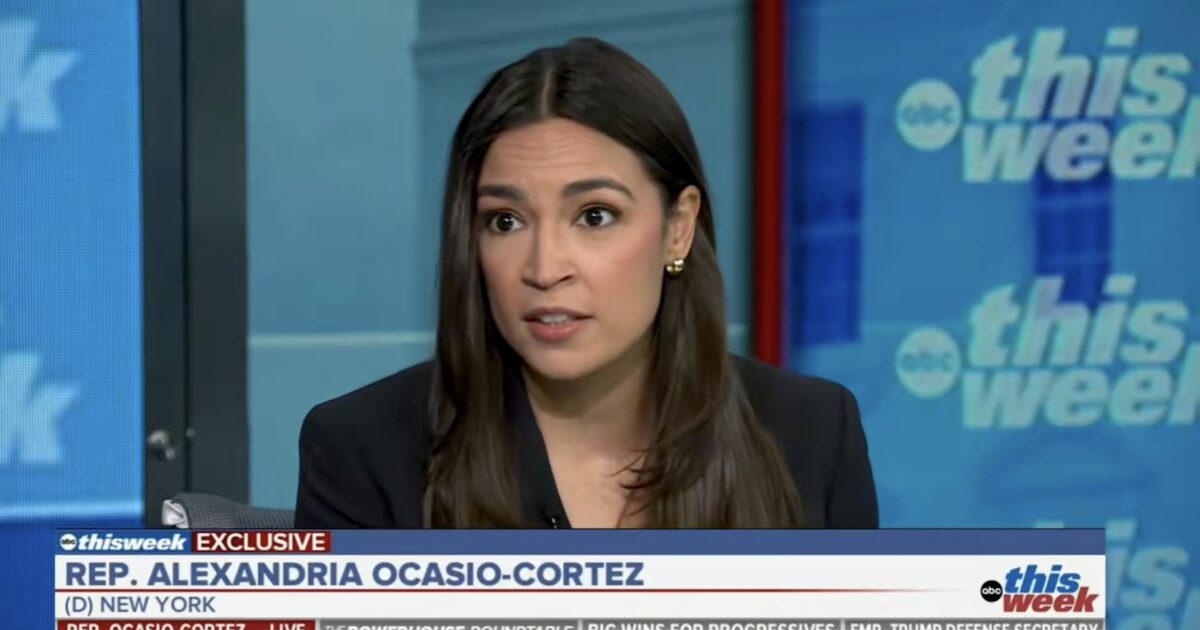

The Sunday morning interview started the way most of them do. Polite. Measured. Two people in studio chairs, a camera light, the familiar rhythm of a political sit-down that viewers have seen a thousand times before.
Then the anchor picked up a piece of paper.
ABC News chief Washington correspondent Jonathan Karl had come prepared with something Rep. Alexandria Ocasio-Cortez does not get asked about often on national television: the written platform of the Democratic Socialists of America, the organization the New York congresswoman has long been associated with.
The List He Read Out Loud
Karl went through it item by item.
- Abolish the police.
- Abolish prisons.
- Amnesty for everyone in the country illegally.
These are not talking points invented by a critic in a green room. They are positions that appear in DSA materials, and Karl laid them out plainly, one after another, before turning the question back on his guest.
Does she agree with them?
It is the kind of moment that makes a press aide sit up straight. For years, Republicans have argued that the progressive wing of the Democratic Party holds views far outside the American mainstream. For just as many years, Democrats have answered that the charge is a caricature — a right-wing straw man built out of fringe social media posts and cherry-picked quotes.
But Karl was not reading from a social media post. He was reading from the group’s own platform. And he was doing it on ABC, in front of a Sunday audience that skews older, more moderate, and far more likely to vote than the crowd on X.

Two Words That Set Off a Firestorm
Ocasio-Cortez did not take the list on point by point. She did not renounce it, and she did not embrace it either.
Instead, she reached for a framing that has now traveled far beyond the studio: Americans, she said, simply are not interested in these “academic debates.”
Academic.
That single word is doing an enormous amount of work, and it is exactly the word critics seized on within minutes of the broadcast. To her supporters, it was a sensible refusal to be dragged into a debate about a platform she did not personally write, at a moment when voters are focused on grocery bills, rent, and health care costs.
To her critics, it was something else entirely — a sitting member of Congress waving away the abolition of police and prisons as a faculty-lounge thought experiment rather than a policy question with consequences for every neighborhood in the country.
Why This Clip Is Not Going Away
Conservative outlets, including The Gateway Pundit, circulated the exchange almost immediately, calling the response “wild.” The clip spread the way these things always do now: stripped of context by some, replayed in full by others, argued over by everyone.
There is a reason it landed so hard.
Crime and immigration are not abstractions to voters over 50. They are the reasons people move, the reasons they install cameras, the reasons they call their adult children before a night out downtown. When a public official calls the debate over those subjects “academic,” it does not read as strategy. It reads as distance.
Ocasio-Cortez remains one of the most recognizable figures in American politics and one of the most persistent lightning rods within her own party — a coalition still arguing with itself over how far left it can go before the middle stops listening.
Karl’s question was, in the end, a simple one. What her answer means for that argument is anything but.