
Part 1 — The Photograph and the Heat
On Father’s Day, my younger brother walked into our father’s kitchen, set a printed invoice on the table, and said he wanted $41,880 for taking care of me.
I picked it up, held it toward the window because my eyes are what they are, read it twice, and set it back down without a word.
He was still talking when my hand went to the shoebox on the counter — the one I had opened for the first time in years that same morning.
To understand why a piece of paper from 1974 mattered more than his invoice, you have to know what happened in this house in August of 1973.
I am seventy-one years old, my name is Wayne Evans, and I have cleaned other people’s houses for fifty-three of those years in a coastal fishing town in Virginia.
I am seventy-one years old, and I have cleaned other people’s houses for fifty-three of those years. My name is Wayne Evans. I live in a coastal fishing town in Virginia, in the same shingled house my father bought in 1961 with money he earned pulling crab pots until his hands cracked open every winter.
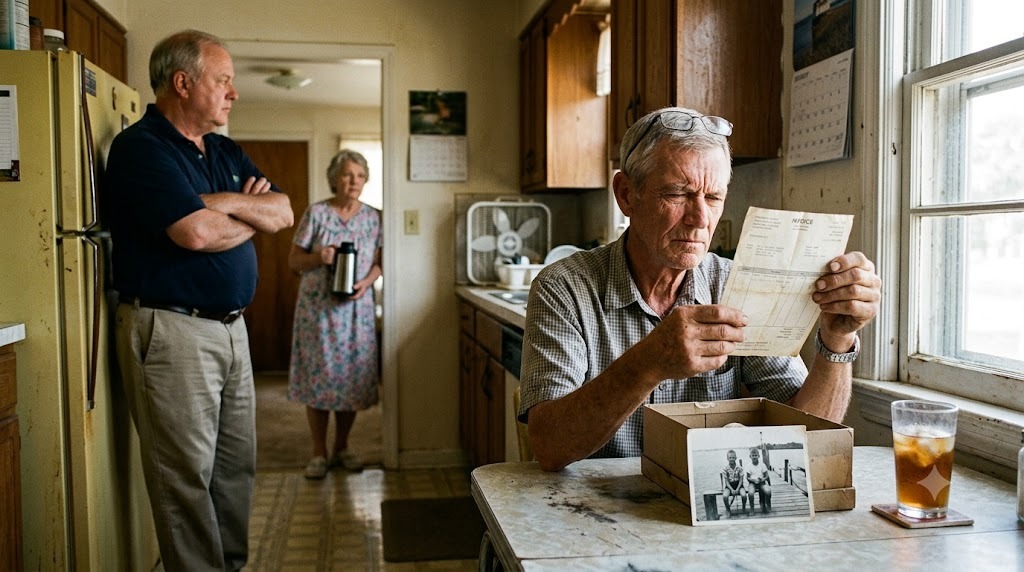
On the morning of Father’s Day, I sat at the kitchen table with an old photograph in my hands. The heat had already come in through the windows — we were three weeks into a dry summer heatwave, the marsh grass gone the color of straw, the creek behind the house shrunk down to a brown ribbon. The photograph was black and white, taken in 1971. Two boys on a dock. The taller one, sixteen, holding a track trophy against his chest like it might get away from him. The shorter one, eleven, squinting into the sun.
The taller boy was me. The shorter one was my brother Brett.
I keep that photograph in a shoebox with everything else that matters, which is not much. A funeral card. A hospital bracelet. And a stamped savings bond, issued in 1974, in an envelope so old the glue had turned brown and given up entirely.
I hadn’t looked at the bond in years. That morning I did, because I had a feeling in my chest I couldn’t name yet, and old paper is what I reach for when I can’t name a thing.

Brett was coming at noon. He comes every Father’s Day, because his wife makes him, and because he likes to stand in our father’s kitchen and tell the story of his life the way he has decided it happened.
In Brett’s version, he was the one who stayed. He was the one who carried the family. He tells it at every gathering, to nieces and nephews and church people and once to a woman from the county paper: “My brother left. I stayed and took care of Daddy.”
Here is what actually happened, and I am going to say it once, plainly, and then I am going to tell you about the bill.
In the spring of 1973 I was a senior at the county high school and I ran the 800 meters faster than any boy in the state of Virginia had run it in eleven years. I have the newspaper clipping. State champion. Two schools offered to pay for me to come run for them — one of them a real university, four years, tuition and board, a piece of paper with my name on it that would have made me the first Evans to hold a degree.
In August of that same year my father’s boat took water off the point and he went in with it. They pulled him out alive but the cold and the pressure did something to his spine that no doctor in 1973 knew how to fix. He came home in a chair. My mother was already gone — she died when Brett was four, and I remember her mostly as a smell of laundry soap and a voice singing off-key in the next room.
So there was a man in a chair, and there was an eleven-year-old boy, and there was me, seventeen, with a scholarship letter in my dresser drawer.
I did not tell anybody I was turning it down. I just did not answer the letter. I got a job cleaning the Baptist church and then two rental cottages on the water and then, eventually, half the summer houses on that stretch of coast. Housekeeper. That is what the tax forms said for five decades. Housekeeper.
I raised Brett. I got him through school. I paid for his class ring and I paid for the tuxedo he wore to prom and when he wanted to go to community college in Norfolk I drove him and I paid the first two semesters out of a coffee can under the sink.
And somewhere along the way — I still don’t know exactly when — Brett decided a different version was easier to live inside. He decided I had left. He decided he had stayed.
He was eleven. Maybe he honestly does not remember. I have made peace with that possibility about four hundred times and un-made it about four hundred and one.
Our father lived nineteen more years in that chair. I bathed him. I turned him at night so he wouldn’t get sores. When he died in 1992 he held my wrist and said, “The bond, Wayne. Don’t let it get lost.” I thought he was confused. He was on a lot of morphine by then.
So that was the morning of Father’s Day. Me, seventy-one, arthritic in both knees, sitting in a hot kitchen with a photograph and a savings bond and a brother due at noon.
What I did not know yet was that Brett wasn’t coming to eat.
Part 2 — The Bill
I need to tell you about Delia Marsh first, because you can’t understand what Brett did unless you understand what he was charging me for.
Three years ago my eyes went bad enough that the doctor in Norfolk told me I had no business behind a wheel anymore. I had cataracts in both eyes and a heart that needed watching and appointments in Norfolk twice a month, which is fifty-one miles each way from our town.
I did not tell Brett. He lives eight minutes away.
What happened instead is that a woman from the church I’d cleaned for thirty years — Delia, sixty-eight, a retired school cafeteria manager with a Buick the color of an old nickel — knocked on my door one Tuesday and said, “I hear you got appointments.”
I said I’d manage.
She said, “That’s not what I asked.”
She drove me that day and every appointment after it for three years. A hundred and four miles, round trip, twice a month, thirty-six months. She would not take gas money. She said the church had a fund for it and I believed her for about a year and a half before I found out there was no fund and never had been.
On those drives Delia learned more about me than my brother has learned in six decades. She knew I couldn’t sleep past four. She knew I still counted laps in my head when I was nervous — one-eighty, one-eighty-two — a habit from a track I hadn’t run on since 1973. She never asked why. She just let me count.
She brought me a thermos of coffee every single time and she never once, in three years, let me sit alone in a waiting room.

Brett found out about Delia last spring. I know exactly how, because his wife let it slip at the pharmacy.
And something in him turned.
He started calling more. Started saying things like “You should have come to me” in a voice that wasn’t hurt, exactly. It was something closer to inventory. Like he was counting up what he was owed.
Then, on Father’s Day, at 12:20 in the afternoon, my brother Brett Evans walked into our father’s kitchen, did not sit down, and put a piece of paper on the table in front of me.
It was an invoice. Typed. Printed on his home printer with a little clip-art border.
Family Care Services Rendered — W. Evans.
He had itemized it. Mileage to Norfolk at the federal rate, which he had looked up, for three years of appointments he had not driven me to — because, he explained, he “would have driven me, if I’d asked, so the value is the same.” Property taxes on the house, which he had paid twice in 2019 and 2020 when I was short. A number for “coordination and family oversight.”
The total at the bottom was $41,880.
“I’m not trying to be ugly about it,” Brett said. He was looking at the refrigerator, not at me. “But I’ve been carrying this family my whole adult life and nobody has ever once put a number on what that costs. You want a stranger driving you around, that’s your business. But then you don’t get to also have me. Somebody’s got to be honest about the accounting.”
I sat there. Seventy-one years old. In the kitchen where I turned our father over at two in the morning so his skin wouldn’t break down.
I want to tell you I said something. I want to tell you I stood up and made a speech.
What I actually did was pick up the invoice, hold it out where the light was better because my eyes are what they are, and read it twice. Then I set it down and I said, “You want the house.”
He said, “I want what’s fair.”
“Say it plain, Brett.”
He said the house was worth four hundred thousand now, waterfront, and that I was seventy-one and couldn’t keep the roof up and it made sense to “put it in the family’s name properly” and settle the balance that way. He’d already spoken to a lawyer. He said that part quickly.
He also said — and this is the part I still hear when I can’t sleep — “Let’s be honest, Wayne. You weren’t here for the hard years. I was.”
Eleven years old. Class ring. Prom tuxedo. Coffee can under the sink.
I did not correct him. Not right then. I have found that correcting Brett is like trying to bail out the creek with a spoon.
Instead I asked him one question. I asked if he remembered a savings bond.
He said, “What?”
I said, “Nineteen seventy-four. Daddy bought a savings bond.”
Brett said he didn’t know anything about any bond and that this was exactly the kind of deflection he expected, and he left the invoice on the table and drove home.
He never asked why I mentioned it.
That is the whole shape of my brother, right there. He has never once asked why.
Part 3 — What Daddy Did in 1974
I sat with that invoice until the light went orange. Then I got the shoebox.
Here is what my father did in October of 1974, fourteen months after he came home in the chair, when I was eighteen and had already stopped answering the university’s letters.
He bought a savings bond. Not with money he had — he had none. He sold his father’s shotgun and the last two good crab pots and he had Delia’s late husband, who worked at the bank branch on Main Street, walk the paperwork through.
He did not tell me. He put it in the shoebox and told me only, nineteen years later on his deathbed, don’t let it get lost.
I had assumed, all those years, that it was a savings bond and nothing more. Two hundred dollars, matured decades ago into maybe eight hundred. Sentimental. Not important.
What I had never done — because my eyes were bad, because I am not a paperwork man, because for fifty years there was always a house to clean — was take the envelope to somebody who reads documents for a living.
That Tuesday, Delia drove me to Norfolk. Not to the cardiologist. To a legal aid office for seniors that she found by making eleven phone calls she never told me about.
The lawyer, a woman maybe thirty-five, went through the envelope twice. Then she asked if I knew what was folded behind the bond.
It was a deed. Recorded, stamped, filed with the county in 1974, and never once superseded.
My father had transferred title to that house — the land, the shingled house, the two hundred feet of waterfront — into my name, alone, in October of 1974. Wayne Evans, sole owner. Fifty-two years ago. He had done it in the same month he sold his shotgun, one year after I quietly did not answer a letter that would have taken me out of that town forever.
He knew. He never said a word about it in nineteen years of me lifting him in and out of that chair, but he knew what I’d given up, and in the only way a broken man with no money could, he wrote it down and made it legal and put it where he thought I’d find it.
Every property tax bill Brett ever paid, he paid on a house that had been mine since before he was old enough to shave.

I want to be clear about what happened next, because I think people expect a courtroom.
There was no courtroom. There was me, alone, in a lawyer’s office in Norfolk, being told I had three options. I could file for recovery of the taxes Brett paid, and win. I could pursue him for attempted fraud, and probably win that too, and put my brother in front of a judge in the county where our name has been on things since 1908. Or I could do nothing at all.
The lawyer told me to take a week. I took eleven days.
What I did, on the twelfth day, was this.
I had her draft one letter. It stated the deed, the date, and the recording number. It stated that the invoice presented to me on Father’s Day had no legal standing. It stated that I would not be pursuing the taxes he had paid, and that I considered that debt settled between us permanently. And it stated the one condition: that Brett stop telling people I left.
Not that he apologize. I’m too old to want an apology. Just that he stop saying it out loud, in this town, at family tables, to my nieces.
I mailed it myself. Delia drove me to the post office and waited in the car.
He has not spoken to me since. That was fourteen months ago. His wife sends a card at Christmas. I understand that I chose this — that if I had simply eaten the invoice and let the story stand, I would still have a brother, of a kind. There is a cost to the thing I did and I pay it every Sunday when I see the back of his head at the eight o’clock service and he does not turn around.
But he stopped saying it. I hear from three different people that he stopped saying it.
Now here is the last thing.
In 1974, the man who walked my father’s paperwork through the bank on Main Street — who did it after hours, for free, for a crippled crabber with no money and no idea how any of it worked — was a teller named Harold Marsh.
Delia’s husband. Dead twenty-two years. She never knew he’d done it. I only found out because his initials were on the back of the deed.
So in October I put the house in a life estate. I keep it until I die. Then it goes to Delia Marsh, or to her children if she’s gone before me. She fought me on it for two hours in that same kitchen, said it was too much, said she only drove a car.
I told her the truth. I told her that in 1974 a stranger did a kindness for my father that took him twenty minutes and took me fifty-two years to find. And that in 2023 that stranger’s widow knocked on my door and asked about my appointments.
I told her I have been alone in this house since 1992 and that for three years, twice a month, somebody has handed me a thermos of coffee and let me count laps in my head without asking why.
The savings bond is still in the shoebox. It matured a long time ago. It is worth about nine hundred dollars and I have never cashed it and I am not going to.
Some things you keep because of what was folded behind them.