
Part 1 — The Tackle Box on the Porch
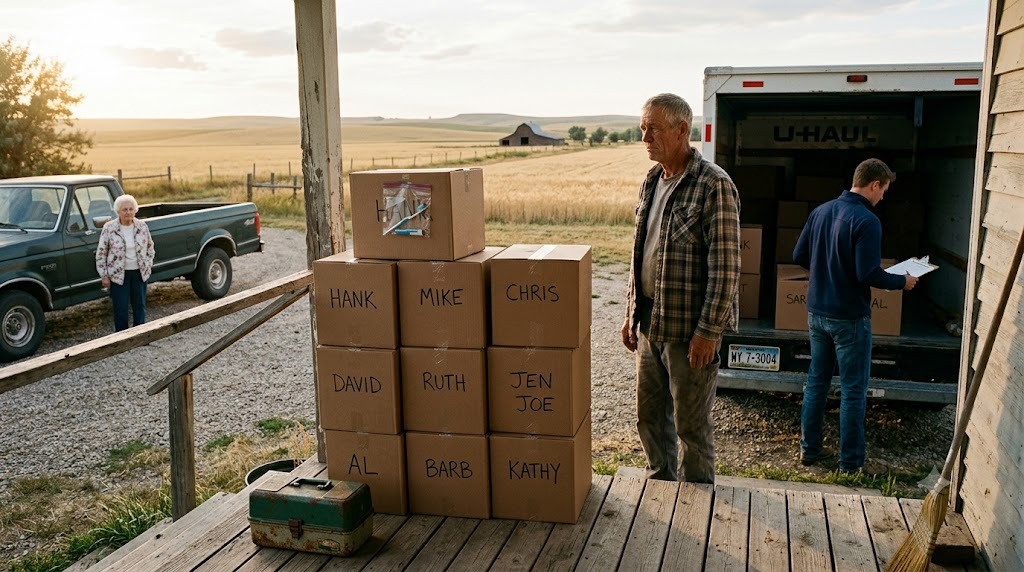
My toothbrush was in a Ziploc bag, taped to a cardboard box on my father’s porch. Eleven boxes. Every one of them labeled MARTIN in black marker.
I set down my keys, looked at my brother’s clipboard, and said nothing at all.
Behind him, through the open front door, one thing in that emptied house was still blinking — and it had been blinking for years.
I was sixty-four years old that Father’s Day, and I had spent the last four of them living in that house so our father would not die alone in it.
To understand why my brother could stand there and believe he was the one who had been wronged, you have to go back fifty-three years, to a green metal box that never held a single fishing lure.
The first thing Martin Morris remembered about the rusted fishing tackle box was that it had never held a single fishing lure.
He was eleven years old, and his father, Walter, had come home from the feed store in Sheridan County with the box under one arm and a look on his face like a man who had gotten away with something. It was green metal, already scratched, already going orange at the hinges. Walter set it on the kitchen table and opened it, and inside there were no hooks, no line, no bobbers. There were three arrowheads from the north pasture. A spark plug. A folded dollar bill from 1961. A photograph of their mother squinting into the sun.
“A man needs a place for the things nobody else would keep,” Walter said.
Trevor was seven then. He reached for the arrowheads, and Walter let him hold them, and Martin remembered feeling no jealousy at all, only a warm and uncomplicated pride that his little brother got to touch the good things too.
That was the version of the family Martin carried for fifty-three years. He would learn, eventually, that Trevor carried a different one.

Martin was sixty-four now. He had spent the last nine years as a hospice volunteer, driving the long gravel roads of a rural farming county in Wyoming to sit with people in their last weeks. He was good at it. He had a talent for silence. He knew how to be in a room where nothing could be fixed, and he knew that most people, at the end, did not want advice. They wanted a witness.
He had learned that from his father, who had been dying slowly for four years in the same farmhouse he was born in.
Martin had moved back in during the second winter. He handled the morphine schedule, the hospital bed in the front parlor, the oxygen concentrator that hummed like a refrigerator. He learned which nurse to call and which to avoid. He learned to read his father’s breathing the way you read weather.
He also learned the shape of a phone that does not ring.
Trevor lived in Denver. He had a good job in commercial real estate, a second wife, a boat. He called on Christmas, sometimes, and when he called he asked questions that sounded like a man reading from a checklist. Is he comfortable. Is the house holding up. Are you getting any help. Martin always said yes to the last one, which was a lie, and Trevor always accepted it, which was the part that stung.
Nine years. Trevor had not stood in that house in nine years.
Walter died on a Tuesday in early June. Martin was holding his left hand. The sun was still up.
Six days later, on Father’s Day, Martin drove back from a hospice visit in the next county and turned into the long driveway at five in the afternoon, when the light comes across the wheat in that flat gold Wyoming way that makes even a broken fence look holy.
There was a rented box truck backed up to the porch.
Martin got out slowly. He was a slow man by then, in his body and in his temper. He walked up the steps and saw that the parlor had been emptied. The hospital bed was gone. The braided rug was rolled and taped. His father’s chair — the one with the worn spot on the right arm where Walter had rubbed his thumb for forty years — was on the truck, on its side, under a moving blanket.
And on the porch, stacked and labeled in black marker, were eleven cardboard boxes containing every object Martin owned.
MARTIN — CLOTHES. MARTIN — BOOKS. MARTIN — MISC.
His toothbrush was in a Ziploc bag taped to the top of one of them.
Trevor came around the side of the house with a clipboard. He was wearing a quarter-zip and boat shoes and he looked, Martin thought, like a man who had come to a funeral by way of a golf course.
“There you are,” Trevor said. “I’ve been calling.”
Martin did not answer. He was looking at the boxes.
“I know how this looks,” Trevor said. “But somebody had to start. The estate’s going to take a year if nobody moves, and you’ve been — Martin, you’ve been in this house four years. You’re not seeing it clearly. I am.”
“You packed my things.”
“I packed the house.”
“You packed my things without asking me.”
Trevor sighed the sigh of a reasonable man in an unreasonable world. “You want to have this conversation now? Fine. Let’s have it. Dad’s care, the whole last stretch of it — you made every call. Every single one. The DNR, the feeding tube, the hospice referral, all of it. You never once brought me in.”
And there it was.
Martin felt something rise in him, hot and clean, and he took hold of it the way you take hold of a horse’s halter. He did not raise his voice. He never had.
“I called you,” he said. “Eleven times in one week, in February of last year, when he stopped eating.”
“I don’t have any record of that.”
“I called you the night before we started hospice.”
Trevor’s jaw moved. “What I remember,” he said, “is a brother who moved into our father’s house and took over. What I remember is being cut out. And I’m not going to pretend otherwise just because it’s Father’s Day and you want to feel like the good son.”
Martin stood there in the golden light with his toothbrush in a plastic bag six feet away and understood something that took the strength out of his knees.
Trevor was not lying.
Trevor had told himself this story so many times that it had become the truth in his own house — told it to his wife, to his colleagues, probably to a therapist. The version where Martin was the controlling one. The version where Trevor had been shut out of his own father’s death.
His brother had rewritten the family history, and he had done it so thoroughly that he could stand on their father’s porch on Father’s Day, beside a truck full of a dead man’s furniture, and believe he was the wronged party.
“Where’s the tackle box?” Martin asked.
Trevor blinked. “The what?”
Part 2 — The Machine Nobody Turned Off
The neighbors came at six.
That is what happens in a rural farming county. Ruth Bledsoe saw a box truck at the Morris place and called her son, and her son called the Andersens, and by six-fifteen there were four vehicles in the driveway, because everyone in a fifteen-mile radius had brought Walter Morris a casserole at some point in the last four years and everyone had seen exactly one Morris son carrying it inside.
Trevor handled them beautifully. Martin had to admit that. He shook hands, he thanked people for their kindness, he said the word “closure” twice. He said the family had decided it was time to move forward. He said the family in a way that included exactly one person.
Ruth Bledsoe, who was eighty-one and had buried two husbands, looked at the eleven boxes on the porch labeled with Martin’s name and then looked at Martin and said nothing at all, which was its own kind of statement.
Martin went inside.
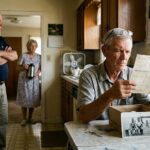
The parlor was stripped to the floorboards. The wallpaper had a bright rectangle where the bed had been. In the corner, on the little telephone table that Trevor’s crew had apparently judged too worthless to load, sat the answering machine.
It was a Panasonic from 1996. Cream plastic gone the color of weak tea. Walter had refused every attempt to replace it. He had refused a cell phone, refused voicemail, refused the entire twenty-first century, and Martin had stopped fighting him about it around year two.
The red light was blinking.
Martin sat down on the floor because there were no chairs left. He set the rusted tackle box down beside him — he had found it exactly where he expected, on the top shelf of the hall closet, still holding three arrowheads and a spark plug and a 1961 dollar and a photograph of their mother squinting into the sun. Trevor’s crew had missed it entirely. Of course they had. It looked like junk.
He pressed play.
The machine did what those machines do — the clunk, the whir, the sound of tape.
The first message was from the pharmacy in 2019.
The second was a wrong number.
The third was his own voice, from four years ago, telling his father he’d be late because of the snow.
Martin sat on the floor of the empty parlor and listened to the whole tape, all forty minutes of it, while outside the light went from gold to amber to the deep blue that comes after. He listened to his mother’s cousin. He listened to a church directory update. He listened to a man from the county extension office in 2021.
And then, at minute thirty-one, he heard Trevor.
“Dad. It’s Trevor. Hey. Martin’s been calling me about — look, about the hospice thing, the paperwork, whatever it is he wants me to sign.”
A pause. The sound of a car, a turn signal.
“I’m gonna be straight with you, because you always were with me. I don’t want any part of the decisions. I don’t want to be the one who signs the paper that says stop. I can’t do it and I’m not going to pretend I can. So — Martin handles it. That’s what I’m saying. Martin handles all of it and I’m fine with whatever he decides, and if anybody asks me later I’ll say the same thing.”
Another pause. Longer.
“I know that’s not — I know what that makes me. Tell Marty I said thanks. Or don’t. Happy Father’s Day, Dad. I’ll come out in the fall.”
The date stamp, in the machine’s flat robot voice: June eighteenth, two thousand twenty-three.
Father’s Day. Two years ago to the week.
Martin did not move for a long time.
He thought about what he had in his hands. He had, in a cream-colored plastic box with a blinking red light, the demolition of his brother’s entire self-image. Not a memory. Not a contested recollection. Trevor’s own voice, timestamped, saying the exact opposite of everything he had said on the porch three hours ago.
He thought about the four vehicles in the driveway. He thought about Ruth Bledsoe.
He thought about how easy it would be.
And then he thought about his father, who had heard that message and never once mentioned it to Martin. Not in the eighteen months he had left. Not when he was lucid and not when he wasn’t. Walter Morris had received his younger son’s confession of cowardice and had chosen to keep it in the same place he kept arrowheads and spark plugs and a dollar from 1961.
A place for the things nobody else would keep.
Martin unplugged the answering machine, wound the cord, and put it in the rusted tackle box. It just fit, with the lid pressing down.
Then he carried the box out to his truck, and he went back for his eleven cardboard cartons, and he loaded every one of them himself while his brother stood on the porch and watched and did not offer to help.
“Where are you going?” Trevor called.
“Ruth’s got a room over the garage.”
“Martin. Come on. This is what I mean. This is exactly what I mean — you make it a whole thing—”
Martin closed the tailgate.
“Trevor,” he said. “I’m not going to fight you for the furniture.”
And he drove out the long driveway in the dark.
Part 3 — What the Silence Cost
Here is what people get wrong about restraint: they think it’s free.
It cost Martin the farm. Not legally — the will split it evenly — but practically, because Trevor had a real estate lawyer in Denver and Martin had a hospice volunteer’s savings account, and by October the property was listed and by January it was sold to a man from Casper who wanted the water rights. Martin’s share came to enough for a small house in town and not much else.
It cost him the county, some. Not everyone, but some. Because Trevor told his version at the funeral reception, and he told it at the estate sale, and a version told confidently by a man in a quarter-zip travels further than no version at all. There were people at the Methodist church who started being a little too kind to Martin, in the way people are kind to someone they’ve decided is difficult.
Ruth Bledsoe was not one of them. Ruth said, once, over coffee: “You could say something.”
“I could.”
“You won’t.”
“Not to you and not to them,” Martin said. “If I have to prove I loved him, then I didn’t.”

It cost him three years.
Trevor came back on a Sunday in April. Martin’s house in town, the small one, kitchen table, two chairs. Trevor looked older in a way that had nothing to do with time. The second wife was gone. The boat was gone. He had, he said, been talking to someone. A professional.
“She keeps asking me why I was so angry,” Trevor said. “At the house. That day.”
Martin waited.
“I kept telling her the story. About how you shut me out. And I’ve told it so many times, Marty. I’ve told it so many times that I—” He stopped. He put both hands flat on the table. “I called Dad. Didn’t I. Before all of it. I called him and I told him I didn’t want to decide.”
“Yes.”
“I’ve known that the whole time.” Trevor’s voice cracked and he let it. “I’ve known it the whole entire time and I built a whole other thing on top of it so I wouldn’t have to look at it. And you let me. You stood there and you let me say it and you didn’t—” He looked up. “Why didn’t you say anything?”
Martin got up. He went to the hall closet. He came back with the rusted tackle box and set it on the table between them and opened it.
Three arrowheads. A spark plug. A dollar from 1961. Their mother, squinting.
And a cream-colored answering machine from 1996.
“It’s on there,” Martin said. “Your message. June eighteenth, twenty twenty-three. Dad heard it and he kept it and he never told me, and I found it the night you packed my toothbrush in a sandwich bag.”
Trevor stared at the machine like it was a live animal.
“You had it. That whole day. With Ruth out there, and the Andersens—”
“I had it.”
“You could have destroyed me.”
“Yes,” Martin said. “That’s what I’ve been carrying, Trev. Not the message. The choice not to play it. Every week for three years I’ve had to choose it again.”
He closed the lid.
“I’m not giving it to you,” he said. “You don’t get to take it home and lose it. It stays in the box. It stays where Dad put it. But you’re going to know it’s here, and you’re going to know I know, and that’s the arrangement. That’s what I’m willing to do.”
“What do you want from me?”
Martin thought about it for a long moment.
“I want you to tell it right,” he said. “Not to me. To them. To Ruth, to the Andersens, to whoever you told it wrong to. You don’t have to play the tape. You just have to stop telling the other version.”
Trevor did it in May, badly, at a Methodist church potluck, standing next to a folding table of deviled eggs with his hands shaking. He said he had not visited his father in nine years. He said his brother had done all of it alone. He said he had come home on Father’s Day and packed his brother’s belongings onto a porch without asking, and that he had done it because it was easier to be angry than to be ashamed.
Nobody said anything. Ruth Bledsoe kept her eyes on him the entire time. That was worse than shouting.
Martin did not stand up. He did not accept the apology publicly and he did not refuse it. He sat with his coffee and let his brother finish, and afterward he put a hand on Trevor’s shoulder for about three seconds on the way to the parking lot, and that was all.
They are not close. Martin does not expect they ever will be. Trevor calls in November and around Father’s Day, and the calls are short and careful, and something in them is finally true.
The tackle box sits on the top shelf of Martin’s hall closet in the small house in town. He is sixty-seven now and still driving the gravel roads, still sitting with the dying, still good at silence.
Sometimes, when a family is fighting in a hallway outside a room where their mother is going, Martin will find himself thinking about a man who heard his son say I can’t do it and never held it against him, never used it, never even mentioned it — who just put it away with the arrowheads and the spark plug and the dollar bill.
A place for the things nobody else would keep.
Martin never turned the machine back on. But he never erased it, either.