
Part 1 — The Waiting Room Where I Was Not Family
The nurse looked past me at his son and asked who was family. “That’s Ruth,” Jason said. “She’s a friend of my dad’s.”
I sat back down in the mustard-colored chair, folded my hands, and let a stranger explain my husband’s heart to a man who hadn’t visited since Easter.
Eleven weeks later, at a table set for thirty, one person set down a glass with both hands shaking — and Jason stopped talking mid-sentence.
But you can’t understand what happened at that table without knowing what a side door is, or what it costs to walk past one. So let me go back to the beginning.
My name is Ruth. I’m sixty-eight, and eleven months before that hospital waiting room, I married Herbert Cooper, seventy-four, who spent fifty-one years as a welder at the shop off Center Street.
The fog came down over the canyon that Tuesday morning like a sheet somebody had thrown over the whole town, and I remember thinking it was fitting. You couldn’t see the university on the hill from our street. You couldn’t see our street from the university. In this town, that’s how it always was — the big stone houses up where the money lived, and the little frame houses down by the rail line where the rest of us stayed put and paid our taxes and shoveled our own walks.
My name is Ruth. I’m sixty-eight years old, and eleven months ago I married Herbert Cooper, who is seventy-four and spent fifty-one years as a welder at the shop off Center Street. Herbert’s hands look like a topographic map. He can still lay a bead so clean you’d think a machine did it. He proposed to me on a folding chair in his own garage with a cup of gas-station coffee going cold beside him, and I said yes before he finished the sentence.
That Tuesday I was sitting in a hospital waiting room with vinyl chairs the color of old mustard, and a young woman with a clipboard came out and said, “Family of Herbert Cooper?”
I stood up.
She looked at her clipboard. Then she looked at me. Then she looked past me, at the man who had come in twenty minutes after I did — Jason Cooper, Herbert’s son, forty-one years old, in a quarter-zip pullover that cost more than my winter coat.
“You’re listed as the contact,” she said to Jason.
“That’s right,” Jason said.
“And this is—”
“That’s Ruth,” Jason said. “She’s a friend of my dad’s.”
I want you to understand something. I did not make a scene. I sat back down in that mustard-colored chair and I folded my hands in my lap and I listened to a stranger explain my husband’s heart to a man who had not been in that house since Easter. I heard the words ejection fraction and we’ll want to keep him overnight secondhand, over a shoulder, the way you hear weather on somebody else’s radio.
I had been married to Herbert for eleven months. Jason had been calling me “Dad’s friend” for all eleven of them, and correcting anybody who said otherwise, and I had let him, because Herbert had said give him time, Ruthie, he lost his mother, and I am a patient woman, and because — and here is the part I’m ashamed of — because a woman who marries at sixty-seven learns fast that half the world thinks she’s a thief.

Herbert came home Thursday. I drove him. I set up the recliner in the front room because the stairs were done for him now, and I put the good pillow behind his back, and I pulled the quilt over his knees.
That quilt. I have to tell you about the quilt.
Herbert’s mother started it in 1961. His first wife, Eleanor, added to it. There’s a square of a boy’s church shirt in it, and a square of a work apron, and a piece of a dress somebody wore to a funeral in 1978. When Herbert and I married, he brought it out of the cedar chest and put it in my lap and said, “You get to add to it now.” So I did. I cut a square out of the sleeve of my mother’s housecoat and I sewed it into the bottom corner, crooked, because my eyes aren’t what they were. Herbert looked at that crooked square for a long minute and then he laughed until he had to sit down.
That’s what a family is. It’s a thing people keep adding to, crooked squares and all.
So for the eleven weeks after that hospital visit, I was the one who added to it. I was the one who learned the pill schedule and wrote it on an index card taped inside the cupboard door. I was the one who got up at two in the morning when his breathing went wrong. I was the one who drove him to cardiology in Salt Lake and sat in the parking garage doing crosswords for three hours. I was the one who washed him, God help me, when it came to that, and never once let him see my face while I did it, because a man like Herbert would rather die than be pitied by his wife.
Jason came four times. I counted. He came with a rotisserie chicken and a lot of opinions about the temperature of the house.
And every time he came, he’d stand in the doorway of the front room, look at me sitting there with that quilt across both our laps, and say something like: “You’re an angel, Ruth. Really. We’re all so grateful for what you do for him.”
What you do for him. Like a service. Like I was billing by the hour.
Part 2 — The Side Door
Thanksgiving that year was Jason’s idea, and it was the first warning shot I should have heard clean.
He and his wife had bought up on the bench — one of those houses with a stone front and a three-car garage and a view down over the whole valley, over the fog, over people like us. He called Herbert on the second Sunday in November and said he wanted to host. Big dinner. Thirty people. The Coopers, the in-laws, some of his colleagues from the university, a couple of donors.
“Donors,” Herbert said to me after he hung up. “At Thanksgiving.”
“He’s proud of you,” I said, because that’s the kind of lie you tell a sick man.
The Tuesday before, Jason came by. He sat on the edge of the couch, which is how you sit when you’re not staying, and he said there was just one thing about the layout of the house.
“The front entry’s going to be crowded,” he said. “Coats, greeters, the whole flow. And Dad’s chair — the wheelchair — it’s a lot to get through there with people watching.”
“He can walk in,” I said.
“I know he can. I’m saying it might be easier. There’s a side entrance by the mudroom. Comes right up into the dining room. No stairs, no crowd. Nobody has to watch him work at it.”
I looked at him. “Nobody has to watch.”
“Right.”
“Jason,” I said, “is it that nobody has to watch him, or is it that nobody has to see him?”
He did the thing where he laughed with only the bottom half of his face. “Ruth. Come on.”
“And me?”
“You’d come in with him, obviously. It’s the same door.”
The same door. Around the back, past the trash cans, through the mudroom with the boot tray, and up into the dining room after everyone was already seated and already holding a glass of something. So the donors and the colleagues wouldn’t have to see the old welder with the oxygen line, or the woman in the department-store blouse who came with him.
I said we’d think about it. Then I went into the kitchen and stood with both hands on the counter for about four minutes without moving.
Here’s what I want the younger women reading this to understand. It wasn’t the door. Doors are just doors. It was that I had spent eleven weeks learning the exact angle to hold a man’s shoulders so he could breathe at three in the morning, and my reward was to be routed past the garbage so I wouldn’t spoil the photographs.

Herbert took a turn the Sunday before Thanksgiving and he did not come back up from it.
I called Jason at eight in the morning. He said he’d try to come by that afternoon. He came at seven at night, stayed twenty-five minutes, took a phone call in the driveway, and left.
You want to know who was there?
Dolores from across the street, who is seventy-nine and brought soup nobody could eat. Mr. Whitmore from two doors down, who sat with Herbert so I could sleep for four hours. Ray Nunez, who ran the shop with Herbert for twenty years and who read the sports page out loud to a man who could no longer answer. And Curtis Pike, who used to deliver our mail on this street for nineteen years before he retired, and who came every single morning at seven forty and sat in the kitchen and cut up an apple even though nobody was going to eat it, because that was the thing he could do.
Friends and neighbors. That’s who was in the room. That’s who is always in the room, and if you’re my age you already know this and you already know that nobody says it out loud, because it embarrasses the people who weren’t there.
Herbert died on the Tuesday before Thanksgiving, a little after six in the morning, in the fog, with that quilt over him and my hand on his chest and Curtis Pike standing in the kitchen doorway with an apple and a paring knife, crying without making a sound.
Jason arrived at nine forty. The first thing he said, standing in the front room, looking around at the recliner and the oxygen tank and the index card taped to the cupboard, was:
“Okay. Okay. So Thanksgiving’s obviously still on. He’d want that. And Ruth — you should still come. Come with Dolores. Use the side door, it’s just simpler.”
Part 3 — Thursday
I went.
Everybody asked me later why, and the answer isn’t noble. I went because Herbert had asked me to be kind to his son, and because I wanted to see it — the whole apparatus of it — with my own eyes, one time, before I decided what I was going to do.
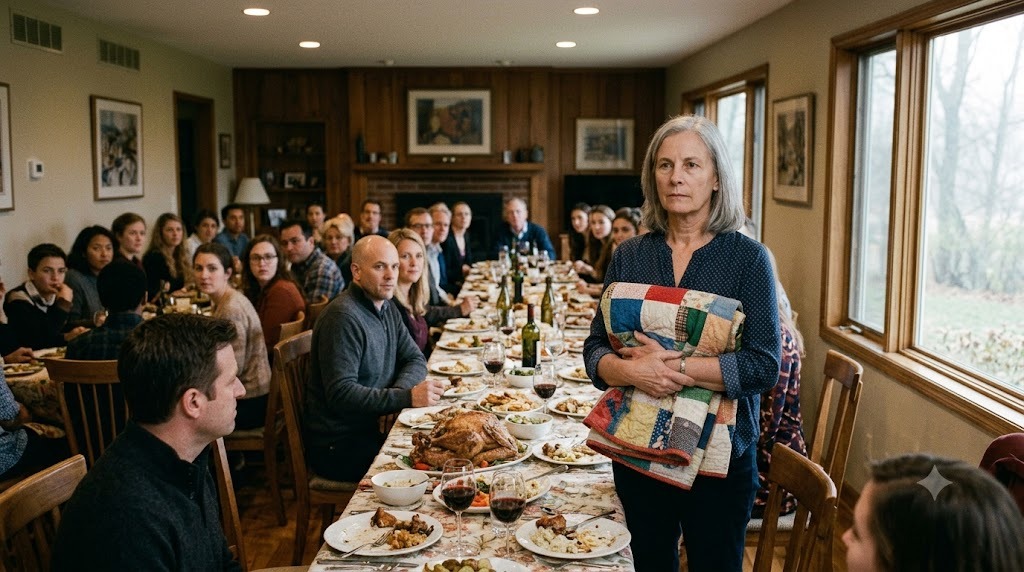
I brought the quilt. Folded over my arm like a coat.
I did not use the side door.
I walked up the front steps in the fog at four in the afternoon with Dolores on one side and Ray Nunez on the other and Curtis Pike behind us in a jacket he’d clearly bought that week, and I rang the bell like a person, and Jason opened it and his face did something complicated and he said, “Ruth. Hi. Wow. Okay.”
They sat me at the far end. Fine. I ate. I said pleasant things to a woman from the development office who asked me twice how long I’d “worked for the family.”
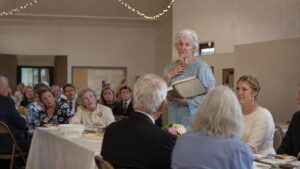
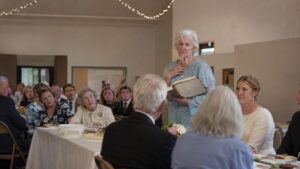
Then Jason stood up with his glass and gave a toast about his father. Fifty-one years at the shop. Salt of the earth. Built things with his hands. He got a little emotional in a way that I believe was real, and he said the family would be “handling everything, the house, all of it, the way Dad would have wanted,” and everybody nodded, and someone said hear, hear.
And then Curtis Pike stood up.
Seventy-one years old, retired letter carrier, forty pounds lighter than he used to be, in his new jacket. His hands were shaking so hard he set the glass down.
“I’m sorry,” he said. “I need to say something, because I’m the only one here who can.”
The room got that particular kind of quiet.
“Most of you don’t know me. I carried mail on Herbert’s street for nineteen years. Nine years ago I got sick and lost my house and Herbert Cooper let me sleep in the room over his garage for fourteen months and never took a dollar and never told a soul, and if any of you are wondering why I’d embarrass myself like this in front of you people, that’s why.”
He put his hand flat on the tablecloth.
“In March, Herbert asked me to drive him to a lawyer’s office on Main because he didn’t want his wife to know and he didn’t want to ask his son. He signed a new will. He changed the deed on the house. I was one of the witnesses. He asked me to keep it to myself until after.”
He looked down the table at me.
“Ruth. He left you the house. All of it. He said — his words, I wrote them down after — he said, she’s the one who stayed.“
I have thought about that moment every day since. What I remember most is not triumph. It’s the sound of a woman near the middle of the table setting down a fork very carefully.
Jason’s face went white and then red. He said, “That’s not — Curtis, that’s not something you get to announce at a dinner.”
And Curtis Pike said, “You gave her a side door, Jason.”

I stood up. I want to be clear that nobody rescued me. Nobody was going to.
“I’m going to say three things,” I said, “and then I’m going to go home.”
“Ruth—” Jason said.
“Three things. First: Curtis, thank you. You did a hard thing.
“Second: Jason, I’m not going to fight you over that house. If you want to contest it, contest it. But I’m not going to spend the last good years I’ve got in a courthouse arguing with your father’s son about whether I’m family. I’m sixty-eight. I don’t have the years to spend on it.”
He started to say something and I raised my hand, and to his credit he stopped.
“Third. I’m not coming back. Not next Thanksgiving, not Christmas, not for anything. I’m not doing this again — the far end of the table, and ‘a friend of my dad’s,’ and the side door. I did it while he was alive because he asked me to. He’s not here to ask anymore.”
I picked up the quilt.
“This has your grandmother’s church dress in it and your mother’s apron and a square off my mother’s housecoat that I sewed in crooked and your father laughed at until he had to sit down. It belongs to whoever’s still adding to it. That’s not me anymore and it sure isn’t you. I’m giving it to your daughter.”
Emma is nineteen. She was sitting four seats down and she had been crying quietly for about two minutes. I set it in her hands and she held onto my wrist.
Then I walked out the front door. The fog had come back up over the bench and you couldn’t see the valley at all.
Here’s the cost, because there’s always a cost and I don’t believe stories that pretend otherwise. Ray Nunez didn’t speak to me for three weeks because he thought I should have fought. Dolores died in February. Curtis Pike lost the only family gatherings he ever got invited to. And I sold the house — I did take the house, in the end, because Jason never contested it, and I sold it, and I moved into a two-bedroom near the library, and some mornings I wake up and reach over for a man who has been gone two years.
Winning is not the same as getting your life back.
But last April, Emma drove down from the university and knocked on my door. She had the quilt in a canvas bag. She’d had it cleaned and she’d added a square — a piece of her grandfather’s work shirt, the blue one, sewed in crooked as anything.
“My dad wants to know if he can come next time,” she said. “He said to tell you he’ll say it in front of everybody. Whatever it takes. He said he knows what he did.”
I looked at that crooked blue square for a long minute.
“Tell him he can come,” I said. “Front door.”