
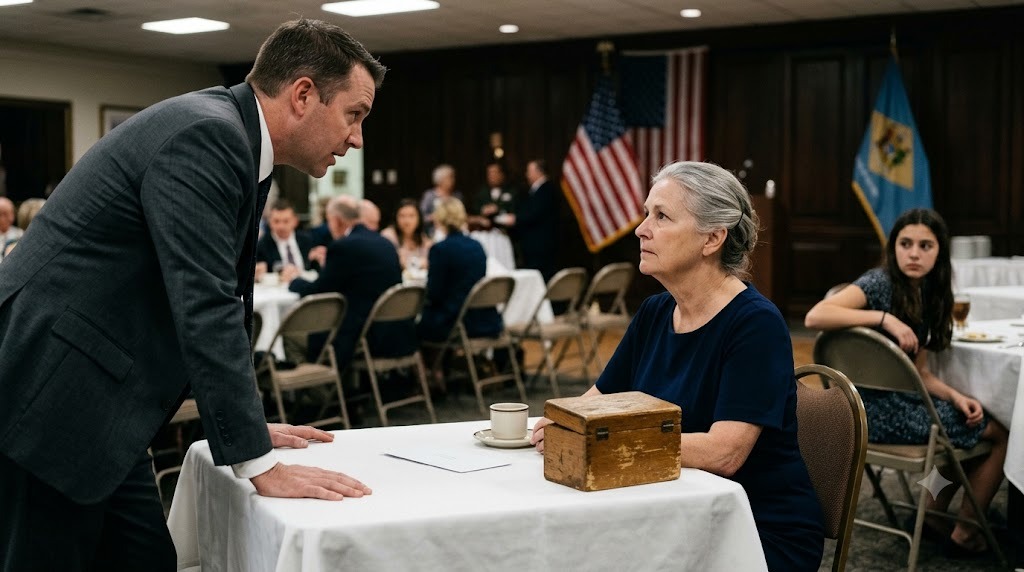

Part 1 — The Woman Who Kept Her Life in a Box
My son stood at the podium at his retirement dinner and thanked his father for filling out every scholarship form by hand. His father had been asleep by seven every night of his childhood.
I clapped with everybody else. I did not look at anyone. I kept my hands moving until the applause stopped.
Under the tablecloth, my nineteen-year-old granddaughter took my hand and held it too tightly, and did not let go for the rest of the speech.
To understand why she did that, you have to know what I have hidden from every person in that room for fifty-nine years — including the man at the podium, who has known it since he was eleven.
My name is Ruth Johnson. I am sixty-five. I have folded bulletins at St. Anne’s for thirty years, and I cannot read a word of them.
The morning of my son’s retirement dinner was gray the way only a Delaware October can be gray — a low ceiling of cloud pressing down on the roofs, the air smelling of the river and the diesel from the base two miles east. I stood at the kitchen window of the house on Bellevue Street and watched the flag on the corner lot hang wet and still, and I told myself that today I would be proud and I would not cry.
My name is Ruth Johnson. I am sixty-five years old. I have folded bulletins at St. Anne’s every Saturday morning for thirty-one years, set up chairs for the Wednesday soup kitchen, and washed more coffee urns than I can count. That is what people know about me. What they do not know is that I cannot read.
Not the way you can. I can find the ladies’ room. I can recognize my own name on an envelope, and CAMPBELL’S on a soup can, and STOP on a sign. But a paragraph is a fence I have never learned to climb. I left school in the fourth grade in 1966 to watch my brothers while my mother cleaned rooms at a motel on Route 13, and by the time anybody noticed, I had learned the one skill that mattered more than reading: how to hide it.
So I recorded everything instead.

On the counter beside me sat the wooden recipe box. My husband Earl made it in 1979 out of scrap oak from the base carpentry shop, sanded it down over three evenings, burned my initials into the lid with a soldering iron because he could not find a stamp. Inside were index cards. On every card, in the careful block letters I had taught myself to copy but not to read fluently, was a single word or two — CHRISTMAS 81. HOSPITAL. ASHLEY FIRST DAY. EARL SICK. And behind each card, tucked into the slot, a small numbered tab that matched a cassette tape in the hall closet.
Thirty-nine years of tapes. My whole life, spoken out loud into a Panasonic recorder Earl bought me the year Ashley was born, because I could not write a diary and I refused to go through this world unrecorded.
Ashley Johnson is my son. He was named for my mother’s maiden name, and he hated it from the day a boy in fifth grade told him it was a girl’s name. He is forty-one now. He went to the University of Delaware on a scholarship I did not understand the paperwork for — Earl filled it out at the kitchen table with a pen he kept clicking — and he came home speaking a little differently every year, until one Thanksgiving I realized my son had an accent I did not have.
He did well. That is the part I want you to hear before anything else, because I am not a bitter woman. He did very well. Twenty years at a defense logistics contractor out by the base, up and up, until he was the man they were throwing a retirement dinner for at forty-one — an early buyout, a corner-office send-off at the officers’ club, three hundred dollars a plate that somebody else was paying for.
He called me on Tuesday. “Ma. The dinner’s Saturday. Wear the blue thing.”
“The blue thing is from your father’s funeral.”
“It’s fine. It’s dark. Just — nothing with the church logo on it, okay?”
I said okay. I have said okay to my son for forty-one years.
Here is what I did not tell him, because he would not have had the patience for it: that week, my furnace died. That the man from the gas company had left a paper on my door that I could not read, and I had carried it to Mrs. Delgado two houses down, and she had read it to me in her kitchen with her hand on my wrist. That I had eaten cold cereal for four days in a house that was fifty-four degrees at six in the morning, and had not called my son, because the last time I called my son about money he had gone quiet in a way that made me feel like a bill he had forgotten to pay.
Mrs. Delgado told her nephew. Her nephew told the men at the VFW. And on Thursday morning, three men I barely knew — one of them a staff sergeant with grease to his elbows, one of them seventy-eight years old and using a cane — showed up at my door with a rebuilt furnace unit off a base surplus lot and a box of doughnuts.
They worked six hours in my basement. They would not take money. The old one, Walt, drank my coffee and looked at the water heater and said, “Ma’am, who’s been taking care of this house?”
“I have.”
“Where’s your family?”
I said my son was very busy. And Walt looked at me for a long moment with the specific pity of a man who has heard that sentence before, and he said, “We’ll come back next month and look at that roof.”
That night I went to the hall closet, took down tape 71, and I sat in my cold-turning-warm kitchen and I said out loud into the little machine: “October. Three men fixed my furnace and I don’t know their last names. Ashley doesn’t know it was broke. That’s my fault, I didn’t call. But I want it on here that strangers came.” And then I put a new index card in the box in my block letters: FURNACE. STRANGERS.
I did not know then that the card would matter. I thought I was just doing what I always did — putting my life somewhere it could not be argued with.
Part 2 — The Bill
The officers’ club had white tablecloths and a color guard and a slideshow. I sat at table four with two of Ashley’s colleagues who asked me what I did and then found other people to talk to when I said I volunteered at a church.
My granddaughter Maya sat beside me. She is nineteen, a sophomore at Delaware Tech, and she has her grandfather’s flat calm way of watching a room. She held my hand under the tablecloth during the invocation like she was steadying a ladder.
Ashley spoke for eleven minutes. He thanked his director. He thanked his team. And then he said, “And I want to talk about where this came from. My mother raised me in a house with nothing in it. But my father — my father sat with me every night and taught me everything I know about discipline. Every scholarship form, every application, that man filled it out by hand. Whatever I’ve built, I built on his back.”
Applause. Somebody at table two dabbed their eye.
I sat very still.
Earl worked swing shift at the base motor pool. Earl was a good man and I loved him for thirty-four years, and Earl was asleep at seven p.m. most days of Ashley’s childhood. It was me at that table. Me who could not read the scholarship form, so I had Sister Marguerite from St. Anne’s read it aloud to me line by line over three nights while I copied the answers Ashley dictated, letter by letter, in block capitals, because my son at seventeen refused to write it himself and I would not let his refusal cost him a future.
Earl clicked the pen. I wrote the words.
Maya’s hand tightened on mine.

The dinner ended. People drifted toward the bar. Ashley came to our table with a glass in one hand and an envelope in the other, and his wife Denise a half-step behind him with her purse already on her shoulder.
“Ma. Good, you’re still here. Before I forget.” He set the envelope down beside my dessert plate. “I need you to look at that.”
“What is it?”
“It’s a schedule. Nothing bad.” He said it the way you say nothing bad to a dog. “Denise and I have been carrying costs on Bellevue Street for a long time. Property tax, the insurance, the sewer assessment last year. It’s been adding up. Twenty-two thousand and change. Now that I’m not drawing a salary, I need to get that squared away. It’s just a payment plan. Two-fifty a month, or we look at selling the house and settling out of the proceeds.”
The room got very quiet at our table.
“Ashley,” I said. “That’s my house.”
“Ma, it’s a family asset. Nobody’s putting you out. But I’ve been the one keeping it afloat and you can’t expect that to just go on forever. You’ve got Social Security. You’ve got — ” he gestured vaguely — “the church thing.”
“You told me at your father’s funeral that house was mine and I never had to worry.”
“I told you a lot of things at Dad’s funeral. I was thirty-two.” He smiled at Denise. “This is a kindness, honestly. Somebody’s got to be the adult about it.”
I looked at the envelope. Nine years of not asking my son for anything. Four days of cold cereal. Three strangers in my basement with doughnuts. And now a bill, handed to me across a white tablecloth in front of people who thought I was the woman who folded bulletins.
I could not read the number on the paper. I had to take his word for what he was charging me.
That is what he was counting on. I understood that in one clean, cold second, and it did not make me angry the way you would think. It made me tired, and then it made me very, very clear.
“I’ll look at it at home,” I said.
“You’ll look at it tonight?”
“I said I’ll look at it at home.”
Maya drove me. Neither of us talked until we hit Route 13 and she said, to the windshield, “Grandma. He knows you can’t read it.”
“I know.”
“Then why —” She stopped. Started again. “Do you have anything? Anything on paper?”
And I thought about the wooden box on my counter. The oak lid with my initials burned crooked into it. Thirty-nine years of index cards I could copy but not read, and thirty-nine years of tapes where I said everything out loud because paper had never been mine.
“I don’t know what I have,” I said honestly. “But I have every day of it.”
We sat at my kitchen table until two in the morning. Maya took the cards out one at a time and read them to me, and I told her which tape each card matched, and she ran up and down the hall to the closet like a girl half her age.
At 1:40 she pulled a card near the back that said, in my block letters: EARL PAPER. LAWYER. 2011.
Behind that card, folded into the slot where a tab should have been, was a document I had put there fifteen years ago because a young lawyer at the base legal office had handed it to me and said “keep this somewhere safe” and I had put it in the only safe place I had ever owned.
Maya unfolded it. She read it twice. Then she put it down on the table and pressed both hands flat on top of it.
“Grandma,” she said. “Whose name did Grandpa put on this house?”
Part 3 — A Gray Morning, and a Room Full of People Who Stood Up
The deed was recorded in New Castle County on the eleventh of March, 2011. Earl had gone to the base legal office nine months before the cancer took him and transferred the property on Bellevue Street into a single name.
Mine. Ruth Johnson. Sole owner. Free and clear, the mortgage retired in 2004.
Ashley had never paid a property tax on that house in his life. The county bills went to me. I carried them to Mrs. Delgado, and she read them, and I paid them in money orders from the Wawa on Philadelphia Pike, four to six a year, thirty-nine dollars a trip. The insurance came out of Earl’s small survivor annuity, which came to me. The sewer assessment my son mentioned by name — I had paid it in November in three installments, and there was a card in the box that said SEWER. PAID. NOV, and a tape where I said out loud how much it hurt to write that check.
My son had invented twenty-two thousand dollars of debt and handed it to a woman he knew could not read it.
Maya wanted to blow it up. She wanted to post it. She wanted to walk into Denise’s office. She was nineteen and she was incandescent, and I let her burn for about ten minutes and then I said, “No.”
“Grandma —”
“If I destroy him, I lose him. And I’ve buried enough people.”
Here is what I chose instead, and I chose it myself, sitting at my own table at two in the morning with the recipe box open in front of me. Nobody rescued me. No lawyer swept in. Walt and the VFW men did not fix this for me; they had already given me the only thing I needed, which was the knowledge that I was worth six hours of a stranger’s Thursday.
The parish had its fall recognition breakfast the following Saturday at St. Anne’s. A gray overcast morning, the same low Delaware sky, folding chairs in the parish hall, urns of coffee I had washed a hundred times. Ashley came because Denise liked being seen there and because he assumed I had spent the week failing to understand his envelope.
Father Kearns called me up for the thirty-year service pin.
I brought the wooden recipe box with me to the microphone.

“Most of you have known me thirty-one years,” I said. “There’s a thing you don’t know. I can’t read. Fourth-grade education. I’ve hidden it my whole life and I’m tired of the hiding.”
You could hear the room stop.
“So I kept my life in here.” I held up the box. “My husband made it. Every card’s a day. Every day’s on a tape in my hall closet, because if I couldn’t write it down I was going to say it out loud. Thirty-nine years.”
I found my son’s face at the back. He had gone the color of the tablecloth at the officers’ club.
“Last Saturday I was handed a bill for twenty-two thousand dollars for a house. The person who handed it to me knew I couldn’t read what was on the paper.” I did not say his name. I have never said his name. “I want to be plain, because I don’t want anybody guessing. I own my house. My husband put it in my name in 2011 and the deed’s been in this box since. I’ve paid every tax on it myself, in money orders, for fifteen years. There is no debt. There was never a debt.”
Nothing. Not a chair creaking.
“I’m not asking anybody to be angry on my behalf. I’ve had enough anger in my life to know what it costs. What I’m asking is this.” I set the box on the podium. “If you’re sitting on something you can’t read — a letter, a form, a bill — bring it here. Bring it to me. I’ll sit with you and we’ll find somebody. Because two weeks ago three men I’d never met came and fixed my furnace and wouldn’t take a dollar, and I have never in my life been so ashamed of how little I asked for.”
Maya stood up first.
She was nineteen, in the fourth row, and she stood up and she walked the length of that parish hall past her father’s table without looking at him, and she stood beside me at the podium and she took my hand.
Then Walt stood up, with the cane. Then the staff sergeant. Then Mrs. Delgado. Then a woman I had never spoken to in eleven years of the same eight o’clock Mass, and then the whole back three rows of men from the VFW who had come for the free eggs, and then everyone.
They clapped for a long time. I did not cry, which surprised me. I had promised myself a week earlier that I would not, and it turned out I meant it.
Ashley left before it stopped. Denise’s coat caught the corner of a folding chair and knocked it over, and nobody picked it up.
Here is the cost, because I will not lie to you and tell you this ended clean.
My son has not spoken to me in nine months. He tells people I humiliated him in a church. Denise has blocked my number. Christmas came and went and I sat with Maya and Mrs. Delgado and ate a ham, and there was an empty chair, and I felt it in my chest like a stone every hour of that day.
I did not press charges. The base legal aid attorney said I could — attempted fraud against an elder, they take it seriously here — and I said no, and she wrote it down, and I made her read back to me what she wrote so I would know exactly what I had chosen.
People tell me that was weakness. They are wrong. Weakness is what I did for forty-one years — saying okay, hiding the fence I couldn’t climb, eating cold cereal at fifty-four degrees so my son wouldn’t sigh at me on the phone. Forgiving him and still telling three hundred people the truth on the same morning — that took more from me than anger ever has. Anger is cheap. I know, I’ve bought it.
Maya lives with me now. She has her own key. Tuesday nights she comes home from Delaware Tech and we work on the tapes — she’s digitizing them, one by one, and typing what I say, and there are four hundred and eleven of them. She says when she’s done, she’s going to print the whole thing and put it in the county historical society, because there is not one record in Delaware of a woman like me in my own words.
The recipe box sits on the kitchen counter where it has sat since 1979, and the deed is at the bank now, but I keep the card that says EARL PAPER. LAWYER. 2011 in the slot where it’s always been. Some mornings I take the lid off and run my thumb over the initials my husband burned in crooked because he couldn’t find a stamp.
A man who never once made me feel stupid put my name on a house. And a nineteen-year-old girl crossed a room full of folding chairs to stand next to me.
I could not read a word of my own life. But I got every day of it down. And when the day came that somebody tried to tell me a different version, I had the tapes, and I had the box, and I had the truth in my own voice.
That is not nothing. That is, I have come to believe, very close to everything.