

Part 1 — The Room With the Folding Chairs
My new boss looked at my hands across the lawyer’s table and said, “Martha, nobody makes parts that way anymore.”
I put my hands in my lap and said nothing, the way my mother taught me.
Four months later he stood in the doorway of a shop bay he had already emptied, and he needed something from me.
But I want to start where it actually started, in a lawyer’s office on a Tuesday in October, with the air conditioning still running because it was ninety-one degrees outside and Arizona does not care what month the calendar says.
My name is Martha Miller. I am seventy-two years old. I have been a factory worker for forty-one years at Kessler Precision, a machine shop in a working-class suburb west of Phoenix, the kind of town with a feed store, three churches, and a VFW hall with a swamp cooler that rattles.
The lawyer had set out folding chairs because there were more of us than he expected. Ray Kessler had put a lot of people in his will, most of them for small things. Ray hired me in 1985 because I walked in with my discharge papers and a micrometer in my purse, and he handed me a piece of scrap and said, “Tell me what it measures.” I told him. He said, “You’re late for your shift.”
Ray’s grandson sat in the front row with his phone face-up on his knee. Tristan Edwards. Thirty-four. He had flown in from Denver twice in ten years, both times for funerals.
“Ma’am, you can go ahead and sit,” he told me, as if the chairs belonged to him already. They did, technically. I sat.
The lawyer read the parts everybody expected. The company to Tristan. The house to Tristan’s mother. Then he got to me.
“To Martha Miller,” he read, “the entire contents of tool crib B.”
Somebody in the back laughed. Not meanly. Just surprised.
Tool crib B is a caged room at the back of the plant with a padlock and a light that flickers. It holds fixtures, ground reamers, gages, and boxes of tooling Ray and I made by hand over four decades for jobs nobody else in the state would take.
“Congratulations,” Tristan said afterward in the hallway, smiling. “You inherited the junk drawer.”
“Your grandfather knew what was in it,” I said.
“My grandfather also kept drawings on paper,” he said. “We’re going digital, Martha. Honestly? The skill set in that building is analog. It’s a museum.”

I asked him about the photograph.
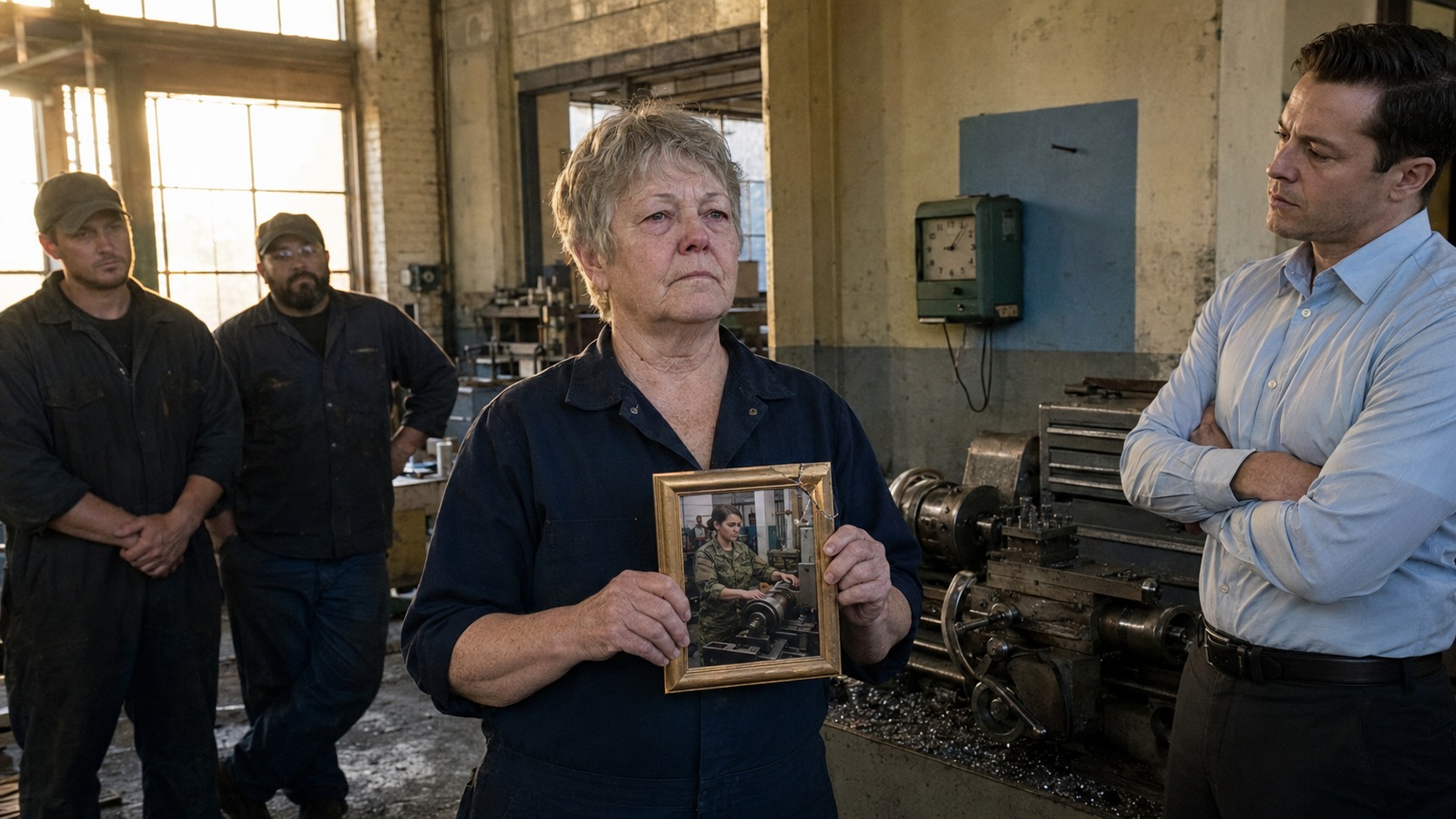
There was a picture that hung above the time clock at Kessler Precision for as long as I worked there. A cheap gold-colored drugstore frame with a crack in the bottom corner, the kind you buy for two dollars and never replace. Inside it: a nineteen-year-old girl in Army fatigues with her sleeves rolled past the elbow, standing at a lathe, squinting because somebody made her look into the sun.
That girl is me. The Army taught me to cut metal before I was old enough to sign a lease.
Ray hung it there himself. He used to bring new hires over, point at it, and say, “That’s what I hired. Not the paperwork.”
“The frame,” I said. “The one from over the time clock. Where is it?”
Tristan checked his phone. “We cleared the office at the care center. Some of it went to donation, I think.” He shrugged. “Martha, it’s a picture.”
Here is what he didn’t know, and what I didn’t know either, standing there in that hallway with my purse against my chest.
Three weeks before Ray died, I drove out to Palo Verde Care Center with two burritos and a set of drawings he had asked to see. I signed the visitor log. The young man at the desk ran his finger down a list, then ran it down again.
“You’re not on here,” he said.
“I’ve been on there since March.”
“It’s been updated. Family requested it. Immediate family only.”
I asked him to call the room. He said he wasn’t allowed. I asked him to tell Ray that Martha came. He said he’d pass it along, in that voice people use when they will not pass it along.
I sat in my truck in that parking lot for a while with the burritos going cold on the seat, and the light came in low and gold across the hood, and I finally backed out and drove home.
Ray died eighteen days later. I heard it from the parts driver.
So when Tristan said it’s a picture, I did not argue. I went home, and I did not know that the ugliest little frame in the county was already sitting in a cardboard box in a church office nine miles from my house, waiting for somebody to remember my last name.
Part 2 — The Night Shift Nobody Was Supposed to Work
By November the plant had a new sign, new lighting, and a consultant with a lanyard.
Tristan called it Kessler 2.0. He bought a machining cell that could run parts while everybody slept, and I will say this honestly: it was a good machine. I have never been against new machines. I’ve been against people who think a machine is the same thing as knowing something.
He cut third shift. Dutch went first — sixty-six, flannel shirt in July, been there thirty years. Then Roz, who could hear a bearing going bad through a closed door. Then Manny, who ran the press brake and brought tamales at Christmas.
Then he cleared the drawing vault.
“It’s all scanned,” the consultant told me. “Redundant hard copies.”
I came back at seven that night with my truck. The vault smelled like ammonia and old paper, and I loaded the original vellums — the ones Ray drew by hand in the seventies, with his notes in the margins in that skinny pencil printing of his — into banker’s boxes and put them in my garage between the Christmas decorations and my late husband’s fishing gear.
Nobody stopped me. Nobody noticed. That was sort of the point of me by then.
They moved me to “materials flow.” That means pushing carts. My badge said Materials Associate. A young tech named Colby once explained to me, kindly and slowly, how a micrometer works.
“Thumb the ratchet,” he said. “So you don’t over-tighten.”
“Colby,” I said, “I was doing that under a poncho in the rain when your father was in grade school.”
He laughed. He thought I was joking.
Above the time clock there was a nail and a rectangle of paint two shades darker than the rest of the wall, where a cheap gold frame had hung for forty years and kept the sun off. Dutch saw me looking at it on his last day.
“He used to point at that thing,” Dutch said. “Every single hire.”
“I know it.”
“They painted around it and never even knew.”

In March everything came apart at once.
Our anchor customer rebuilds legacy ground-support equipment — the tugs and carts that move aircraft around, machines older than Tristan, still in service, still needed. We made the bronze bushings and the valve bodies. That account was most of our year. Most of our jobs.
The parts started failing final inspection. The seats leaked. They scrapped one lot, adjusted, scrapped another. The vendor blamed the material. The consultant blamed the vendor. The model had come off a scan of a 1971 drawing, and the machine was making exactly what the model said, over and over, beautifully, wrong.
Thursday afternoon I was pushing a cart past the glass office and I could hear Tristan’s voice through the door, high and thin, the voice of a man doing math he doesn’t like.
I stood in the doorway.
“You want the analog answer?” I said.
He looked at me for about three seconds. Whatever he was going to say, he swallowed it.
“Yes.”
I went home and got the box.
I unrolled the original vellum on the conference table, and there was Ray’s pencil printing in the margin, dated the year I was in high school: a note about spring-back in the old die, and a note that the seat was cut with a shop-ground reamer at an angle that was never, ever going to show up in a scan, because it wasn’t on the drawing. It was in the tooling. The drawing assumed you had the reamer. The men who wrote it assumed the shop would go on being a shop.
“Where’s the reamer?” Tristan said.
“Tool crib B,” I said.
He closed his eyes.
“Which you own,” he said.
“Which I own.”
I want to tell you I made him beg. I didn’t. There were people on that floor with car payments.
I unlocked the crib at six o’clock Thursday evening and I did not go home until Friday afternoon. I ran the old manual lathe in the back bay, the one they hadn’t hauled off yet because the scrapper wanted too much to move it. Dutch showed up at eleven at night in his flannel and didn’t ask about pay. Roz came at midnight. Manny brought food nobody asked for and everybody ate.
Around hour twenty my right hand cramped up and stayed cramped. I taped two fingers together, put my hand in a bucket of ice for ten minutes, and went back. You don’t need a good hand to hear a cut going wrong. You need a good ear and about fifty years.
The truck left the dock at ten past four on Friday. The parts passed.
Monday morning Tristan sent an email to the whole company with the word “teamwork” in it, and a check to me for two thousand dollars, and in the production meeting he called the whole thing “a process gap we’ve now digitized.”
My name was not in the email.
Dutch called me that night. “You going to the reunion Saturday?”
“I don’t think so.”
“Ray’s old unit,” he said. “You should come.”
I almost didn’t. My hand hurt, and I was seventy-two, and I was tired in a way sleep doesn’t fix.
I went.
Part 3 — What She Had Been Carrying Since September
The VFW hall smelled like coffee and sheet cake. Late afternoon, the light coming in the west windows low and gold across the folding tables, men in ball caps with unit patches, wives with photo albums, the flag in the corner that never gets moved.
A woman came across the room toward me with a grocery bag. Sixty-eight, maybe. Reading glasses on a chain.
“Are you Martha? From the shop?” she said. “I’ve been carrying this since September.”
Her name was Elly Vasquez. She volunteers at St. Anne’s, drives residents to appointments, sits with people who don’t have anybody sitting with them. She had sat with Ray.
She took the frame out of the bag. Cheap gold plastic. Crack in the bottom corner. A girl in fatigues at a lathe, squinting into the sun.
I had to set my coffee down.
“He asked me to take him outside that afternoon,” Elly said. “He wanted to see the road. There was a notary who came out to the parking lot — a young fella in a blue Corolla. Ray signed some papers on a clipboard on the hood.”
“What afternoon?” I said.
She told me the date.
It was the day I was standing at that front desk, forty feet away on the other side of a wall, being told I wasn’t on the list.
“He had this in his lap the whole time,” she said. “He made me take it. He said, ‘Give it to Martha at the shop.’ I didn’t have a last name, honey. I asked at the church. I asked around. I’ve had it on my desk since.” She put her hand flat on the frame. “He said one more thing. He said, ‘Tell her the ground is hers.'”

Monday morning I drove downtown to the county recorder’s office and waited behind a man renewing something.
The clerk found it in about four minutes. A deed, signed and notarized in a care facility parking lot on a Thursday in September, recorded at 3:52 that same afternoon. Two acres. The ground under Kessler Precision.
Ray had owned that land personally since before the building went up. The company only ever leased it from him. His will gave Tristan the company. It could not give him what Ray no longer owned.
I paid six dollars for copies and sat in my truck in a parking garage and cried for the first time since the funeral, not about land.
Tuesday I walked into the glass office with a manila envelope. Tristan looked at it the way you look at a snake in a woodpile.
“I already talked to counsel,” he said.
“Sit down,” I said. “I’m not suing you.”
Here are my terms, and I want you to understand that I wrote them at my kitchen table with a pen, alone, and that a lawyer later told me I left a great deal of money on the table. He is right. I did.
The lease continues at exactly what Ray charged, and every dollar of it goes into an apprenticeship in his name. Manual shop first. Hands before software.
Tool crib B stays, and it becomes the training bay.
Dutch, Roz, and Manny come back with their years intact, if they want to, and two of them did.
The photograph goes back on its nail above the time clock, and it stays there after I’m gone, and it is not about me. It’s what Ray pointed at.
And one thing more. He had to stand on the floor, in front of everybody, and say what was done in September. Not to me. To them.
He did it. It took him half a minute and he read part of it off his phone and it was not good and it was not a movie. Some people clapped. Some people crossed their arms and went back to work, and I don’t blame them one bit.
My hand never came all the way back. I can teach and I can inspect and I can tell you by sound what a machine is about to do, but I don’t run parts anymore, and my husband’s coat buttons get done with my left hand now, slowly, in the truck.
Tristan comes to the training bay on Thursdays. He is not good at it. He asked me once how you know when a cut is right, and I said, “You stop looking and you listen,” and he put the phone down on the bench and listened.
We are not friends. He is not a warm man and I am not a forgiving one. But he is a better boss than he was in October, and I decided that was worth more to the sixty people in that building than a lawsuit I would probably have won.
What I did not get, and will not ever get, is the eighteen minutes I spent in my truck in that parking lot with two burritos going cold, forty feet from a man who was outside in the golden light signing his ground over to me with my picture in his lap.
I keep the frame at the shop, not at home. Cheap gold plastic. Crack in the corner. A girl who is nineteen and does not know a single thing that’s coming.
She still doesn’t know. I do. And every Thursday I stand under her and tell a room full of kids that the old way isn’t the slow way — it’s the way somebody figured out with their hands, and wrote in the margin, and hoped like hell somebody would still be around to read.