
Part 1 — The Wall
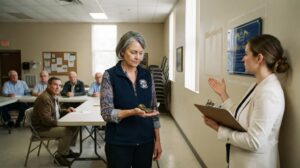
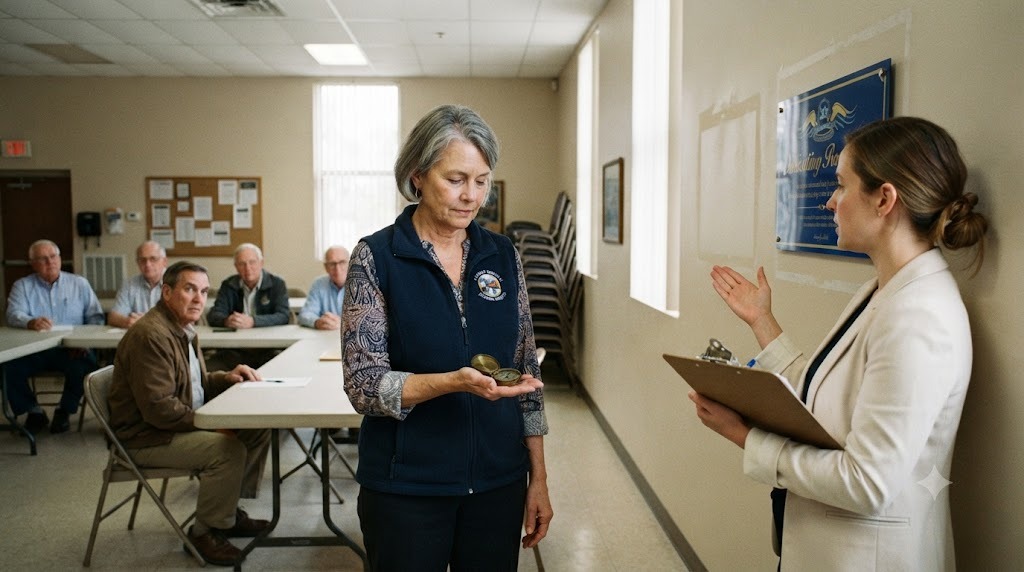
Madison told me to wear the apron over my uniform so I “wouldn’t clash with the photographs.”
I folded it once along its crease and set it down without a word.
I looked past her instead, at a bare patch of wall that hadn’t been bare the day before.
I didn’t know it yet, but that empty rectangle was going to matter more than anything Madison said to me all morning.
To understand why, you’d have to go back to six-forty that same morning, before any of it started.
Madison Edwards told me to put the apron on over my uniform so I “wouldn’t clash with the photographs.”
I took the apron, folded it once along its crease, and set it on the folding table without putting it on.
I looked past her instead, at the wall behind her, at the empty rectangle where a photograph used to hang.
Something about that bare patch of paint told me the morning was not going to go the way anyone in that hall expected.
It was six-forty that morning when I pulled into the depot lot in the gray dark, the sky the color of wet concrete, rain threatening but not yet falling. Thirty-one years I had parked in the same spot, third from the fence, because the fence blocked the worst of the wind off Route 9. I was sixty-four years old. I had driven Bus 14 for the Millbrook Township school district since I was thirty-three, since before half the parents on my route were born.
Before I unlocked the bus, I did what I had done every working morning of my adult life. I reached into my jacket pocket, took out a small brass compass with a hinge worn soft as an old door, and pressed my thumb against the glass until it fogged. My father had carried it through Korea. He’d pressed it into my palm the morning I left for basic training and said only, “So you always know which way is home.” I had never once needed it to find my way anywhere. I carried it anyway.
Today the depot wasn’t just a depot. Today it was the reunion hall.

Millbrook sat now inside what everyone called Baywood Estates, curved streets of vinyl-sided colonials with names like Meadowlark Court and Fox Hollow Lane. Thirty years ago it had been my family’s dairy farm — four hundred acres of my father’s land, sold off piece by piece after his heart gave out, until the depot itself sat on the exact spot where the old hay barn used to stand. I had watched them pour the foundation. I had said nothing then either. Some griefs you just drive around, the way you drive around a pothole you know isn’t going anywhere.
Once a year, the local chapter of my father’s old unit — men and women who’d served alongside him, and later a few who’d served alongside me — held their reunion in the depot’s community room, because it was central, because it was cheap, and because I had always been the one who unlocked the doors early and made the coffee. Nobody had ever asked me to. I just did it, the way I taught myself to check mirrors before I could legally drive a car.
I let myself in through the side door at six-fifty. That was when I saw Madison standing on a stepladder in the community room, in a cream blazer far too clean for six-fifty in the morning, unscrewing the frame of a photograph from the wall.
It was the Wall of Service. Twenty-two years of names and faces — veterans from the township, one photo per honoree, hung the week of the reunion and left up the rest of the year as a kind of quiet thank-you. My photo had hung there for six years, ever since the old commander insisted on it after learning I’d made staff sergeant before I was twenty-five. It was a small photo. I was in my dress uniform, unsmiling, the way my father had taught me a soldier stands for a photograph.
“Madison. Morning,” I said.
Madison didn’t turn around right away. When she did, she had the frame tucked under one arm like a folder she meant to file. “Oh — good, you’re here early. I need the tables in a horseshoe today instead of rows. And I was thinking we’d do a fresher branding wall this year. More forward-looking. I’ve got new signage coming from the print shop.” She gestured at a stack of glossy boards leaning against the wall, showing the district’s new logo, blue and gold, sleek as a car commercial.
“What happens to the old wall?” I asked.
“Storage, probably. We can revisit it.” She said it lightly, the way you’d mention moving a filing cabinet. “It’s a little dated. No offense to anyone in the photos.”
I looked at the space where my own photograph had hung for six Novembers, now bare drywall with four small nail holes, like a wound that hadn’t scarred over yet.
“I’ll get the coffee going,” was all I said.
I had learned a long time ago which battles were worth the breath. This one, this morning, I decided, was not going to be won standing on a stepladder arguing about a picture frame. I had thirty-one years of routes memorized down to the crack in the sidewalk outside the Hendersons’ place. I knew, better than almost anyone alive, that patience wasn’t surrender. It was just a longer road to the same destination.
By eight, the horseshoe of tables was set, the new signage was up, gold letters catching the gray morning light through the tall windows, and the coffee urn was hissing quietly in the corner the way it had every reunion morning since I’d first plugged it in myself.
At eight-fifteen, Madison found me refilling the creamer.
“Oh, perfect, you’re already on it,” she said, not quite a compliment, not quite anything at all. “Can you also handle the name tags at the door? People will start arriving around nine, and I really want this to run smoothly. First reunion I’m hosting — I want it to look effortless.”
“I usually sit with the unit during the opening remarks,” I said.
“Oh — sure, of course, once everything’s set up,” she said, already turning away, already checking something off a clipboard that had appeared from nowhere. “I just meant, while it’s quiet. You know this building better than anyone. That’s actually why I wanted you on point for logistics this year.”
It was, I thought, technically a compliment. It just wasn’t the one I’d expected on the one morning of the year that had always, without anyone saying so out loud, belonged to me.
I put the apron in the bottom of my tote bag, where it stayed folded the rest of the morning, and I went to unlock the front doors, because someone was already knocking, and because whatever else this day turned out to be, the first guest through that door was not going to be left standing in the cold.
I had no idea, yet, exactly how many people were about to walk through it — or why, by the time the last car pulled out of the lot that afternoon, the arithmetic of who had actually shown up would tell me something no photograph on any wall ever could.
Part 2 — The Horseshoe
By nine-thirty, the room had filled the way it always did — slowly, then all at once, the way a kettle takes forever to notice it’s boiling and then screams. Men in their seventies and eighties in pressed shirts. A scattering of younger faces, sons and daughters who drove their parents in because the roads out here still confused GPS units that had never heard of a farm road renamed Fox Hollow Lane.

I worked the door with the name tags, greeting men I’d known since I was twenty-four years old, men who called me Sergeant Phillips out of habit even though none of them had outranked each other in decades. Old Walt Cieslak, ninety-one, who had known my father, gripped my hand and said, “Your dad would’ve hated that new sign out front. Too shiny.”
“He’d have painted over it,” I said, and Walt laughed the way old men laugh when the joke is really about someone they miss.
Madison stood at the front of the horseshoe in her cream blazer, running through the morning’s schedule with the district superintendent, a woman named Carol Danforth who had flown in from the county office specifically to see how the reunion was run this year — because there was talk, real talk, of consolidating the transportation department’s community outreach under Madison’s new “modernization initiative,” and Carol wanted to see it for herself.
That was the piece I didn’t know yet. That this morning wasn’t only a reunion. It was an audition.
At ten, Madison took the small podium microphone and welcomed everyone with a speech about “honoring our veterans while looking toward the future of Millbrook Township,” a phrase that made several men in the front row exchange a glance I recognized instantly, because I’d worn that exact expression myself more than once that morning.
Then Madison said, “And I want to give a special thank-you to our transportation staff, who worked so hard behind the scenes to make today possible — especially Janice, who helped set up the room and kept the coffee going all morning. Let’s give her a hand.”
The applause came, warm and brief, the applause you give a caterer.
I stood near the coffee urn, in my uniform vest, and felt something I hadn’t felt since basic training — the particular sting of being seen and misnamed in the same breath. Not invisible. Worse. Visible, and mislabeled. Thanked like hired help, in a room full of people who had known me as family for thirty years.
I did not react. I had learned that from my father too — that the loudest thing in a room is sometimes the person who says nothing at all. I refilled a coffee cup that didn’t need refilling and let my eyes go, once, to the bare rectangle of drywall where my photograph used to be.
“You alright?” Walt murmured, low enough for only me.
“I’m fine, Walt.”
“You don’t look fine. You look like your father did the day the bank called about the farm.”
I almost smiled at that. Almost.
The morning went on. Carol Danforth mingled, shook hands, took notes on a tablet. Madison hovered near her, narrating the room like a tour guide — “This is our transportation coordinator, she handles all our route logistics” — three separate times, to three separate people, never once using the word veteran, never once mentioning the six years my photo had hung on that wall, or the medal in a drawer at home that I hadn’t looked at in months because looking at it always made me think of the men who never got old enough to come to a reunion at all.
At eleven, something almost went sideways that had nothing to do with Madison at all. A young mother, new to the district, had wandered in by accident looking for the after-school program sign-up, her toddler on her hip, and stood confused near the door, holding a printed map from the district website that had the building numbers wrong.
Madison, mid-conversation with Carol, waved a hand toward her new GPS-based routing app, still in beta, proudly explaining how it would eliminate exactly this kind of confusion going forward.
“Ma’am, you want building four, not six,” I said, before the app had finished loading on Madison’s phone. “Go out the side door, past the flagpole, it’s the low brick building. Faster than walking back around front.”
The young mother thanked me, relieved, and left. Carol Danforth watched the whole exchange without a word, then looked, for just a second, at Madison’s phone, still loading, still spinning its little wheel of progress, and said nothing either. But I saw the look. I’d been reading rooms since before Madison Edwards was born.
By noon, the formal program was winding down, and Madison approached me near the coffee station with the particular brightness of someone about to ask a favor while calling it an honor.
“So — small thing,” Madison said. “We’re doing photos with Carol for the newsletter, just the leadership team and a few key volunteers. Would you mind grabbing a few more coffee refills first? I want the room to look full and warm when we shoot.”
I looked at her for a long moment. Not angry. Just looking, the way you look at a stop sign you’ve passed ten thousand times and are seeing, for the first time, actually needed repainting.
“Madison,” I said quietly. “Do you know why this reunion happens in this building, every year, on this exact weekend?”
Madison blinked. “Because it’s central? And free?”
“Because this building sits where my father’s barn used to stand. This whole development — Baywood, Fox Hollow, all of it — used to be four hundred acres that fed half this county. My father served this country and then lost his own land paying the bank he’d trusted his whole life. I have unlocked these doors every reunion morning for six years because nobody else remembered to, and because it mattered to me that the men who served with him had somewhere warm to sit.”
I set down the coffee pot.
“I’m not your key volunteer, Madison. I’m not your transportation coordinator today. Today I’m one of the people this wall was supposed to be for.”
Madison’s mouth opened, then closed. For the first time all morning, she looked less like a woman running an event and more like a woman standing very close to a mirror she hadn’t asked for.
“I didn’t mean —”
“I know you didn’t mean anything by it,” I said. “That’s sort of the whole problem.”
I untied the apron — the one still folded, untouched, at the bottom of my tote bag — and did not put it on. Instead I reached into my jacket pocket, closed my hand around the small brass compass, and walked toward the horseshoe of tables, toward the men who had known my name since before Madison Edwards had one.
What happened in the next ten minutes was not a scene. Nobody raised their voice. But it was, I would think later, the loudest silence I had ever stood inside of — and it was about to answer a question I hadn’t even known I was asking.
Part 3 — The Count
I sat down at the horseshoe of tables, in the seat closest to Walt Cieslak, the seat that had always, unofficially, been mine.
I didn’t announce anything. I didn’t need to. Carol Danforth, tablet in hand, watched me cross the room and settle into that chair with the particular ease of someone taking a place that had never really belonged to anyone else, and something in Carol’s face shifted from polite interest to genuine attention.
“Mrs. Phillips,” Carol said, walking over. “Do you have a minute? I wanted to ask you something, not for the newsletter. Off the record.”
I nodded.
“How many of these men are here because of the official district invitation list,” Carol asked, “and how many are here because you personally called them?”
It was such a specific question that I almost laughed. Instead I looked around the horseshoe — really looked, the way you look at a bus route you’ve driven so long you stopped seeing the individual houses and started seeing only the shape of the whole neighborhood.
Walt Cieslak, ninety-one — I’d called him myself, because his daughter worked nights and couldn’t drive him.
The Alvarez brothers, two seats down — I’d remembered their father’s unit number when nobody in the office could find the old roster, and called them directly.
Dorothy Kwan, the only woman besides me at the reunion who’d served — I’d tracked down her new address myself last spring after her card came back undeliverable.
Even Carl Whitfield, sitting stiffly by the window, the man who’d feuded with my father for a decade over a fence line — I’d called him too, three years running, because grudges belonged to the dead and reunions belonged to the living.
I did the count in my head, slowly, honestly, the way I’d count children off a bus at the end of a route. Of the twenty-six veterans in that room, I had personally called nineteen of them. The district’s official mailing list had reached the rest — mostly the ones already close enough, connected enough, to have heard about it anyway.
There was no secret in that number. No hidden medal, no forgotten citation, no envelope with my name on it waiting to be opened. Just an arithmetic so plain it had been sitting in front of everyone all morning, waiting for someone to actually add it up.
“Nineteen out of twenty-six,” I said quietly. “I called them myself. Every year. Because somebody has to remember that a reunion isn’t a room. It’s a list of names somebody didn’t let go of.”
Carol was quiet for a moment. “That’s not in any job description,” she finally said.
“No,” I agreed. “It never was.”
I thought, briefly, of my father, of the brass compass warm now in my palm, of the barn that used to stand exactly where the new gold letters on the wall now caught the afternoon light. I thought of thirty-one years of mornings, of a photograph that had hung for six of them and come down without a word of warning on the seventh.

Then I stood, and walked to where Madison was clearing away the empty coffee cups near the podium, her cream blazer no longer quite so crisp.
“Madison,” I said. “I’m going to step back from organizing the reunion. Effective today. I’ll still drive Bus 14 — the kids didn’t do anything to me. But the coffee, the tables, the calls I make every October to make sure the right men end up in that room — that’s done. You wanted to modernize this. Consider it modernized. You’ll be doing it yourself from here on.”
“Janice, that’s not — I didn’t want you to feel —”
“I know,” I said, not unkindly. “You didn’t want anything in particular. That’s the part I can’t keep working around.”
I didn’t slam a door. I didn’t raise my voice. I simply picked up my tote bag, the apron still folded and unused inside it, and walked out through the side entrance into the gray, overcast afternoon, past the flagpole, past the low brick building where a young mother had found her way an hour earlier because someone still remembered the shortcuts.
Three days later, a card arrived at my house, handwritten, not typed. Madison’s handwriting was small and careful, the handwriting of someone used to being graded.
*Janice — I said the wrong thing on the wrong morning to the wrong person, and I don’t think I understood why until I watched you count that room. I’m having your photograph reframed for the wall. I understand if that doesn’t fix anything. I’m sorry.*
I read it twice, then set it on the kitchen counter next to the brass compass, which I had taken out of my jacket pocket that evening for the first time in years to actually look at — not just carry — running my thumb over my father’s initials worn nearly smooth.
I didn’t know yet if I’d go back to the reunion next October. I didn’t know if forgiveness was something I owed Madison, or something she would have to earn one small, unglamorous year at a time, the way I had earned that room’s trust — one phone call, one name remembered, one October at a time.
What I knew, standing in my kitchen with the compass in my hand and the rain finally starting outside the window, was simpler than any of that. I had not waited to be rescued. Nobody had walked in at the last minute to announce who I really was. There had been no medal produced, no general at the door, no gasp moving through the crowd.
There had only been a number — nineteen out of twenty-six — and the plain, undeniable fact of who had actually shown up, and who had done the showing up for them.
I set the compass down, pointing, as it always did no matter which way I turned it, toward the one direction that had never once let me down.
Home.