
Part 1 — The Fog Hadn’t Lifted
They handed me a trash bag before anyone offered a word of sympathy.
“The Hendersons already thanked the caterer,” my grandson said, not looking up from his phone.
I did not correct him.
Outside, the fog still sat low over the ridge, and so did my name, twenty years unwashed.
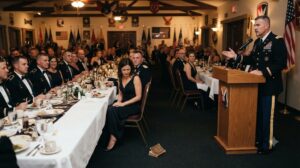
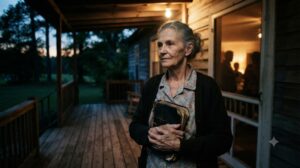
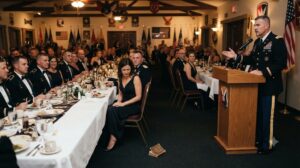
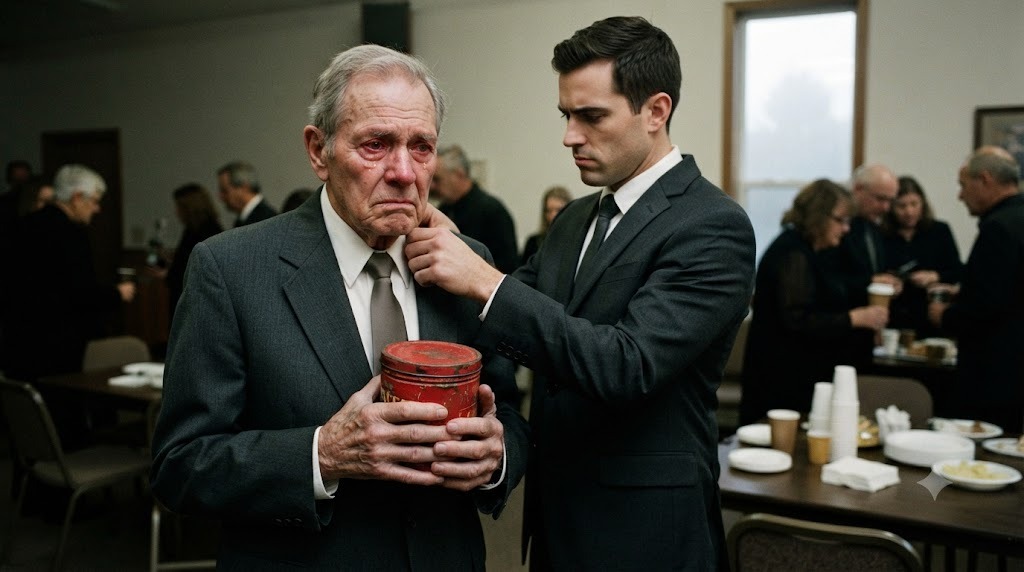
My name is George Hall. I am eighty years old, and that morning I was standing in the fellowship hall of Mount Zion Baptist Church, in the small Appalachian town in West Virginia where I have lived my whole life, wearing my good gray suit to bury my wife of a lifetime, Ruth.
Brandon didn’t mean the trash bag as cruelty, exactly. That’s the part that took me years to understand about my grandson. He simply could not picture his grandfather any other way. To Brandon, I had always been the old man in the Walmart vest who said “welcome in” to strangers for minimum wage, the one whose name still got lowered voices at the diner counter. A caterer’s assistant fit me better than a mourner in his mind. He straightened my collar without asking, the way you’d fix a mannequin.
“Grandpa, your tie’s crooked. People are looking.”
People were always looking. That was the trouble.

Twenty years ago, the creek behind Miller’s Gap rose eleven feet in one night and took four houses with it, along with the Caldwell boy, who was six. I still remember the smell after — wet insulation and diesel and river mud, a smell that never fully leaves a mountain town once it’s been through that kind of water.
I set an old coffee tin on the counter of the general store the next morning. Folgers, red plastic lid, the paint on the label already scratched from my grandfather’s hands before mine. I didn’t ask anyone for money. I just set it there and went back to stacking sandbags. By that evening it was half full.
For six weeks, that tin traveled from the store counter to the church vestibule to the back of my truck. Neighbors put in what they had. Some put in five dollars folded twice so no one would see the amount. I never counted it in front of anybody. That was my first mistake, though I didn’t know it yet.
Because when the tin quietly stopped making its rounds — when I stopped bringing it to church, stopped answering when people asked how the relief fund was doing — nobody heard an explanation. They heard silence. And silence, in a town that size, fills itself in with whatever story is easiest to believe.
The story that took hold was that George Hall had run a fake charity on his neighbors’ grief and kept the difference.
Ruth heard it in the beauty shop before I heard it from anyone at all. She came home that day and didn’t ask me if it was true. She just took my hand at the supper table and held it a little too long, like she was checking it was still attached to a good man.
“Do you want to tell them anything?” she asked, once.
“No,” I said.
She never asked again. That was the kind of woman Ruth was.
I lost my seat on the church building committee. I lost an invitation to speak at the VFW breakfast I’d spoken at for a decade. My own daughter Denise — Brandon’s mother — stopped correcting people when they brought it up, because by then even she had started to wonder.
Only one person in this family ever left town over it. My older girl, Carol. She packed a U-Haul the spring after the flood and drove to Ohio and didn’t come back for anything smaller than a funeral. I always believed she left because she was ashamed of me. I was wrong about that too, though I wouldn’t find it out for a long while yet.
So there I stood, the morning we buried Ruth, in a fellowship hall smelling of coffee urns and casserole dishes, being handed a trash bag by the grandson I had personally taught to tie a necktie, in the town that had spent twenty years deciding what kind of man I was without once asking me.
I set the trash bag down on the folding table. Under it, half-hidden behind a stack of paper cups, somebody had already put out an old red-lidded coffee tin to collect loose bills for the flowers.
It was the same tin. My tin. Someone had found it in the church storage closet and never thought twice about what it had once meant.
I hadn’t seen it in almost twenty years. My hands went cold looking at it, the way they do before a fall.
Part 2 — What Wanda Remembered
I was refilling the coffee urn — because someone still had to, and it might as well be the man everyone already thought was staff — when I heard a voice behind me go very quiet.
“George. Is that — is that the tin?”
I turned around to find Wanda Pruitt standing there with a paper plate of ham biscuits going cold in her hand. Wanda teaches third grade now, has for eleven years, has a framed Teacher of the Year certificate hanging in the front hallway of the elementary school. Back when the creek took the Caldwell boy, Wanda was nine years old and living in a camper behind what used to be her family’s house, because the flood had taken the rest of it.
“It is,” I said.
Her eyes went bright and wet in a way that had nothing to do with onions in the casserole. “You bought my school shoes out of that tin. Fourth grade. I remember because they were the first shoes that weren’t somebody else’s first.”
I hadn’t expected anyone to remember that. I had worked very hard, for twenty years, at being a man nobody remembered kindly.
“Wanda—” I started.
“Everybody thinks you stole that money,” she said, low enough that only I could hear it. Her jaw was set the way it must get with a classroom of eight-year-olds who won’t sit still. “I’ve thought about saying something for years. I didn’t know if it was my place.”
Across the room, Brandon was refilling his own coffee, half-watching us the way a man watches something he’s already decided isn’t his business. He had grown up handsome and careful, the kind of careful that comes from spending your whole childhood correcting the story people told about your family before they could tell it themselves. He’d left for Charleston at eighteen and built himself into someone with a business card and a watch he didn’t need to check twice. He loved his grandfather. He was also, God help him, ashamed of me, and had been since before he was old enough to know the difference between the two feelings.

What none of them knew — what I had never told a living soul, including Ruth, all the particulars of — was where the money in that tin had actually gone.
Six families lost their homes that spring. The state sent caseworkers, and the caseworkers moved fast and moved on, the way state help does in a county that size. Three children ended up needing somewhere to stay longer than a shelter cot allows, while paperwork caught up to people’s lives. Wanda was one. A boy named Tommy Ferris was another, whose father drank himself sideways after the water took the family’s tools and, with them, his trade. The third was a set of twins whose mother worked two jobs and needed exactly enough help, quietly enough, that she wouldn’t have to explain herself at the diner either.
I didn’t file to be anybody’s foster father. Back then, in that county, in that decade, an old farmer with a wife and a pickup truck and a room over the garage could take in a child on a caseworker’s handshake and a promise to feed them, and nobody asked too many questions as long as the child was warm and in school. I did that three separate times over four years. Every dollar in that tin went to shoes, to a winter coat, to Tommy’s court fees when his father needed a lawyer he couldn’t afford, to a deposit on the Ferris family’s new trailer once his father dried out enough to try again.
I kept every receipt. Every single one, taped into a composition notebook, tucked under the false bottom I’d built into that same coffee tin — because even then, some stubborn part of me knew that a day might come when I’d need to prove where every dollar went.
I never showed anybody that notebook. Not because I was proud of hiding it. Because the caseworker had asked me, plainly, not to talk about which children I was helping and why — court records, custody matters, a father trying to get his life back without the whole county watching him fail at it in real time. Protecting three kids’ dignity cost me my own. I decided that trade was fair, and twenty years is a long time to keep believing a decision you never let anyone question.
“Wanda,” I said, “there’s things about that money I never explained. Not to you. Not to anybody.”
“Then explain them,” she said. “Please, George. Before this town buries you believing a lie, same as they’re about to bury Ruth believing you never grieved right either.”
Across the fellowship hall, I saw my daughter Carol come through the double doors, twenty years and four hundred miles late to almost everything, her car keys still in her hand like she hadn’t decided if she was staying.
Part 3 — The Family Member Nobody Expected
Carol found me by the coffee urn same as Wanda had. She didn’t hug me first. She never has been a woman for hugging first.
“I found the notebook,” she said. “Fifteen years ago. Cleaning out the garage loft after you and Mom moved the tools down. I read every page of it and I never told you I found it.”
The room had gone strange and slow around me, the way it does right before a fall you can’t stop.
“Why didn’t you say something,” I asked her. Not a question, really. More like a man asking why the weather had done what it did.
“Because I was so angry at you,” Carol said, “for never once defending yourself, even to us. I left this town thinking my father let his own family believe he was a thief rather than open his mouth. It took me years to understand you weren’t protecting your pride. You were protecting three kids who never asked to be famous for being poor.”
Brandon had come up behind her by then, his careful face gone unsteady for the first time I could remember since he was small.
“What notebook,” he said.
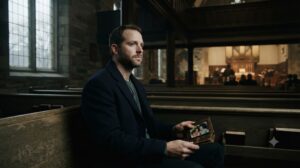
Carol looked at her nephew a long moment. Then she reached into her purse and set the composition notebook on the folding table, right beside the red-lidded tin that had started this whole thing twenty years before.
“Your grandfather raised half this county’s decent people out of that tin,” she said, loud enough now that a few heads turned. “Wanda Pruitt teaches your children’s Sunday school class. Tommy Ferris runs the volunteer fire department. Go ask either one of them who bought their winter coat the year the creek took their homes.”
The fellowship hall got very quiet, the particular quiet a room gets when it realizes it’s spent twenty years being wrong out loud.
I could have let Carol carry the rest of it. She’d already done more than I had any right to ask. But a man doesn’t get many chances at eighty to decide, for himself, what kind of ending he wants — and I’d let other people write my story for two decades running. I wasn’t going to let even my own daughter finish it for me now.
“I’m not going to stand here and let you make me a hero,” I said, to the room, to Brandon most of all. “I made a choice twenty years ago to keep three children’s business their own, even at the cost of my name. I’d make that same choice again tonight, receipts or no receipts. The only thing I regret is that your grandmother spent the last twenty years of her life married to a man half this town whispered about, and she never once asked me to defend myself either. That’s the debt I can’t collect back. Not from you. Not from anybody in this room.”

Brandon didn’t say anything for a long moment. Then he did something I hadn’t seen him do since he was nine years old — he put his arms around me, right there in front of the ham biscuits and the paper cups, and didn’t check first whether anyone was looking.
“I handed you a trash bag,” he said, into my shoulder. “At Grandma’s funeral. I need you to know I’m sorry doesn’t cover that.”
“No,” I agreed. “It doesn’t. But it’s a start.”
Six months later, the county unveiled a small brass plaque outside the Mount Zion fellowship hall, at my request plainer than anyone wanted it — no dates, no dollar figures, just a line the deacons agreed to after I asked them twice to cut it shorter: In quiet service to the children this town almost forgot. No mention of coffee tins or flood water or the twenty years a good man let people believe the worst of him rather than say one true thing about three kids who needed him more than they needed his reputation.
Wanda cried at the unveiling. Tommy Ferris, forty now, broad-shouldered and steady, stood at attention the whole ceremony like he was back in some uniform nobody had asked him to wear. Carol stood beside me and didn’t leave for Ohio again until the following week.
Ruth never got to see any of it. That’s the part I still can’t make peace with, some mornings, standing at the sink with my coffee going cold — that the woman who held my hand through twenty years of other people’s certainty died still married, in the town’s eyes if not her own, to a man they’d never bothered to un-convict.
I keep the tin on my kitchen windowsill now, empty, lid a little more scratched than it used to be. Some mornings the fog sits low over the ridge exactly the way it did the day we buried her, and I think about how long a good name can stay lost in a small town before somebody finally goes looking for it.
Longer than it should. But not, in the end, forever.