
Part 1 — The Envelope Under the Fruit Bowl
They printed the Father’s Day programs with everyone’s name on the back page — mine wasn’t there.
I folded the flyer twice, tucked it under the fruit bowl, and went back to refilling the tea.
Three weeks later, I was the one holding every dollar in that house, and for the first time in eleven months, I was the one deciding what happened to it.
That part comes later.
Let me start where I always start, at my own kitchen table, late at night, in the house Frank and I built payment by payment over thirty-one years.
They printed the programs for my son-in-law’s Father’s Day cookout with everyone’s name on the back page. Aunt this. Uncle that. Even the neighbor’s beagle got a mention. Mine wasn’t there. I folded the flyer in half, tucked it under the fruit bowl, and went to check on the baby monitor like nothing had happened. Three weeks later, I was the one holding every dollar that came in and out of that house, and for the first time in eleven months, I was the one who decided what happened to it.
But that comes later. Let me start where I always start, at my own kitchen table, in the house Frank and I built payment by payment over thirty-one years, back when it still belonged to me.
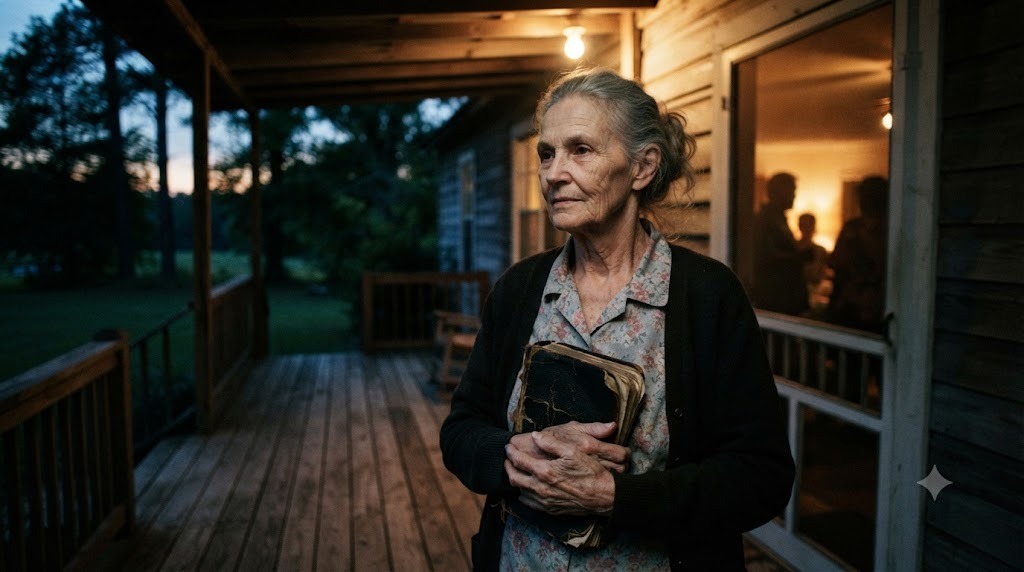
I do my counting late, after the phones stop ringing. That night I had four small stacks of cash from the two farm accounts I still keep books for, a coffee gone cold, and Frank’s Bible sitting where it always sits, an arm’s length from my right hand. The leather had gone soft and dark from his thumbs, and the spine had cracked clean through the year before he passed, so it fell open now to whatever page it wanted. That night it fell open to Job. I didn’t think much of it then.
My daughter Paige called at 9:40. Paige doesn’t call to chat. Paige calls with a plan already built, waiting for me to say yes to it.
“Mama, I looked at your statements when I was helping you with the online banking,” she said. “The Meridian Growth thing. The seven thousand two hundred you sent them in March.”
I went still.
“It’s not real, Mama. There is no Meridian Growth. I called the number on the confirmation email. It rang to a pizza place in Ohio.”
I already knew, somewhere under the part of me that didn’t want to know. A man named Gary had called me in February, right after the first anniversary of Frank’s passing, when I was still bad with numbers and worse with being alone. He said he could roll Frank’s little pension into something that paid better. He had a voice like a Sunday preacher. I gave him access I should never have given anybody.
Paige didn’t ask if I was scared. She didn’t ask if I was ashamed, though I was, plenty. She said, “This is exactly why you can’t be out here handling money by yourself anymore, Mama. It’s decided. You’re moving into the spare room. Marcus and I already talked about it.”
I want to be clear about something before I go further. I was not against help. I have never once in seventy-six years been too proud to take a hand up. What I was against was what came wrapped inside the hand.

The spare room at Paige and Marcus’s new house sat off the laundry, small enough that the twin bed touched two walls at once. Paige called it “getting Mama settled” in front of people. In private, the arrangement had numbers attached. Four hundred dollars a month, deducted straight from my Social Security, “since clearly you can’t be trusted managing your own funds right now.” And in exchange for a roof, I would keep the children, both of them, every weekday, six in the morning until Paige got home from the office, no pay, because “family doesn’t charge family for love, Mama, that’s different.”
I sat with that math a long time before I answered her. Then I told her the one thing I decided before I would agree to any of it.
“I’ll come,” I said. “I’ll keep the babies happy to do it. But I want it written down, every part, the rent and the hours both, signed by us both. And Paige, I want my own bank account left alone. Nobody touches it but me. Not to help. Not to fix. Not ever again.”
She laughed, short and surprised, like I’d told a joke that didn’t land. “Mama, you just lost seven thousand dollars to a stranger on the phone. You want me to leave your account alone?”
“Yes,” I said. “That’s exactly what I want.”
She agreed, mostly to end the conversation, I think. She did not expect me to hold to it. I have never in my life said a thing I didn’t intend to hold to.
Part 2 — The Program
The rest of that spring went the way you’d expect. I got the children up, fed, dressed, and delivered to the bus stop with their hair combed and their lunches packed the way their mother liked, exact turkey-no-mustard, exact apple-cut-in-fours. I did the wash. I did the supper most nights, since Paige got home late and Marcus got home later. I paid my four hundred dollars on the first of the month like a boarder, out of a Social Security check that wasn’t built to stretch that far to begin with.
Frank’s Bible came with me, of course. It sat on the nightstand in that narrow room, next to a lamp that buzzed if you touched the shade wrong. Some nights I’d open it just to have something in my hands that was mine, that nobody had signed a paper about, that nobody was charging me rent to hold.
Father’s Day fell on a Sunday that year, humid enough that the porch screens fogged over by four in the afternoon. Marcus’s mother drove in from Aiken. Paige’s whole church group came. There was a smoker going, and sweet tea in a dispenser with a spigot, and somebody’s cousin playing guitar badly and happily on the back steps.
Paige had programs printed at the copy shop, a nice touch, the kind of detail that photographs well. Hosted by the Harris Family, it said on the front. On the back, a column of names under Special Thanks. Marcus’s mother. Marcus’s brother. The neighbor’s dog, Biscuit, who had apparently been very supportive.
My name wasn’t there.

I want to tell you I made a scene. I didn’t. I have been raised in farming country long enough to know that a scene is a gift you give the person who wronged you, and I wasn’t in the business of gift-giving that day. I folded the flyer once, then again, until it was small enough to slide under the fruit bowl on the counter, next to a bowl of peaches nobody had touched yet. Then I went and found my grandson, who had a paper airplane stuck in the gutter, and I got him a broom to fish it down, and I laughed with him about it, and if my eyes were wet, I told myself it was the humidity.
Paige found me in the kitchen an hour later, refilling the tea. “You’re quiet,” she said, the way people say it when they already know why and don’t especially want the answer confirmed.
“I’m fine,” I said.
“Good,” she said, and went back out to the porch.
That was the night I made my decision, though I didn’t announce it, not to her, not to anyone, not even to Frank’s Bible sitting closed on my nightstand like it was waiting for me to open it and ask what to do. I already knew what to do. I had known since March, since the four hundred dollars, since the words you can’t be trusted managing your own funds. I had simply been giving her the chance to prove me wrong about what kind of arrangement this really was.
She hadn’t.
I gave notice the way I do everything, on paper, calm, dated. Thirty days, same as I’d have given a landlord, because that’s what she’d made herself into. I had kept two of my bookkeeping clients the whole time, quietly, on my own phone, in my own name, exactly as I’d insisted from the start. It wasn’t much. It was enough for a deposit on a little rental two counties over, closer to my sister, closer to my church, closer to a life where nobody deducted my rent before I saw a dime of my own check.
Paige did not ask me to stay. She said, “You’re really doing this over a party program, Mama?” And I said, “No, baby. I’m doing it over eleven months of one.” I picked up the Bible from the nightstand, packed my two suitcases, and I left the spare room exactly as clean as I’d found it.
Part 3 — What She Came Back to Say
Eleven years is a long time to go without your daughter calling on a Sunday. It is a longer time to watch your grandchildren grow up mostly through school photos somebody else decides to text you, or not.
I won’t pretend those years were easy. I built a small life back up out of ledger work and garden tomatoes and a church group that became, without my noticing exactly when, something closer to family than the family I’d left. There is a particular kind of loneliness in being the one who walked away with your dignity intact, because dignity doesn’t keep you warm at night, and it doesn’t hush a house that used to have children’s noise running through it. I missed those babies something fierce. I missed being needed in a way that didn’t come itemized.
What I did not expect was unexpected belonging finding me anyway, in the shape of Ruth from two pews over, who started dropping by on Wednesdays with peach preserves, and then just started dropping by. In the shape of my sister’s grandbabies, who took to calling me their other grandmother without anybody asking them to. Loneliness doesn’t always get answered by the people who owed you the answer. Sometimes it gets answered sideways, by people who simply showed up.

Paige showed up on a Tuesday this past spring, unannounced, standing on my porch in clothes too city for our road, wringing her hands the way she used to as a little girl before she’d broken something she knew she’d have to confess to.
“I’m not here to ask you for anything,” she said first, like she’d rehearsed it in the car.
I let her sit in the porch chair across from me. I didn’t offer tea right away. Some things a person has to sit through thirsty.
“I’ve been in therapy this past year,” she said. “Since the divorce. My therapist asked me to think about a time I did something to somebody I loved that I’ve never made right. I kept coming back to you. To that spare room. To that program with everybody’s name but yours.”
She was quiet a moment, looking at her hands.
“You’d just been scammed out of that money, Mama. You were scared and you were grieving Daddy and I looked at that as an opportunity instead of looking at it as you needing me. I told myself I was protecting you. I wasn’t. I was making you pay me back for being human. And then I erased you off a piece of paper on top of it, because some tiny part of me needed you smaller than me that year. I don’t have a good reason. I just have that one.”
I sat with it a long moment, the way I sit with a column of figures before I’ll swear to the total.
“I appreciate you saying it,” I told her. “I do. But I don’t need your sorry, Paige. I needed you eleven years ago, standing at that stove, telling me my name belonged on that page same as anybody’s. This is a different day now, and I’ve built a good one without you in it. I’m glad you know what you did. That doesn’t mean I owe you the space to feel better about it.”
She started to say something else, and I lifted my hand, gentle, not unkind, the way you’d hush a child who’s said their piece and doesn’t need to say it twice.
“You can come back around, if you mean it, slow, and let it be slow,” I said. “But I’m not handing you forgiveness today just because you finally found the words. I had to find mine alone, out here, for eleven years. You can wait a little while for yours to matter.”
I stood up then, and I went inside for the tea after all, because I am still, underneath everything, a woman who was raised to offer a glass of tea to anybody sitting on her porch. When I came back out, Frank’s Bible was sitting on the little table between our two chairs, right where I’d set it down that morning doing my reading, cracked spine and all, older now than either of us likely have years left to match it.
Paige looked at it a long time before she looked at me.
“I remember that thing on your nightstand in the spare room,” she said quietly. “I used to wonder what you were praying for in there.”
“Mostly,” I said, “that I’d have the sense to walk out with my head up whenever the day came that I needed to. Took eleven years for you to come find out I did.”
I let her sit a while longer. I did not walk her to her car. When she pulled out of my drive, I went back to my chair, and I opened that old cracked Bible to wherever it wanted to fall, and for once, it fell open to Ruth, and I sat there in the last of the daylight, alone and not lonely, which I have learned, the hard way, are two entirely different things.